

The newest addition to the Space Collection at work, it is incredibly rare to find control panel systems of the Mercury spacecraft. I am doing my research on this one still, and would love to know of any source for the part numbers for the Earth Path Indicators (EPI) that flew on MA-6 and possibly MA-7 and MR-4. Were any assigned to later missions, and subsequently removed before flight, as happened with MA-8?
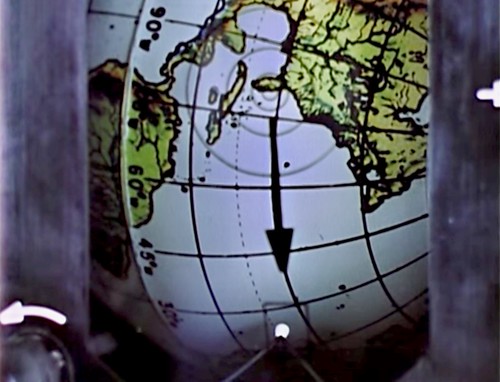
The “Inclination Degrees” shows how many degrees from exactly along the equator the orbital track was and was set for 32.5 degrees (of a possible 20°-40° range), the orbital inclination of Glenn’s inaugural orbital flight, and all of the Mercury flights to follow. It could run for 20 hours on a winding, while the earth turns inside the box once every 90 minutes (adjustable by the “orbit time” knob). Manufactured in 1960 by Honeywell.
The Earth Path Indicator (EPI), also called an Earth Orbit Indicator, was one of the navigational tools installed in the Mercury space capsule. Like the Soviet Globus that followed in 1968, it consists of a small revolving globe driven by a clockwork mechanism. Once in stable orbit, the astronaut would wind up the clockwork, and set the position of a tiny scale model of the Mercury capsule, under which the globe would slowly rotate. A means of replicating the Earth below, the EPI would inform the astronaut of his orbital tracking and where he was in relation to countries, cities, oceans, ground stations, and eventually the point of re-entry into the Earth’s atmosphere. This information was critical to making observations of the Earth, maintaining communications, and concluding the mission with a safe and successful splashdown. The EPI was launched in 1961 on the unmanned test flight MA-4 (that unit is in the Smithsonian), and then on the 1962 Mercury flights of John Glenn and Scott Carpenter, the first Americans to orbit the Earth. The EPI was ultimately deemed superfluous and was part of the hardware removed for Wally Schirra’s Mercury-Atlas 8 mission.

 The panels from MA-7 and MR-4, on display in museums, have an empty space where the EPI would reside.
 More inside views:
 Labels from the



Leave a Reply to jurvetson Cancel reply