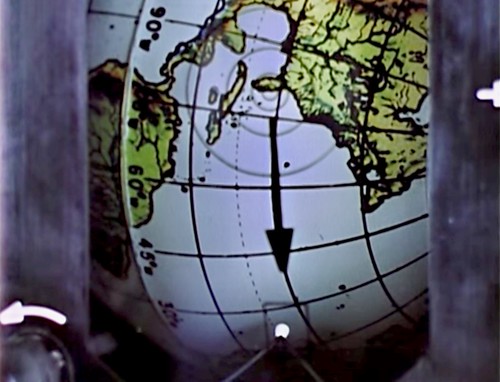
The newest addition to the Space Collection at work, it is incredibly rare to find control panel systems of the Mercury spacecraft. I am doing my research on this one still, and would love to know of any source for the part numbers for the Earth Path Indicators (EPI) that flew on MA-6 and possibly MA-7 and MR-4. Were any assigned to later missions, and subsequently removed before flight, as happened with MA-8?

The “Inclination Degrees” shows how many degrees from exactly along the equator the orbital track was and was set for 32.5 degrees (of a possible 20°-40° range), the orbital inclination of Glenn’s inaugural orbital flight, and all of the Mercury flights to follow. It could run for 20 hours on a winding, while the earth turns inside the box once every 90 minutes (adjustable by the “orbit time” knob). Manufactured in 1960 by Honeywell.

The Earth Path Indicator (EPI), also called an Earth Orbit Indicator, was one of the navigational tools installed in the Mercury space capsule. Like the Soviet Globus that followed in 1968, it consists of a small revolving globe driven by a clockwork mechanism. Once in stable orbit, the astronaut would wind up the clockwork, and set the position of a tiny scale model of the Mercury capsule, under which the globe would slowly rotate. A means of replicating the Earth below, the EPI would inform the astronaut of his orbital tracking and where he was in relation to countries, cities, oceans, ground stations, and eventually the point of re-entry into the Earth’s atmosphere. This information was critical to making observations of the Earth, maintaining communications, and concluding the mission with a safe and successful splashdown. The EPI was launched in 1961 on the unmanned test flight MA-4 (that unit is in the Smithsonian), and then on the 1962 Mercury flights of John Glenn and Scott Carpenter, the first Americans to orbit the Earth. The EPI was ultimately deemed superfluous and was part of the hardware removed for Wally Schirra’s Mercury-Atlas 8 mission.

6 responses to “Mercury Earth Path Indicator as used by the first American in orbit, John Glenn on MA-6”

  1. In the instrument panel of MA-6 from the Smithsonian, with the the EPI just above the periscope, left of the mechanical clock:The panels from MA-7 and MR-4, on display in museums, have an empty space where the EPI would reside.

    Adam Savage built a MA-6 replica, highlighting the EPI: “This is maybe my favorite instrument of any cockpit ever.” And “I would kill to have one of these” from his video overviewMetal tag on back:More inside views: Labels from the Mercury Familiarization Manual And details: "EARTH PATH INDICATOR
    The earth path indicator (see Figure 12-5) consists of a spherical map (globe) of the earth gimballed and rotating in a manner to indicate ground position under the capsule. The indicator is spring motor powered and is capable of running 20 hours without re-winding. The globe, which is approximately 3.85 inches in diameter, will display the following geographical features:

    (1) All continents
    (2) All bodies of water having major dimensions of 300 statute miles
    (3) The sixteen largest rivers of the world
    (4) All islands having major dimensions of 500 statute miles
    (5) All known islands or island clusters separated from continents by 300 statute miles and having major dimensions less than 500 statute miles shall be identified by an .020 diameter circle.
    (6) The fifty largest cities of the world are identified by .020 dots.
    (7) 15° latitude and longitude lines are presented and numbered.

    Controls are provided on the face of the indicator to wind the spring motor and to adjust the orbit time, adjust orbit inclination and to slew the globe about the earth and the orbital axis. The touchdown area is displayed as a rectangle and the luminous dot inside of the rectangle being the point of impact. The landing area is 3040 nautical miles ahead of instantaneous orbital position above the earth as indicated by the four-ring bullseye. The instrument is externally lighted by cabin floodlights."

    And instructions from Glenn’s MA-6 Flight Ops Manual:

  2. Here is an interesting use of the EPI: In the 1962 NASA documentary of John Glenn’s MA-6 flight, they used a unit on the ground to provide video annotating the orbital path at the time. Because the EPI is essentially a wind-up analog computer that shows the orbital position, just based on original launch parameters (inclination and orbit time (derived from altitude)) and no input from the spacecraft, an EPI on the ground can be in sync with the unit in orbit. They introduce it here and revisit several times, such as minute 32:38 “with a beautiful view of the African coast” and a series starting at 39:07 when MA-6 suffered a Left Yaw thruster problem in the automatic control system, and Glenn did a manual takeover.

    I see it also features in the Reentry Mercury Simulator

  3. You’re going into space orbit. Remember to re-wind your global position indicator. If it’s not displaying the correct position, look out the window and adjust according to features you see on the earth below. (!) Amazingly primitive, but ok as a general reference/moving map, I guess…

  4. Wow I had no idea they did it like this. Seems like a clever idea to do it without computers or electronics

  5. So, Adam Savage dropped by, and we opened it up, and gave it a wind up… short videoAdam Savage and Mercury Earth Path Indicator — his favorite instrument from any cockpitOh, and for Gemini, instead of a mechanical clockwork, they used a cardboard map with transparency overlay! Like the one have, used on the first flightFlown Gemini Orbital Chart GT-3

  6. I just picked up the flown orbital clock from MA-7, details hereScott Carpenter's Flown Mercury Aurora-7 Spacecraft Clock

Leave a Reply to sbove Cancel reply

Your email address will not be published. Required fields are marked *