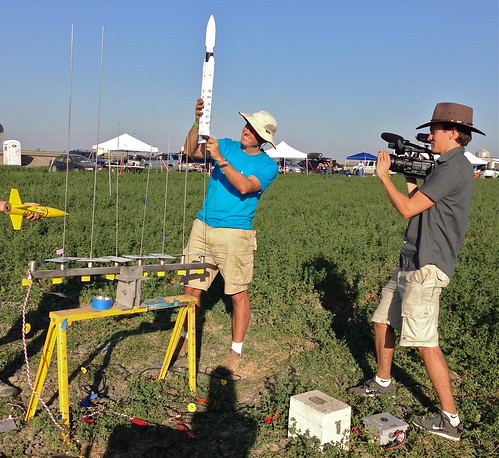
I still have some work to do on the stability of this model. We 3D printed a new fairing, trying more nose weight this time. The three Aerotech D motors came up to pressure in a sequence that may have sent it over (below)
The center motor lit on the rail, and then just as it flies free, one of the two outboard engines lights, sending it arcing over to me (the motor closest to us is not lit in this frame):
And then it does light, as seen in the main photo above.
The peak-thrust-early curves of the motors ensure an unstable launch if they don’t all light-off simultaneously. Not sure if anything can be done about this aside from *very* careful installation of the igniters, ensuring each motor is from the same batch, and LOTS of available current (e.g. very large battery) preventing brown-out on any one igniter. Given the wide linear separation of the 3 motors (vs. a tight cluster) failure to light-off simultaneously is a guarantee of irretrieveable instability.
Doesn’t the original have a clamp-down feature in the launchpad to prevent take-off without full ignition of all engines? Might be tricky to synchronise on a model rocket though given the short burn time of the motors.
Well…this is the second time I have seen a Falcon attempt a powered landing…heehee… No flame-out due to lack of fuel delivered to the engines this time! …. all joking aside… you and Elon now have a race between the two of you .. on who can get reusability achieved!…… good luck to both of you!!!!
No matter what, the two or more engines that are off axis must ignite simultaneously or the trajectory would alter (exceptionally so if the delay between two off axis & opposing engines is appreciable)… Being especially true that there is no guidance or control surfaces other than the fixed fins.
Holy Cripes!!!! Drop the homing device & RUN…. ===8-o
Great shot, one of kind (hopefully). I think we talked to about possible assymetric thrust on another rocket model… cool effect when controlled, but I would think difficult to control on these models. Maybe that’s a worthy challenge for hobbyist development?
While running three engines seems to be what you like I suggest trying to run a single engine until you get a stable flight. Perhaps a E or an F class engine. The Real Falcon Heavy has an advantage of being able to cover for one or more failed engines and still fly straight.
If you had 27 engines in your model you might also find some redundancy that would ensure a stable flight. The size of the rocket model though would have be huge in order to accommodate this. It might would be quite expensive per flight with 27 engines to pay for.
My vote is to keep it simple first and work from there.
Leave a Reply