Canon PowerShot S100
ƒ/2
5.2 mm
1/30
100

On July 20, 1969, Eagle landed on the moon. These are the handwritten notes from the Grumman engineers as they pushed to complete Lunar Module LM-5 in 1968. On the last page, they learn than this particular Lunar Module would be the one to bring the first humans to the moon. (That page and several others can be seen here.)

The Grumman Engineering Log served not only as an engineering notebook but also as an intercom between the day and night shift – separate teams that needed to push the ball forward from where the other left off. So we are offered a rare peek into the concerns, uncertainties and conversations that might have otherwise been quietly undocumented .

This log has informed the writing of Pellegrino’s book Chariots for Apollo, but only a few scholars have had access to these pages to date. Heritage reported that this original document is the only one in existence, with no copy on file anywhere. So I thought it would be good to make a color scan of the entire book, and make it available to all. So, here is the PDF file (8MB).

My hope is that we can collectively decode some of its mysteries, or better yet, find some of the engineers to see if it jogs their memories. There is a list of all of the engineers on p.2. We only have first initial and last names. So any insights to the full names or their whereabouts would be appreciated.

I am also hoping that space historians who come across interesting passages can share what they know in the comments below (with reference to date or page number). Are any of the part numbers significant, especially those swapped between the Apollo 9,11,12 and 13 Lunar Modules? I will also add a glossary of acronyms below as we decode them. Also, if anyone can OCR the hybrid handwriting, please do. Our attempts with free OCR tools have failed so far.

The Log documents a surprisingly high number of electrical problems. For example, in the sample pages I photographed above they are troubleshooting charred wires (10/17/68) and tripping circuit breakers (CB) just seven months before launch (12/11/68). Ross Fleisig summarizes: the Lunar Module was a completely battery-operated machine, built during a time in which battery technology and sensing equipment were “a black art.” (the first Apollo fuel cell, with comments on power source development)

False alerts from the ship’s Master Alarm are noted throughout the Log (e.g., 6/18/68). This is the very same Master Alarm that sounded throughout the first lunar landing, almost causing a mission abort.

There are also personal notes of exhaustion. When I analyzed the work schedule on a 1968 calendar, they generally maintained a pace of working Monday through Saturday. They did get a reprieve for the July 4 weekend, but then worked seven days a week from July 8 until July 27. While such pushes are not unusual, they did so while rotating through day and night shifts on a weekly basis!

No wonder Hecht makes several personal comments, arising from lack of days off and even lack of meals, as a docking light hook-up error is discovered (8/5-7/68): “Techs & QC had no breaks nor breakfast” after “docking light wires in plastic bag warm” from a hookup error to the AC instead of DC terminal posts.

Some other interesting entries:
6/6/68: floor plates in crew cabin are borrowed from LM-3 (Apollo 9) and other parts on 6/25/68.
7/16/68: exactly one year before the launch of Apollo 11, testing delayed by power outages from the Long Island utility.
7/20–26/68: modifications improving efficiency of battery use will prove critical to the safe voyage of a LM-7 (Apollo 13), simultaneously under construction.
10/17/68 “to unlatch the meter and restore the AC output, the meter relay reset button should be pressed. The GPS man had accomplished this same result by banging the panel, assuming it was a sticky needle” (the Fonz!)
10/18/68: Landing radar connector problems, current surges and popped circuit breakers
10/22/68: “power was lost . CRT’s, etc., went blank. Docking hatch switch is taped in the depressed position. The tape just fell off.”
“Observer said that the floodlights flickered in unison with the RCS jets firing. NASA was not too concerned about this”
10/23-24/68 landing radar tests
11/6/68 “dim DSKY lights are probably a DSKY problem and require action w MIT”, final radar and comm tests before shipping LM-5 to Cape. The DSKY is the keyboard and screen user interface to the Apollo Guidance Computer.
11/11/68: reversed labeling of LM-5’s internal jumper cables
11/13/68 Hecht asks for max of 8 hrs on Fri and Sat
11/15/68 “any time the inverter frequency drifts ± 2 Hz we may get a master alarm and an inverter caution.”
11/30/68 COAS test (the optical sighting tool that allied the ascending lunar module to dock with the orbiting CSM)
11/20/68 Phase III Reliability Report: “Reportable failures have gone down from LM-3, to LM-4, to LM-5 (205 to 74 to 57)… Significantly improved vehicle”
Bob Gilruth (NASA Director of the Manned Spacecraft Center): “some tough technical problems left, but thinks they will be solved”

George Low (Manager of the Apollo Spacecraft Program Office): “this is very likely to be the LM to land on the moon – it should be.”

The engineers added a huge exclamation point next to that note.

P.S. other Apollo 11 artifacts. Happy Anniversary!

30 responses to “How the Eagle Landed — the Grumman Construction Log”

  1. Carr’s Phase III Reliability Report, at the back:
    IMG_1575
    and Grumman cover, signed by Buzz Aldrin.

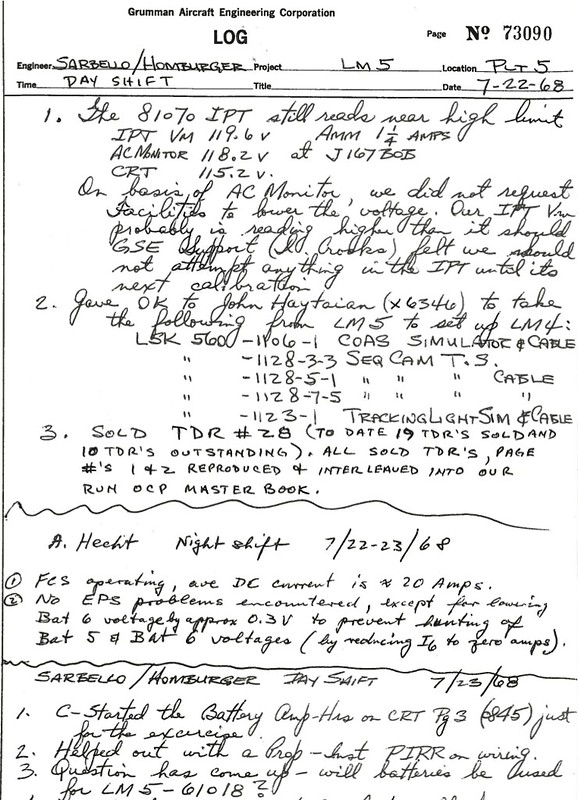
    7/22/68 COAS simulator and other equipment borrowed from LM-5 for LM-4.
    Screen Shot 2012-07-19 at 9.19.13 PM
    Also “Question has come up – will batteries be used for LM 5 – 61018?”

    7/24/68 “Discovered that Panel 8 explosive devices Stage Sep Relays Sys A & Sys B were on.” And then during the day shift “Event Lites went haywire”
    Screen Shot 2012-07-19 at 9.23.49 PM

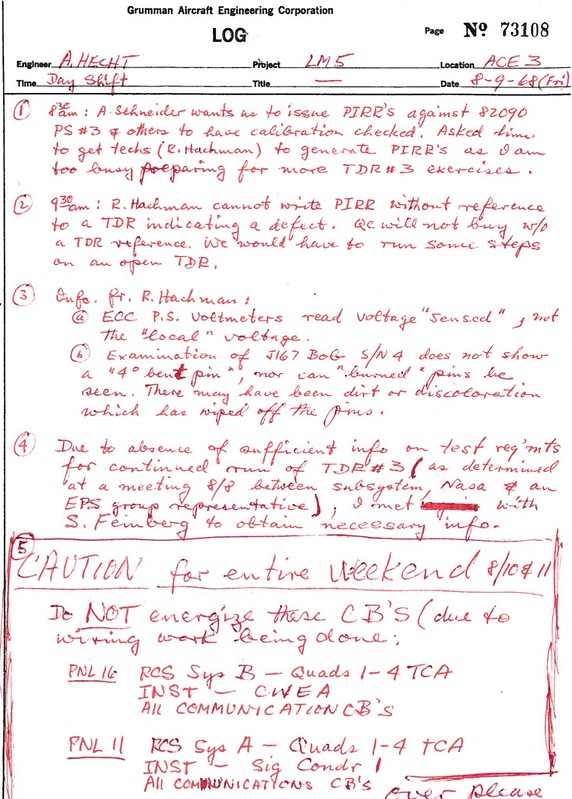
    8/9/68: do NOT energize circuit breakers for RCS (Reaction Control System Engines) after voltmeter failures and bent pins
    Screen Shot 2012-07-19 at 8.37.16 PM
    RCS test firings occurred on the 10/21/68 night shift. Here is more info on those iconic R-4D quads:

    NASM Apollo 17 AS17-145-22220

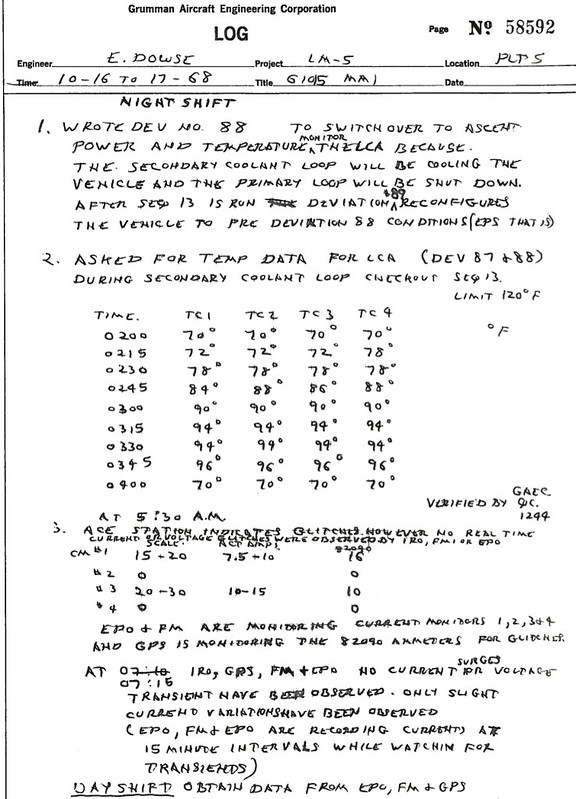
    10/17/68: Temp data on secondary coolant loop, because primary loop will shut down during switchover to ascent stage power.
    Screen Shot 2012-07-19 at 10.16.24 PM

    Picking up the timeline from the LM-5 selection by Low and Gilruth…
    12/2/68 amp hours subprogram: “CRT amp hrs inaccurate. Manually integrated Batt currents for amp-hrs.”
    12/4/68 “A 5am telecom from NASA QC (Bob Wanamaker) was made to Al Jowid at home. Al Jowid wants to quash any further X-Lunar isolation testing.”
    12/8/68 “no power can be applied to the vehicle because of water glycol spillage on two cables in the aft equipment bay area.”
    12/8/68: A. Hecht references replication of electrical tests and procedures modified for LM-5 on LM-6 (Apollo 12) and LM-7 (Apollo 13).
    1/9/69 LM-5 is shipped to KSC at Cape Canaveral

    And as Neil Armstrong recently revealed in a rare interview:
    "A month before the launch of Apollo 11, we decided we were confident enough we could try and attempt on a descent to the surface. I thought we had a 90% chance of getting back safely to Earth on that flight but only a 50-50 chance of making a landing on that first attempt. There are so many unknowns on that descent from lunar orbit down to the surface that had not been demonstrated yet by testing and there was a big chance that there was something in there we didn’t understand properly and we had to abort and come back to Earth without landing."

    ACRONYMS: (the first four are used throughout)
    EPS: Electrical Power System
    CB: Circuit Breaker
    TDR: Test Discrepancy Report, generated as a result of deviation in procedures or findings from the TPS.
    TPS: Test Preparation Sheet

    GSE: Ground Support Equipment. Would not fly on mission.
    LM-3: Apollo 9 Lunar Module
    LM-4: Apollo 10 Lunar Module
    LM-6: Apollo 12 Lunar Module
    LM-7: Apollo 13 Lunar Module

    And thanks to spaceaholic for:
    SMP: Standard Manufacturing Procedure
    — SMP 3914: evaluation of the Descent electrical power system

    OCP: Operational Checkout Procedure
    — OCP 36015: PCMTEA (Pulse Code Modulation Timing Electronics Assembly)

    Turn on and Verification
    — OCP 35627: Data Channel Verification
    — OCP 70010: OCP Support Checklist

    EPS: Electrical Power System
    — 62000 EPS refers to a Pre-FEAT (Final Engineering Acceptance Test) on the electrical power system

    Apollo LM part numbers start with LDW
    — LDW410-81070 is a GSE Power Transformer

    Full Names:
    — Ed Dowse. His son Jimmy is informed of Sunday schedule (8/16/68)

  2. Wow. Thanks for the PDF. I’m sure that will be fascinating reading!

  3. meticulous work!
    super of you to do this 🙂

  4. Another fantastic addition to Jurvetson space museum! Our space history trajectory is J-shaped…get ready for a wild ride:D

  5. And a local battery contractor built the batteries for the LM, name of operation was GULTON Batteries and they were very proud their equipement went to the moon and all the workers gave 110 percent in their jobs……alas, the place folded in id 70’s due to EPA concerns and overseas competition……………..go figger

  6. The main power storage batteries for the LM were supplied by Eagle-Picher…its possible Gulton provided alkiline batteries for some of the smaller subsystems (i,e Pyrotechnics)..

  7. OCRing handwriting is never a good plan: there are scribbled out bits, little diagrams, text inserted, etc, and all that will get lost in one way or another.

    There are 127 handwritten pages here. Considerably more than 127 people will download and read this.

    First handwritten page is page4, so I’ll do that.

    If other people pick a page and do it, great. Doing them in order would reduce the cacophony.

    If occasionally people do pages others have already been done, no loss, that just means there’s redundancy.

  8. Thanks Steve! We get to work to find out more.

  9. [It strikes me that this could be best done with some kind of wiki, so things like underlining, tables, and striking could work; and so that people could fix each other’s work; and so that each page could have a template with the first fields already on… but in the absence of one…]

    Grumman Aurcraft Engineering Corpoation
    LOG
    Page No 73052
    Engineer: A. Hecht
    Project: LM-5
    Location: PH5
    Time: 8am/6pm day shift
    Title: —
    Date: 6-5-68

    (1) Mod 14 to TPS 70010 prep was issued last night; deleting ECS Control Unit & all assoc cables (because P/J 765 cannot be mated due to absense of ECS Relay Box).

    (2) Generated dev. #8-11 to incorporate Mod 14 change into OCP (temporary).

    (3) Attended LM5 Mtg: Heard following statement:
    DO NOT USE Bag of OLD CB Guards delivered to vehicle yesterday. They may be _TIGHT_ _FIT_.
    Delivery of NEW CB guards promised for 6/10 (Mon)

    (4) Waited for QC coverage to transfer stamps for 70010 Prep TPS to OCP from 0915 until 1430. No QC coverage available.

    Advised Pad Supervisor, Dan Getrost (QC), D. DeMartino, R.Valdez(QC), Meeting at Command post (inc Al Beauregard), and Milt Cohen.
    Result: At 14:30 still no QC, no promise except "We’ll tryt for tonight".
    Pad supvsr will call x6111 when QC becomes available. Returned to pet 39.

    ————–

    (5) Checked 17:20 w. pad supervisor for QC assignment. He suggested we call back after 18:15 to get QC coverage (ask for Vinnie Mackel, pad supvsr).

  10. A wonderful source of great information. Thanks

  11. Another transcriber of page 4, commenter "z7q2", at:
    boingboing.net/2012/07/21/how-the-eagle-landed-the-grum.h…

    I think they did a rather better job than I did, but a wiki would be best.

  12. Amazing how these pages could pretty much be taken out of the Space Shuttle logs. Same idea happened with the Shuttle, shift logs were written to tie in the next shift. These look like 10 hour shifts, we have 8 hour shifts. "Call To Stations" – Start a procedure, check to make sure that there is no other paperwork that costrains working the procedure. OMI (Operations Maint Instructions) in Shuttle speak. Deviation / Dev – change the procedure to correct wrong instructions.

  13. Oh yeah:
    CDR – Commander – Spacecraft operator / tech. Works the switches inside the spacecraft.

  14. If you want to find the engineers in the book, I recommend contacting the Grumman museum in long island new York. When I visited a couple years ago I met an engineer that did quality control on the lunar lander leg shock absorbers. Other retired engineers from the lunar lander program were there giving tours too.

  15. The name of at least one of the engineers, Salvatore A. Sarbello, is on this monument in Titusville, FL: http://www.spacewalkoffame.com/monuments/engravings/apollo/

    Interestingly, the block lettering in many of Sarbello’s log entries looks hauntingly like that of my late father, who indeed worked on the L(E)M program in the late 60s at Grumman Bethpage. My mother thinks so, too. One might argue that Sarbello probably wrote his own log entries, but I noticed that in one of Sarbello’s entries, his name was misspelled! How likely is it that he spelled his own last name incorrectly?

  16. @dewi_morgan2: I’d be willing to do some pages, too. I think it would be good, too, to collect in one place somewhere all the additional names mentioned in the log entries themselves, too. On page 4 alone, you’ve already identified:

    Dan Getrost (QC)
    D. DeMartino
    R.Valdez (QC)
    Al Beauregard (Command post)
    Milt Cohen
    Vinnie Mackel (pad supvsr).

  17. Ross Fleisig obit: cable.poly.edu/in-memorium/2012/january/ross-fleisig Oddly, that NY Poly page isn’t dated. This newspaper page is: http://www.antonnews.com/gardencitylife/obits/20222-obituary-ros...

    Kind of sad. They’re all passing away.

  18. Wow – big thanks to Xeni Jardin and her Boing Boing post for spreading the word on this. So many new people are pitching in to help. Translating pages, setting up a wiki (Thanks Jay!), etc.

    CampBlueBay – great links there! In the Fleisig obituary: as "Spacecraft Team Manager, he directed over 100 engineers, technicians, and quality control specialists in the final assembly, integration, and ground test of the Apollo 11 LM-5 Eagle."

    And from the SCAT pages: "There are roughly 90 people on a vehicle — about 70 of them are test engineers. Not only do they exchange program information up and down the line but they report what’s going on to people on other LMs, who, in turn, reciprocate… each LM is better than the one before it. It’s documented progress."

    [http://www.flickr.com/photos/specxtramedia] – Cool lead, thanks. I have one of those shock absorbers…. pretty amazing single-use design… They never compressed as far as they could, and that’s why Neil had to make one giant leap (the bottom rung of the ladder was a foot higher than he expected):

    Apollo Lunar Module Shock Absorber

    This particular 5” x 21.5” shock comes from Art Romeo, head of the Grumman Restoration Team at the Bethpage N.Y. hangars where they prepared two Grumman Lunar Modules for the Smithsonian and Cradle of Aviation Museums.

    And I just added some more timeline nuggets that I found last night up above. I will duplicate them here if you are one of the 6K people who have read this page as of this morning:

    10/23-24/68 landing radar tests
    11/6/68 “dim DSKY lights are probably a DSKY problem and require action w MIT”, final radar and comm tests before shipping LM-5 to Cape. The DSKY is the keyboard and screen user interface to the Apollo Guidance Computer.

    Apollo DSKY from CM Simulator

    11/11/68: reversed labeling of LM-5’s internal jumper cables
    11/13/68 Hecht asks for max of 8 hrs on Fri and Sat
    11/15/68 “any time the inverter frequency drifts ± 2 Hz we may get a master alarm and an inverter caution.”
    11/30/68 COAS test (the optical sighting tool that allied the ascending lunar module to dock with the orbiting CSM):

    Apollo 16 Lunar Module COAS – brought back from the moon by Mission Commander John Young

    >>> LM-5 selection by Low and Gilruth… and then:

    12/2/68 amp hours subprogram: “CRT amp hrs inaccurate. Manually integrated Batt currents for amp-hrs.”
    12/4/68 “A 5am telecom from NASA QC (Bob Wanamaker) was made to Al Jowid at home. Al Jowid wants to quash any further X-Lunar isolation testing.” [what is this?]
    12/8/68 “no power can be applied to the vehicle because of water glycol spillage on two cables in the aft equipment bay area.”
    12/8/68: A. Hecht references replication of electrical tests and procedures modified for LM-5 on LM-6 (Apollo 12) and LM-7 (Apollo 13).
    1/9/69 LM-5 is shipped to KSC at Cape Canaveral

  19. Can’t remember if Leo DeMarinis is mentioned in the notebook. Will have to wait until we transcribe the thing and we can do text searches, I guess. In the meantime, this is an interesting newspaper article from 2009.

    The Eagle has landed
    Ashland resident and rocket scientist recalls his extensive work on the first lunar module
    http://www.mailtribune.com/apps/pbcs.dll/article?AID=/20090913/N...

  20. [http://www.flickr.com/photos/jay_dugger] – thanks for the Apollo 11 Eagle Grumman LM-5 Construction Log Wiki

  21. THE single coolest thing I’ve ever seen on Flickr. Thank you for putting this on here. I worked 26 years on the shuttle program and may know a few names mentioned throughout throughout this log. If I do, I will contact you. thanks

  22. This is a test comment to see if all of the rich embedded HTML is gone or just not displaying in the new flickr format

  23. don’t see anything….

  24. hi steve
    thankyou for all your research and imformation
    40 years later….and i;m trying to find info on my dad who worked for grummans…i saw your photo of the honeycomb strut from art romeo…i was told he was someone my dad worked with..i would appreciate any information you might have on him….what years he worked at grummans….is he still around and can he be contacted…hoping you can help..thankyou

  25. The PDF is gone.
    Any chance of posting its new home ?

  26. Thanks for the heads up. Must have gotten lost in a web site update. Does it work for you now?

    P.S. my first comment above, now hidden by flickr truncation:

    Carr’s Phase III Reliability Report, at the back:
    IMG_1575
    and Grumman cover, signed by Buzz Aldrin.

    7/22/68 COAS simulator and other equipment borrowed from LM-5 for LM-4.
    Screen Shot 2012-07-19 at 9.19.13 PM
    Also “Question has come up – will batteries be used for LM 5 – 61018?”

    7/24/68 “Discovered that Panel 8 explosive devices Stage Sep Relays Sys A & Sys B were on.” And then during the day shift “Event Lites went haywire”
    Screen Shot 2012-07-19 at 9.23.49 PM

    8/9/68: do NOT energize circuit breakers for RCS (Reaction Control System Engines) after voltmeter failures and bent pins
    Screen Shot 2012-07-19 at 8.37.16 PM
    RCS test firings occurred on the 10/21/68 night shift. Here is more info on those iconic R-4D quads:

    NASM Apollo 17 AS17-145-22220

    10/17/68: Temp data on secondary coolant loop, because primary loop will shut down during switchover to ascent stage power.
    Screen Shot 2012-07-19 at 10.16.24 PM

    Picking up the timeline from the LM-5 selection by Low and Gilruth…
    12/2/68 amp hours subprogram: “CRT amp hrs inaccurate. Manually integrated Batt currents for amp-hrs.”
    12/4/68 “A 5am telecom from NASA QC (Bob Wanamaker) was made to Al Jowid at home. Al Jowid wants to quash any further X-Lunar isolation testing.”
    12/8/68 “no power can be applied to the vehicle because of water glycol spillage on two cables in the aft equipment bay area.”
    12/8/68: A. Hecht references replication of electrical tests and procedures modified for LM-5 on LM-6 (Apollo 12) and LM-7 (Apollo 13).
    1/9/69 LM-5 is shipped to KSC at Cape Canaveral

    And as Neil Armstrong recently revealed in a rare interview:
    "A month before the launch of Apollo 11, we decided we were confident enough we could try and attempt on a descent to the surface. I thought we had a 90% chance of getting back safely to Earth on that flight but only a 50-50 chance of making a landing on that first attempt. There are so many unknowns on that descent from lunar orbit down to the surface that had not been demonstrated yet by testing and there was a big chance that there was something in there we didn’t understand properly and we had to abort and come back to Earth without landing."

    ACRONYMS: (the first four are used throughout)
    EPS: Electrical Power System
    CB: Circuit Breaker
    TDR: Test Discrepancy Report, generated as a result of deviation in procedures or findings from the TPS.
    TPS: Test Preparation Sheet

    GSE: Ground Support Equipment. Would not fly on mission.
    LM-3: Apollo 9 Lunar Module
    LM-4: Apollo 10 Lunar Module
    LM-6: Apollo 12 Lunar Module
    LM-7: Apollo 13 Lunar Module

    And thanks to spaceaholic for:
    SMP: Standard Manufacturing Procedure
    — SMP 3914: evaluation of the Descent electrical power system

    OCP: Operational Checkout Procedure
    — OCP 36015: PCMTEA (Pulse Code Modulation Timing Electronics Assembly)

    Turn on and Verification
    — OCP 35627: Data Channel Verification
    — OCP 70010: OCP Support Checklist

    EPS: Electrical Power System
    — 62000 EPS refers to a Pre-FEAT (Final Engineering Acceptance Test) on the electrical power system

    Apollo LM part numbers start with LDW
    — LDW410-81070 is a GSE Power Transformer

    Full Names:
    — Ed Dowse. His son Jimmy is informed of Sunday schedule (8/16/68)

Leave a Reply

Your email address will not be published. Required fields are marked *