Canon PowerShot S90
ƒ/2
6 mm
1/30
320

Formerly titled “What’s That? (103)” Puzzle Series: What is this, or what do you want it to be? More specifically, where and when would this be used?

Update: it was solved within a few hours… jump to answer below.

This is what made Neil Armstrong have to make a “giant leap“.

30 responses to “Apollo LM Landing Gear Shock Absorber”

  1. Clearly used to absorb impact. The first time I have seen an actual "crumple zone".

  2. I’ll guess it was used in film canisters dropped from satellites or high altitude spy craft.

  3. I agree with [http://www.flickr.com/photos/belleville] … and the beehive structure of hexagonal compartments may have been thought for making the structure tremendously resistant and solid, while remaining as light as possible… maybe for space-related goals it makes sense to create something with such strong structure and light weight… as per the materials, well, they are probably the best they could be for their time.

  4. It looks like the insert to a catalytic converter.

  5. oh here it talks about the hexagon tiling as having "tensile strength"… en.wikipedia.org/wiki/Hexagonal_tiling … and then also talks about the "space filling" properties of honeycomb structures…

    this is as far as I can go tonight… 😀

  6. reminds me an artificial beehive structure.. symbol of industry and co-operation..

  7. posted together, i guess…

  8. I’ve chipped the innards out of a Vette’s catalytic restrictor before. The honeycomb was much finer and very brittle. It required a hacked ECM and a low temp thermostat to complete the upgrade.

  9. I think it’s for aerospace, like mentioned before, share with [http://www.flickr.com/photos/belleville] … and maybe this is a clue to it http://www.hexcel.com/Products/Aerospace/AHoneycomb-Key + http://www.hexcel.com/Products/Aerospace/AHoneycomb-Key [because of the amber colored debris, I think it’s some kind of glass fiber and I reached this website…]

  10. Solid fuel sacrificial primer?

  11. hmmm the sort of accordion like folds in the vertical direction along with the honey comb give it all a large surface area, is it an exhaust port of some sort that dissipates heat and dampens sound at the same time? errr…i don’t know about the sound thing.

  12. Part of a Catalytic air purification/recirculation system from an Apollo module. The little yellow fuzz balls are remnants of foam-pre-filters this was pressed against.

    Alternate guess: part of a top-secret anti-gravity nausea reduction program that was never disclosed to the public…until now: the "space bong" – astronauts (especially pilots) would suck on this to get on-demand purified weed vapors (non-caustic to sensitive ship electronics). They didn’t cal him Buzz Aldrin for nothin’.

  13. the alien keeps good company while making such a leap

  14. I’d say Jeffrey is correct. Either thermal exchange or some type of acoustical noise reduction device.

  15. Remind me of Willard Wigan ‘s micro sculptures =)

    PhotonQ-Shooting a Ball in a Niddle Hole PhotonQ-PotoNenigmA°8

  16. Impact absorber for aerospace application. I’d guess it was used in the landing gear for Apollo? I’ve seen (used) similar structures to absorb energy from spacecraft/LV separation rings. Usually they were pre-crushed some amount (like this one) to ensure/start the planned distortions under use. I’ll go with it being a test article for the Apollo LEM landing gear….. which means that it’s probably a fish habitat for guppies …..

  17. A peroxide catalyst pack?

  18. [http://www.flickr.com/photos/jerryfi_99] Given the size, bits of what appears to be plant matter stuck to the side and impact on lower left I would guess something like that with a hobby rocketry application.

    I was thinking along the lines of a gas diffuser or some sort of plug behind the parachute but I cant really justify that.

  19. looks to me like something built to absorb stress in extension…
    Like a metallic bungee cord..
    Also looks quite expensive..

    ? Landing (shock) cable for the new (and zany) Mars rover……………….

  20. I’ll bet it’s been to the moon and back.

  21. Bingo [http://www.flickr.com/photos/jerryfi_99] jerryfi! As I remain in awe at the puzzle-solving power of the flickrverse. And a special credit to the Alieness, see below….

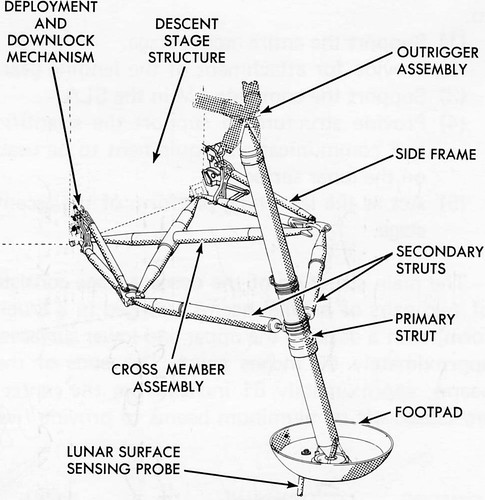
    This is the single-use crushable aluminum honeycomb shock absorber located inside the primary strut of the landing gear of the Lunar Module.

    Once the contact probes touched the lunar surface, the descent engine was shut off, and the spacecraft fell the remaining distance.

    Landing Gear Assembly

    (separately, I have posted a photo of the Deployment and Downlock Mechanism)

    And inside that primary strut: Landing Gear Primary StrutApollo Lunar Module Shock AbsorberThis honeycomb was designed to take an impact of 10 ft. per second, but none of the landings were more than 4 fps, so they did not crush very far, and the final step off the LM ladder was thus a longer step.

    From the Apollo 11 transcript:

    109:22:48 McCandless: Okay. Neil, we can see you (on the TV) coming down the ladder now. (Pause)

    109:22:59 Armstrong: Okay. I just checked getting back up to that first step, Buzz. It’s…The strut isn’t collapsed too far, but it’s adequate to get back up.

    109:23:10 McCandless: Roger. We copy.
    109:23:11 Armstrong: Takes a pretty good little jump.

    The same under-compression happened on Apollo 12, and Pete Conrad faced the same "giant leap" down to the landing pad from the bottom of the ladder. He was shorter than Neil. Conrad’s first words on the Moon were: “Whoopie! Man, that may have been a small one for Neil, but that’s a long one for me.”

    Here are some engineering details from Tom Kelly’s Moon Lander:

    “Concerned about the weight and potential for leakage of fluid into space from conventional hydraulic or pneumatic energy absorbers, I insisted on a dry version. In the proposal we thought it would be some form of molded elastic compound, but as the design evolved into an extendible four-legged landing gear a new energy absorbing material had to be developed to dissipate sufficient energy in a short stroke. Jiggs and Marcy searched for suitable materials and came up with crushable aluminum honeycomb. Hexcel had developed aluminum honeycomb as a lightweight, rigid, high-strength filler material for aircraft control surfaces, particularly the trailing edges, which typically taper down to end in a point. Hexcel was exploring new uses for its material and believed that it could be configured as a highly efficient energy absorber for the LM landing gear. Marcy designed some test struts for which Hexcel fabricated cylindrical slugs of crushable honeycomb. The initial test results were very promising: they indicated that the amount of energy that could be absorbed by a three- to four-inch diameter honeycomb cylinder with a crushable stroke of twenty-four to thirty-six inches was in the range required by the LM’s landing conditions. I asked Jiggs to proceed with the landing gear design using this approach, and we authorized Hexcel to conduct a development program to characterize and optimize crushable honeycomb for energy absorption.”

    (So now you can parse my cryptic clue that the Alieness identified the Hexcel company that manufactured this, and made Neil’s giant leap a couple feet longer than planned)

    And from The Apollo Spacecraft News Reference (Lunar Module):

    “The strut is of the piston-cylinder type; it absorbs the compression load of the lunar landing and supports the LM on the lunar surface. Compression loads are attenuated by a crushable aluminum-honeycomb cartridge in each strut. Maximum compression length of the primary strut is 32 inches. The aluminum honeycomb has the shock-absorbing capability of accepting one lunar landing. This may include one or two bounces of the LM, but after the full weight of the LM is on the gear, the shock absorbing medium is expended. Use of compressible honeycomb cartridges eliminated the need for thick-walled, heavy-weight, pneudraulic-type struts.”

    This particular 5” x 21.5” shock comes from Art Romeo, head of the Grumman Restoration Team at the Bethpage N.Y. hangars where they prepared two Grumman Lunar Modules for the Smithsonian and Cradle of Aviation Museums.

  22. I am impressed… how from the minimal debris remaining on the thing, presuming fiber glass, I got to Hexcel itself… the mysteries of the neural network…

    Awesome puzzle!!!! Congrats [http://www.flickr.com/photos/jerryfi_99]

  23. Excellent

    I remember the phrase; "contact light,engine stop"….quite vividly

    http://www.youtube.com/watch?v=MR-IjVv5NNQ&feature=related

  24. I had no idea this kind of stuff was available commercially. Congrats to the secret astronaut [http://www.flickr.com/photos/jerryfi_99/]
    and the alien
    [http://www.flickr.com/photos/36613169@N00]

  25. i still think it’s from the fortress of solitude…

  26. Another hive mind like illustration to Kevin Kelly’s article, Why the Impossible Happens More Often

    aminotes.tumblr.com/post/9701541566/kevin-kelly-on-why-th…

  27. i still think it looks like the most overly priced, horrible tasting cupcake.

  28. And this photo of the finished leg and description of how it led to Neil Armstrong’s "giant leap" just came out in EDN: Chronicles of Grumman’s 1960s LEM Development

    EDN LEM_lander_leg_containing_crushable_honeycomb_foreground_and_Kapton_covered_foot_background_

    "One particularly interesting and challenging problem was designing the LEM landing legs with some sort of shock absorber to gently ease the landing onto the diversely landscaped lunar surface. Conventional shocks would not function in a low-gravity, no-atmosphere environment. The members of the Grumman mechanical team put their heads together, and the honeycomb structure came to mind. It was light but strong and would crumple inside the tube of the landing leg as it bore the brunt of the landing. Success!

    The famous first words spoken by Neil Armstrong as he descended the LEM ladder toward the lunar surface on July 16, 1969, had a dual meaning. As he jumped onto the lunar surface Armstrong said, "That’s one small step for man, one giant leap for mankind." He jumped! This was because the LEM had landed more softly than expected, and the legs did not crumple as much as expected. Some experts say that the astronauts, being jet pilots, actually landed the LEM softly instead of using the agreed-upon procedure to cut the engines when the LEM was within a few feet of the surface. If the expected impact force had occurred, the last rung of the descent ladder, attached to the landing leg, would be located close to the surface. It was not, so Armstrong had to leap to the ground from a much higher level than planned. Luckily, the low-gravity environment allowed him to float gently to the surface. "

    Thanks jerryfi for the pointer! The article came out on my birthday no less. =)

  29. I added this story to a tribute of Armstrong memories for his birthday…

    Happy Birthday Neil Armstrong

  30. Great pic, Steve. Hey, how about a contest for ideas of how hex cores of various materials could be used? Laughingly, I thought of big plastic hexes growing bansai trees and truffles (since they need each other), or alternating layers of flexible polymer with hard polymer to make modern dry shocks or or or…

Leave a Reply to Jeffrey Wallace Cancel reply

Your email address will not be published. Required fields are marked *