

I recovered the HCX flight computer file from an unusual flight this evening. Can you tell what happened?
I recovered the HCX flight computer file from an unusual flight this evening. Can you tell what happened?
Lawn dart?
Can you re-scale the graph so it shows the negative parts of the vertical speed?
A clean parabola in altitude after burnout… parachute not ejected !!
(the spike of blasting nose cone is absent from acceleration curve)
Bingo, photon-wave! This is the swan song parabola for the big V-2 coming in ballistic (photos). Most of you got the gist of it.
Max airspeed 473 MPH (going up)
Descent Rate: -245 f/sec (ouch!)
Max Acceleration: 7.7 G (the spike of landing was not captured…)
Here are some new photos for a sense of scale (left photo by Stanley Moss)


and the short video montage from the ground with some sweet sounds…


I was amazed that the SD mini card recording this flight survived the massive compression of the 98mm avionics bay into something that looked like a softball. It took quite a bit of work to pry it apart. The HCX computer snapped in half, the LCX had its components shaved clean off, and the SD card cage snapped off. But the data survived! (unfortunately, in contrast, the microSD card in the HD camera snapped in half)
I will ask the computer designer if there is way to get more data points than we see here.
Nils: Per the thrust curve below for this motor, there is a slight drop in thrust after 1 second, and a more dramatic drop at 5 seconds:
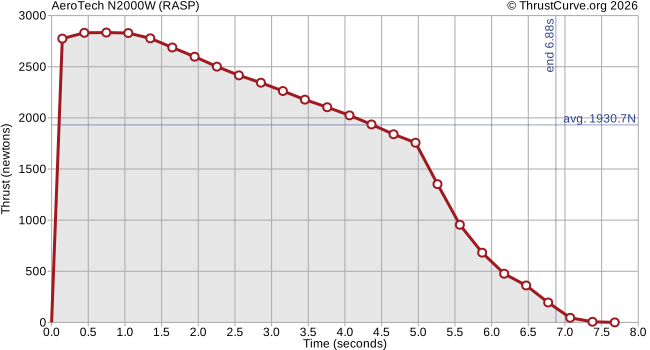
I think we are seeing the instantaneous impact on acceleration, in practice, is quite dramatic.
@slopetrash I want to note that the red plot in the top graph is the actual acceleration of the rocket in flight as was measured by the on board accelerometer, whereas the curve from ThrustCurve corresponds to a simulation of the expected motor thrust. The blue curve at top is the barometric altitude sensed in the rocket. Its second derivate with respect to time produces a more smoothed acceleration curve that could resemble to the ThrustCurve graph.
By the way, the later graph is a signature of the grain geometry into the motor. Circular bore configuration in the motor produces progressive-regressive thrust curves as shown here. The Wikipedia article about solid fuel rocket is self-contained.

Leave a Reply