Canon PowerShot SD850 IS
ƒ/2.8
5.8 mm
1/250
80

So I had to ask Eric if the phones were context or functionality-driven. I thought of Elon Musk who carries two identical phones, one for Tesla and one for SpaceX.

For Eric, it’s functionality. The Motorola phone seemed like the odd one. It’s for phone calls. But not just because it’s better at that,. but because it’s bad at data services. So if he wants to go to dinner and have a real conversation without distractions, he’ll just bring the voice phone.

Clearly, we were full of distractions. =)

Eric is kicking off the conference now…

41 responses to “Techonomy Kickoff Lunch”

  1. From the panel up there now:

    Kevin Kelly:
    "Technology is the most powerful force in the world . We think of it almost like culture. But it’s different. The technium is an emergent thing itself. It even has it’s own agency."

    Eric Schmidt:
    "Every 2 days, we create 5 exabytes of new data, which is more data than from the beginning of time through 2003. UGC is really making a difference. With phone tracking, we can predict where you are going to go. From 14 pictures on the Internet, we can tell who you are with 95% accuracy. Society is not ready for the questions that will be asked by these technologies."

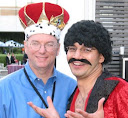
  2. got distracted with the shirts…

  3. More, as it’s happening:

    Kevin Kelly:
    “I so rarely disagree with Eric. He says technology is neutral. It’s absolutely positive. It expands choices. That itself is a good.”

    Eric: “I meant the device is neutral. There are in fact evil people in the world. My overwhelming view is that on balance technology is positive."

    "We need much greater transparency and no anonymity. Anonymity is too dangerous. Information is too powerful and it can be misused.”

    Kevin: “That’s the negative; there is also a positive. What we all want from technology is absolute customization and personalization. You can only have that with absolute transparency.”

    Q from Doc Searle: Who is the “we” that has access to this information? Is it Google and the government?
    Eric: “Well I hope it’s not the government. I don’t think we are ready to put modern AI technology on top of the data.”

  4. Q: These technologies are making us work too hard.
    Eric: This I why God invented the off button. I can go without it for 90 minutes for a dinner.
    Q: How long can you be off? Can you go days?
    I can do it for 90 minutes.

    Kevin: You can choose to live with stone-age technology. You can choose to be Amish. The Amish optimize for leisure. They don’t optimize for choice.

  5. Great updates and insides.
    Keep them coming so we can feed our brain =)

    "What’s true for the group is also true for the individual. It’s simple: overspecialize, and you breed in weakness. It’s slow death." GITS

    As for what Kevin is saying. I am reading an interesting book about that, you may like (in french for now) :
    le paradoxe du sapiens de Jean-Paul Baquiast

    The Paradox of Sapiens offers a surprising answer to a question that concerns us all: why are humans, capable of extraordinary achievements in all fields, show themselves incapable of preventing disasters – disasters that are announced yet, like climate change? The author demonstrates that the real players in evolution are superorganisms-combined on the symbiotic mode of primates still largely controlled by genetic and cultural inheritance of tribal hunter-gatherers on the one hand, and technology increasingly powerful developing according to specific logics less and less controllable, on the other.(google-translation)

    Something else, reading at the moment, I would recommand to any techonomists is You are not a gadget by Jaron Lanier . Long time since a book made me rethink everything I thought about technology and the way we look at it. Great book so far !!!
    Have you read or heard about it ?

    (ps: cool geeky photo ; )

  6. Have not read it. I recall disagreeing with many things Jaron says but find myself mesmerized by his mental pivots nonetheless.

    Back to the show:
    David Christian, on Big History:
    "What is the source of our creativity? Collective learning. The key evolutionary moment is when we crossed a threshold in linguistic proficiency. Information began to accumulate from generation to generation. Cultural information accumulates as it can with networked computers."

    "It’s a dangerous gift. We adapt at warp speed and the biosphere adapts at biologic speed."

  7. Where are the Margheritas????

    Perhaps I am naive, however, I would have to agree that technology is overall positive. I don’t think that anyone would argue that we aren’t banging rocks together or wearing animal skins (for the most part) anymore. I imagine that some of what makes certain advancements appear positive or negative is "perspective". If you are an oil executive then the gulf spill is simple a bump in the road of progress. If you are a conservationist, then it’s devastating. There is clearly a waxing and waning that goes on like a game of tug of war, or the waves on a beach, but overall from a human perspective the movement has been positive. Look at it from a universal perspective and it’s all null and void. Give or take a few million or billion years and it is likely that everything and anything that human technology had accomplished will be swept up in some supernova or black hole. Perhaps only the simple fragment of DNA or nucleic acids will remain as evidence of our technology as it floats through space on the fragments of what remains of our mother earth. That’s just one peons perspective.

  8. that’s why we need to become a space-faring species. =)

    Stewart Brand:
    “Biology is the most useful way to think about everything. Data comes first; theory comes last.”

    “Radio spectrum and climate are resources and we need to have international agreements about them.”

    “We are terraforming the planet anyway. We can’t just stop and blend back in. The question is whether we can do that well, and that takes good engineering.”

    “Environmentalists have residual opposition to nuclear and GMO, but embrace synthetic genomics and fusion. Danny Hills calls fusion synthetic solar." (visual)

    “The developing world will get all this technology when it actually works. Like cell phones.”

    Q from SFI’s Doyne Farmer: With the vision of the UN selling the fuel to developing countries, will all fuel enrichment occur in one place? With BP, we have to expect a certain rate of spills. If we are shipping fuels all over, we are going to have spills and theft.

    The precautionary principle makes sense. But you have to put a sell-by date on the things you worry about. We have had nukes for 40 years without incident. We’ve been eating GMOs for 10 years. There will be problems. But there will be less than we have with oil and gas.”

  9. Brian Arthur, SFI
    All complexity comes from successive integration of simpler objects.

    “I’m interested in where it all came from? I’m thinking about technology. I began to see patterns again and again. All technologies are combinations of technologies that already exist.”

    “Every few years, we get a new body of technology. But the economy does not adopt the new technology. It comes up against it. An industry creates new business processes and technologies from the body of technology. The economy is remaking itself. This is continuous and never-ending. What change in character do we have right now? What is underway? It is still too early for nanotech or synthetic biology to make a difference. Perhaps Steve Jurvetson can correct me on this. For the past 50 years, it has obviously been computation. It’s like a new language and business is selecting new words and phrases from that language.”

  10. I’m with you Steve. I believe that without a real push into space, "all the rest" really makes little sense (hence to origin of religion but we won’t get into that). Unfortunately, convincing the greater population will not be that easy (even though it would seem obvious). I just wonder if we will have the capability to achieve the technological advancements necessary to escape the ultimate future of universe. Will life as we know it be sustained at the great speeds necessary to make the voyages that a future mankind will need to attain? Or perhaps are we the remains of a past humankind that realized that the only survival would be attained by spreading the basic genetic building blocks across the vastness of space in hopes of reaching a viable planet?

  11. I would love to read some good entry from a more oriental philosophy or worldview to balance out all these statements. I deem it’s all OK, but just one-eyed. I am sorry, I see too much yang energy into all these outlooks about the future. I would like to see some balance, there’s an evident lack of yin here.

    Dr.DAD, I don’t think we are capable to escape the ultimate future of our universe. But given that we still don’t know what is the universe (even though so many people make us believe so -yesterday religions, today science-), I have hope. You cannot know if you will escape the future of something you don’t know in real fact what is it made from or about. Nor we know about ourselves, by extension.

  12. Great ideas, thanks:) amazing to meet Eric, wou!

    Yep, high-tech is a male dominated field – to "yang" comment.

    Satellites are watching everyone and everywhere, hmmm… sounds strange, is it true? I am personally not very comfortable with this lack of privacy for adults or for children online … some sense of balance, common sense and boundaries are important and healthy.

    There is always some better idea and better technology. Collective learning and exchange of ideas helps:)

  13. Alieness I always have hope. And the best part about not knowing is that there is always something interesting to learn!

  14. Google’s coming full scale assault on building a social platform is going to be a very fascinating application of Google’s views on privacy. I look forward to being able to compare / contrast how they manage things versus Facebook.

  15. Good blogging, J-man. My 2005 SonyEricsson phone has 48 MB memory — for mp3s and java games.

  16. vj and Gi^2: could be the selfish biocosm…. Gardner concludes with a nested spiral of recapitulation: “An implication of the Selfish Biocosm hypothesis is that the emergence of life and ever more accomplished forms of intelligence is inextricably linked to the physical birth, evolution, and reproduction of the cosmos.”

    My battery died mid-session last night. Here is Brian Arthur’s conclusion:
    “I think of the physical economy as being above the ground and is visible and tactile, and under the ground is a massive root system, a mirror economy, a vast system of interconnected functions triggering other functions that we don’t see. It’s like trees and their root systems. But if you look up close, there is something more subtle happening than that. Every time we connect to the digital world, it’s by sensing something. Like camera sensors. Then it executes something in the physical world. It reminds me of a definition of biological intelligence for primitive organisms. Can it sense its environment and react appropriately. Jellyfish developed a neural layer throughout the jellyfish. It can sense food and move in the right direction. In the economy we are developing a secondary neuronal layer. It is communicating, vast, autonomous, concurrent, and there is no central brain. It is a neural layer. It is doubling in size every 22 years. This autonomous neural layer is the biggest change ever in the economy. I don’t know if it’s benign or malicious; that’s for a late night bar conversation.”

    John Hagel: “Referring to the underground neural layer. And Schmidt’s info explosion distracts us from tacit knowledge, which is hard to build in the absence of trust-based relationships. And that leads to talent development.

    We also have to confront the growth of religious fundamentalism in all of its forms. We could take 3 reactions:
    1) dismiss them as a bunch of idiots
    2) oppose it
    3) engage with it. We have an opportunitiy if we understand it, and why it’s growing:
    a) mounting pressure. Dark side of tech economy, we can’t stand still
    b) erosion of stability
    c) erosion of relationships. Moving to transactions."

  17. We should be less considerate of religion, yes?

    David Gelernter, in a fascinating evening talk:

    "Younger people are privacy-damaged. At a young age they are told that spy satellites watching them. That everything is watched. Especially the satellites. It’s utterly untouchable. They grow up being unaccustomed to say ‘this is mine.’ The momentum is with those who don’t care about privacy."

    "Do we take the time to check if what we say is true? This is an extra layer in post-modernist thought."

    On Cobol and the Internet:
    "There’s nothing we can’t throw in the garbage. I hope we do it early and often."

    Mirror Worlds reflections:
    “A big flaw of the book was being too conservative. One is always surprised at how fast hardware moves and how slow software moves.

    Q from 30-something about not caring about any privacy issue online:
    “I think it was Groucho Marx who said: ‘I’ve been rich and I’ve been poor; I prefer rich’. Soldiers in 1943 had no privacy. None. They could adapt to that. People more productive and happier when they have more privacy.

    “Self-governance over the Internet scares the hell out of me.”

    “Is twitter a life stream? Absolutely.”

    [The elephant in the room, as we reflect on his comments on privacy, was his his personal experience with the Unabomber. The glove over his damaged hand served as a reminder.]

  18. on stage now…

    Nicholas Negroponte: “50% of the kids in Peru that use this laptop are teaching their parents to read and write.”

    “In Afghanistan, we are spending $2B/week on war vs 2M/week on education. If we move .5% from column A to B, then every child can have a laptop. That will make a transformational change.”

    Kevin Kelly: “What does technology want? We have used the precautionary principle. There is sense of caution first. I think we should use what I call the Proactionary principle. Engage with it first. We can’t predict how technology will happen until we engage with it. This is different with how we first adopt GMOs. Each time a new technology causes a problem, the solution is always a better technology. The response to a bad idea is not to stop thinking but to have a better idea.

    “Technology wants increasing speed and faster evolution of the system. That is the nature of it. The short attention spans that we have – this is actually something we need to do to adapt to things moving faster. Information is the fasting growing thing on the planet. This data flow is the new matrix that we will be operating in.”

    “There are inevitabilities in technologies. We have to embrace that. Genetically modified humans are inevitable. Cloning is inevitable.”
    Maria Bartiromo: Tell me more about Cloning?
    “Human Clones are walking among us today. They are called twins. If we had invented twins, they would be outlawed.”

  19. Did you show Eric the flight of their Nexus One on the Beagle IV? He should have gotten a kick out of that.

  20. I discussed it with him… Did not have my Mac with me. He knew that it was underway.
    (Here’s a photo reference for those unfamiliar with the Google satellite project)

  21. good luck with that.

  22. Andreas Weigand (the fellow in the middle who had the camera), former Chief Scientist at Amazon.com, is speaking in San Francisco this evening on "How the Social Data Revolution Changes (almost) Everything. Why do people share, what do people share? And how does this influence their behavior?" (details)

  23. Thanks for the link and info on him. Will you be at the event ?
    Hope someone record it.
    Interesting subject, especially for fellow flickrers we all are here =)

  24. Just came across this via Gizmodo :

    In an interview with a Wall Street Journal opinion writer, Eric Schmidt :
    " He predicts, apparently seriously, that every young person one day will be entitled automatically to change his or her name on reaching adulthood in order to disown youthful hijinks stored on their friends’ social media sites…

    "I don’t believe society understands what happens when everything is available, knowable and recorded by everyone all the time," he says… "I mean we really have to think about these things as a society."

    =)

  25. "I mean we really have to think about these things as a society." This is why I want to study epistemology (gnoseology, to be precise).
    thebookofsand2006.blogspot.com/2008/06/epistemology-that-…

  26. RE: (in)tolerance to religion. = The solution is to Grow Up, not to be more intolerant. Maturing helps a lot. I highly recommend growing up for intolerant people, specially intolerant people to other people’s feelings and wolrdviews. You cannot be really intolerant to/of something you don’t understand (as you clearly don’t, if you did you wouldn’t talk like you always do). And magically, once you understand something, you get to a higher level of comprehension that leads to Compassion, not to intolerance, thus you enlarge your own worldview to encompass with others’, in a meaning-full way that is helpful and not harmful.

  27. Not sure if "you" is directed at the speaker quotes or me. If me, there is a difference between tolerance and endorsement. By analogy, I can "tolerate" a Nazi or racist in the sense of sympathizing that they were misguided in their youth, but I don’t have to accept their beliefs, or condone them, or shrink from criticizing those beliefs. Far from it. Societal norms can only advance if we speak openly against those medieval thoughts. I hope you would agree with this so far. Yes?

    Then consider that fundamentalist religion is cognitive racism.

  28. Écrasez l’Infâme

  29. Tolerance becomes a crime when applied to evil. However if Hitler were to invade Hell, I should at least stand in the Commons and say a few words on behalf of the Devil.
    Oh, but there are no such things as Hell, the Devil and Evil. How to deal with Hitler did take the US quite some time to figure out. Libidinous atheist and communist bastards at the Saturday Evening Post in a state of typical moral turpitude. Écrasez l’Infâme in that context even in that older more honorable Godly America.
    lh3.ggpht.com/_lzD5cS9PEnc/TI-OLyMIALI/AAAAAAAAAaM/siFVyL…

  30. Thanks for the pointer. Somehow, when we read Voltaire at my parochial high school, we did not explore that phrase. No wonder I liked Voltaire.

    From Écrasez l’infâme!: The Triumph of Science:

    "In 1784, the 60 year old Immanual Kant (1724-1804) published a brief essay in the Berlinische Monatsschrift, the official mouthpiece of the German Enlightenment. Kant’s essay was called, Was ist Äufklarung? Kant began the essay in the following way:

    Enlightenment is man’s emergence from his self-imposed nonage. Nonage is the inability to use one’s understanding without another’s guidance. This nonage is self-imposed if its cause lies not in lack of understanding but in indecision and lack of courage to use one’s mind without another’s guidance. Sapere Aude! Dare to Know! Have the courage to use your own understanding is therefore the motto of the Enlightenment.

    They were agreed that Christianity was a supernatural religion. It was wrong. It was unreasonable. It was the infamous. Écrasez l’infâme! shouted Voltaire. "Wipe it out! Wipe out the infamous!" Only science, with its predictable results was the way to truth, moral improvement and happiness."

    Hitler: There is no need for belief in a particular skygod for society to recognize and punish wackos like Hitler. Yes, when politics get twisted into religion-like brainwashing rhetoric about being the chosen ones, it can be difficult to see for some. But society will get better over time in recognizing cult movements as what they are. It doesn’t help, though, to have a normative basis that religious thought is somehow protected from scrutiny and public debate. It’s like banning anti-virals in thought space. What better policy for the viruses of the mind to propagate? If someone is spouting hateful drivel, we should call them on that. In Hitler’s case, as a Creationist Christian, he had the Nazi belt buckles engraved with "Gott mit uns." ("God [is] with us", a commonly abused confusion).

    Venetta – spirituality is one thing (no complaints there); organized religion, on the other hand, will probably not pass a cost-benefit analysis in the modern era.

  31. Brian Arthur, SFI
    “All complexity comes from successive integration of simpler objects.”
    I love ALL statements. Yes, evolution to states of higher complexity is always by integration
    of simpler objects.
    For Eric Schmidt
    "I don’t believe society understands what happens when everything is available, knowable and recorded by everyone all the time," he says… "I mean we really have to think about these things as a society."

    Yes. Google staff in particular as a part of society has not come to grips I mean with this fact. I see plenty of things that would make more than just kids want to change their names, wear masks or get plastic surgery.
    Some of us do in fact understand some of the privacy implications as well as why Mexican police wear ski masks in photos with cartel guys.

  32. exactly. Or why Eric flipped out, appropriately, when a site broadcasted his home address and estimated worth.

  33. Hitler, Stalin, Mao an eternal tyrannical braid. To paraphrase the "Metaphorical fugue on minds and machines in the spirit of Lewis Carroll." In the spirit of Voltaire,
    Quoi que vous fassiez, ecrasez l’infâme, et aimez qui vous aime. Which is not so much an advocacy of science and technology as the fraternal part in the trinity of Liberté, Egalité, Fraternity. The French Revolution gets a bit out of hand when it comes to the implementation of the " ecrasez" and the determination of the "l’infâme." I find the statement that : "there are truths which are not for all men, nor for all times" extremely relevant today, indeed as such relevant statements tend to be. In particular with respect to the absolute positive value of science and tech. When you have science and technology giving multiple means of mass destruction on a planetary scale (not just warfare either) that does tend to make you think in relative value terms. Sir Francis Bacon certainly got it right about the power of technology. I will have to dig a bit more to understand his sense of it vis-a-vis nature, divinity and religion. Frigging Latin. I know who to call but he’s out in the field digging up satanic icons.

  34. Love Kant’s quote, discussion highlights do make sense to me:)

  35. Eric flipped out, appropriately, when a site broadcasted his home address and estimated worth? Gee, he is the head of a major multinational public corporation. Did he not learn at Princeton and Berkeley that his financial holdings, statements in public, income, etc. are all legitimately part of the public domain? The level of naive with Google is mind blowing.
    Its not like they have things there that people really want to know who are not so nice like me.
    Of course just like for politicians it crosses the line when you get kids involved for the media, financial and blogo-hounds. This new technology is quite the privacy destroyer now isn’t it? You used to have to get private detectives, spies and company rats to dish this out. Just go thru some Google divorces and see how much fun that is. I clearly recall some school daze companions who needed bodyguards in those circumstances. In my case it is a bit more simple.

  36. You should have taken more pics at the conference Steve 🙂
    All the same, the few you have are great.

    Featured here on QUEST, along with the videos posted by Techonomy.

  37. Thanks. I took more but only posted a few. If there is some speaker you were wanting, let me know; I might have it.

  38. Hitler as a creationist Christian. A Teutonic Elmer Gantry. Please! Here is the trivial Atheist page using the belt buckle as an example.
    http://www.bowness.demon.co.uk/belt.htm
    That slogan goes back farther than Fred the Great in German history, like on the Prussian coat of arms and WWI issue gear.
    upload.wikimedia.org/wikipedia/commons/6/61/Preussen1709.jpg
    Albert Speer’s memoirs have some fine examples of what Hitler really said and thought about the wrong religion.
    books.google.com/books?id=XLSa_RIDHMUC&pg=PA96&lp…
    In addition to my associate who uncovers satanic source artifacts I have another who is a premier Nazi gear dealer. Very sick stuff in my opinion like empty Zyklon B gas cannisters.
    More examples of that great Nazi technology that we are all the better for. Good thing that those Nazi rocket scientists did not get nukes before we did. That would have been a bit of a problem for the triumph of science and technology in human progress for some of us.

  39. "It’s a dangerous gift. We adapt at warp speed and the biosphere adapts at biologic speed."
    Right. The big events that shaped the biosphere of this planet, things like the Permian extinctions, have happened very rapidly and not just relative to the scale of Geo time. That biologic speed is by no means constant in these cases. I forget when the epochs of mass mutations were, but they do exist and in those cases the biosphere gets warp speed adaptations by force of nature. Now it can easily be by force of humanity in multiple ways both controlled and uncontrolled.

Leave a Reply to jurvetson Cancel reply

Your email address will not be published. Required fields are marked *