

DMC-FX7
ƒ/2.8
5.8 mm
1/60
100
…for when I am off wandering in the desert…
Notes from Geoffrey West, recently promoted to the president of Santa Fe Institute
…for when I am off wandering in the desert…
Notes from Geoffrey West, recently promoted to the president of Santa Fe Institute
In the words of Marty McFly: "That’s heavy." I am going to need some time (and some watts) to mull that over.
One additional perspective:
In general, the larger an organism becomes, the more initial investment of energy is required to produce a new organism. A baby blue whale weighs 8 tons and consumes 160 gallons of milk per day, and requires more than a year of care. Smaller animals have a tendency to mature faster and produce more offspring, visualize the reproduction strategies from mice->cats->humans->whales.
The inverse trend to your metabolism vs mass graph is a decreasing ability to search via brute force. If you are a small animal, you can search for solutions by producing a lot of other small animals, most of which will die unsuccessful, but a few will survive to propigate.
The consequence: conventional methods for biological problem solving, i.e. evolution, are decreasingly effective for large animals, given longer generation cycles and increased costs.
Questions:
Is humanities development of technology a method for surpassing natural evolution to solve problems?
Is the development of technology primarily responsible for the success of the human species?
Are we positioning ourselves to supplant natural evolution of the human species with evolution of our own design?
Have we done so already?
Or do whales and other non-technological large species know something we dont?
(This post was off the cuff, so add points and facts I missed)
Interesting thoughts oddwick..
The problem is that the whole system has to be considered, and technology helps create imbalances and several forms of ‘debt’ which the social framework in which it operates doesn’t accomodate promptly. Hence, you get things like tech development creating problems that are ignored (global warming etc.) which eventually may negate the ‘gains’, which are not evenly distributed throughout the overall population and therefore adds to social tensions leading to wars etc. Example: without technological developments, 50 million people could not have died in WW2. WW3 will be much worse. On the other hand, prevention of diseases through technological means could be an argument to the contrary.
Excellent point Victor1. Is it possible humanity will be able to handle the… "system debt", I dont really know what to call it?
Manufacturing processes increase in efficiency and decrease in thier pollution output, think about the pollution put out by coal power during the industrial revolution vs. today. Can we as a society improve the state of technology usage to negate the sins of the past? I believe we can (and implicitely we are all betting on it), but there are certainly valid counter points.
Hi there. If you let me… =)
My 2 cents: We can´t negate the consecuences of our past actions. Maybe we can only put the breaks the sooner and try to repair the damage with new and different actions. But this takes responsibility. Responsibility from all and each of us.
Example: To recover from an illness caused by a autodestructive behaviour (let´s say smoking), to make a change for good, you first have to admit you have a problem, and that implies assuming all the damage you already done to yourself -and others- and all the problems that this will bring still after you get cured. To operate a change you have to be in control of the situation, and that necessarily means to become responsible for your actions. Negating the past doesn´t help, neither avoiding the facts as they are. Also you have to be *ready* to let go all the benefits and good things this behaviour have been giving you so far, that won´t be there when you still will be suffering for the damages the addiction left in you. So, you deal with at least two big losses.
The bitterness of knowing yourself responsible for something that did you wrong pays with the sweetness of knowing yourself capable of turning the tide and making a change for the good for your future. Nevertheless we all know how difficult this is to put into practice.
I believe that humanity as a whole being is still too immature to go through this process successfully. Don´t go too far, observe yourself and the people you know: Do they have the habit of making themselves responsible for their acts, or do they tend to blame others (God, fate, spouse, parents, the dog, the government, economy, ecology, other country´s government, the zodiac, the therapist, etc)? You will see that as soon as you beign to think in terms of responsibility, you start to behave more carefully. However, we are culturaly programmed to put the responsibility out from ourselves. But the benefit of this is illusiory, for in the end, this really means that we are considering ourselves adrift of external conditions that are out of our control. This is not only counterproductive, but very frustrating and overwhelming in our everyday life. For some can be a nightmare.
Also, Nature´s like a spring: the harder we stretch it, the greater it´ll hit in return trying to normalize itself. And as we know, if we force a spring more than it was prepared to, it will never be come back to its natural tension again. Or worse: we can damage it irreversibly.
Health and Illness, pure or polluted, cure and damage… don´t forget that this is just an arbitrary anthropocentric evaluation we make taking on account the state of things at a given time. The ultime truth is that it is all about change and transition. The rule of cause and effect is universal. And bare. What religion translates to "Free will".
Nice post Alieness, agreed on the immaturity of humanity. I do, however, think we are getting "better". "Better" being an arbitrary anthropocentric evaluation, but hey, what am I supposed to do, make some sort of objective statement?
Any thoughts on what metric to use to track the assignment of personal, societal, and special responsibility? I think things are looking up, but have no quantitative basis to support my position.
Oddwick, your system’s/process engineering side can’t be hidden.! Metrics: I’m with you all the way.
Metrics are in the eye of the measurer, and the trick is how we measure the measurements. Without diverting into a political rant, a perfect example is the Reagan years: he’s credited with ‘breaking the soviet union’ so to speak – by our measure a good thing, by communists measure, a bad thing. What always gets left out of the ‘Holy Reagan’ worship, is that he took our national debt from the unspeakable horror of Carters "1 Billion!" up to 4B. Cosmetically, the US did great in the 80’s, but in the overall picture, we assumed financial debt that now is costing us 1/3 of our tax dollars just to pay the interest for. Hey, give me a credit card with which I can buy a house and new car, and I’ll look pretty successful too, specially when I can get my whole town to assume the debt.
Put another way: if 1/3 of our taxes are wasted on bad management, and our major corporations continue to shed workers (and by extension their own customers), why is everyone wondering why our economy is dead in the water? Another example: toxic waste is created by industrial production. The cost is passed onto the consumer via taxing us for ‘Superfund cleanup’. another example of debts unpaid dragging us down – financial, technological and social.
If we think of society as a person and all of us as its cells, there’s an average of intellect and capability we all have a view of. But unless the metrics are made by the whole system, the values of one part overshadows the ‘net reality’ experienced by it all.
Example: a drug addict’s brain is getting what it wants, at the expense of 1) the body supporting the system, and 2) the family/work situations supporting the economics of the drug addict, and the 3) the society which pays for the ills of addiction. By extension, the people who make decisions for, say, ‘Globalization’ and displacemnt of jobs to india/china etc. get bonuses for such decisions, but the systemic implications are that the whole system is lowered in future capability.
The diversity of measurment and valuations makes agreement on a wise starting point less possible than those with a higher intellect in the ‘body’ can determine. So being part of a society means being somewhere in the chain of effects (decision maker or decision outcome receiver) and the net intelligence of the system may or may not lead to success. Some will see it coming and move wisely (like leaving germany before 1940) and the less informed will pay the consequences of the decisions which favor the ‘selfish’ or systemically nearsighted.
Back to Oddwick’s initial comment: we’re cells in a giant system having birth pangs of an iterative nature as the scale of things goes up. Some of us see more and can guess the outcome, but individual approaches – such as spirituality, technology, social development, are all co-evolving each other into an overall result, which satisfies none of the constituants but, in the words of Jack Nicholson…"has it ever occured to you that this is as good as it gets?"
Which brings me back to Epp’s comments… the Tao perspective of the ever morphing but never really changing dynamics of the systems we live in, are best ‘understood’ or ‘accepted’ as: we live in a system always larger than our comprehension, so lets appreciate what we ‘get’ (receive or understand) and try and play a harmonious note in our measure of the symphony of life. And to tie in Alieness’ comments: by operating responsibly on a local level, our own self, we simulate the waveform of progress that becomes the building block of societie’s transformation as a whole.
I’m usually not so wordy. In fact, I prefer silence, acceptance and non-verbal ‘knowing’ as how to get through life, but its a complex world so you have to start where it is, and hopefully drag it back towards simplicity of spirit and wholeness in your own way.
A last thought: the Amish decided that getting more technological than horse and buggy provided no net gain. Their microcosm has none of the problems of the world around them, drowning in technilogical solutions to the problems caused by the last tech solution. I visit SE Pennsylvania occasionally and see them living in the 1800’s. They’re not unhappy, and their social support network makes us look like outakes from Blade Runner.
I have read some interesting accounts of the Roman empire, which tracked the devaluation of thier currency. The researchers used it as a metric to track the fall of the empire, asserting it was indicative of systemic failure of the entire society.
What is the best canary for our modern age? What indicators tell if we are heading in a ‘better’ direction?
Unfortunately, there is an observer effect. Lets say we agree on some measure or set of measures, and then use them on a large scale to try and avoid actions which are cosmetically pretty but mechanically unsound. As people become aware of defects in our progression as a society, our canary becomes part of the facade.
I think this has happens often in dietary practices, a small set of measures are used to determine the health of a diet. Companies cater to the new measures (consider all the new "low carb" companies), and unhealthy habits are expressed in a cosmetically acceptable manner.
This happens in all systems, though it is a bit harder to nail down in the larger, more complex, and more amorphous entities.
► side comment: this is very interesting. I posted my reply to the Alieness question in the on-picture notes as I did not want to interrupt this fine thread. »
On the main thread, who is "we"?
Is the ecosystem happy?
Have you ever met a rich pessimist?
(in the broad sense… not rich as in money)
Do we believe that we, right now, are the endpoint of evolution?
Oddwick: very astute. I think there is a superficial layer of thought, personally and on any scale, where hope for positive outcomes is mixed in with logical thought and therefore the truth can be obfuscated by those ‘in the know’ to those hanging on hope. Psychologically it works the same as sociologically (oh one more drink won’t hurt…) Take hope and positiveity out of the equation, as happens when enough things go wrong for very long, and even the hopeful ‘give up’. The more insightful have enough data (memory of historical precedent) to see through the ‘hope-screen’ and take evasive action early. That bit about the Roman empire is really amazing – I would liken it to all the shenaigans being done to pump up the dollar in recent years, which are not based on sound economic activity or value. In fact, going off the gold standard, let those who set prices and wages stay ahead of those who have no control over either, hence, the zero increase in buying power of average people in the last 30 years. 1970 dollars are worth 3X FY2000 dollars, so a 90k job today is no better than a 30k job then, but it sounds better to those unaware of the time value of money.
Steve: Andy Grove’s book "Only the paranoid survive" is an example of what you’re talking about: the paranoid, or lets use a calmer term like cautious, stay more alert to changes which may impact them and take action sooner than the ‘hopers’. This statistically makes them better adapters and improves their wealth, whether monetary or emotional. I call this the ‘evolutionary quotient’ – your adaptability index.
Good point about ‘who is we?’ In the case above about the ‘happy addict’, the person thinks they are happy but that’s one organ’s impression – the brain. The liver is not happy, nor are all the other cells who’s work is harder to extract toxins etc. Socially, the concentration of wealth in recent years has disenfranchised most people, but unaware of the math mentioned above, they blame themselves more than the system which keeps the carrot out of their reach.
The endpoint of evolution? A matter of definition or description, just like evolution itself. I hold that ‘sense is a subset of nonsense’ and that the mind’s perceptions are as much a part of evolution as the things it ‘thinks’ it observes in an ‘objective’ way. In a way, its the mind that is evolving to understand the world’s activity, and currently evolution is in the heyday of being the ‘killer app’ of explanations, where previously, personifications of the interactions natural phenomena were attributed to spirits or Gods. That’s the western version (The Taoists view holds true even today – everything is a swirl and you may as well learn how the river flows and not paddle against it). To people back then, the personality was the most complex thing around, so that which gave rise to it must have been like a personality but more complex – hence the personifications of ‘gods’ with human tendencies matching the culture which spawned the concept. From the Greeks to the Catholics, the ‘gods’ created were projections of human cognitive functions, raised to the ‘deity’ level. In a way, its the mind getting to know itself.
Now we have more data (education) and people who can compute more of it, so that a ‘theory of evolutionary interaction’ is the new monicker of this world of description development. What makes it all really fun is that the observer/thinker and the observed are both evolving simultaneously and interacting in a way that develops the perceptions and the world being perceived. To add the the clarity or confusion, depending on your education and computing power, is chaos/complexity theory which, as you mention, shows ‘complex’ things as a result of the iterative dynamics of relatively ‘simple’ things or events. Here again, its the decribing system which is designating ‘simple’. An atom was very simple in the 50’s – proton, neutron, electron. Since then, we’ve found so much junk in there, we realize its simplicity or complexity has to do with the evolving depth of our own understanding. The sub-atomic world was probably always the same.
To make things truly confusing, take the new theories where consciousness itself is doing the creating – as described in the movie ‘What the bleep do we know’. Check out :The self aware Universe: by Goswami.
In the end, the flying spaghetti monster put here by aliens is probably the best theory to hang your hat on, and had the # of pirates not declined the way it had, we’d all be more ignorant and happier. 😉
By the way, "the canary becoming part of the fascade" – brilliant. Current example: the white house making up its own news stories with its own fake reporters and ‘experts’, handing this prepackaged pulp to the news media which broadcasts it unedited to an unaware public which trusts the media to at least not do things so superficial.
You’re dead on!
Holy comments, Batman! Wow. This is great. Reflectionsoup for the soul. My favourite. Thanks for the exchange and the rich interaction.
Talking about ‘rich’, what is your definition of rich, Jurv, in this context (i understood the ‘non material’ sense, but i find it insufficient for me to understand your question). Becosh… A person who considers themself as ‘rich’, beyond a material sphere, couldn´t be a pessimist at the same time. To believe you have a rich life, you have to have an optimistic approach to life and how things are, first. Well, at least I cannot think right now of an example in which someone who considers himself rich could be pessimistic.
Or was this exactly what you tried to prove? =)
Again, it is a question of how we approach life, our system of believes and values. (oh this made me remember that thing you said once… the distinction between value, valuation and… and ????! yikes I forgot. Remember? It was very interesting -though I forgot the third thing-)
Oddwick, of course we don´t seek for a way out from our subjective appreciations of things. I think it is a question of just having in mind, as a metathought, that no matter how ‘objective’ they may sound they are subjective. This keep us open and flexible enough to accept other views, and to accept our own changes in how we perceive things and give value to them.
I consider myself quite a "metrics" questioner, and most of times I am reflecting at the "meta" sphere… some friends say that I am a pattern finder. Some kind of dommestic epystemology, I may say it is… and let me introduce you to a simple and recent example:
http://www.flickr.com/photos/gi/43208610/
That is one of the things my mind is working on lately. With this I could also be answering to Steve´s question (‘Do we believe that we, right now, are the endpoint of evolution?’). But I prefer to answer this myself. The precise question is "Do we believe […]". Answer: Possibly. The secondary question: "Are we at the endpoint of evolution?" Answer: Why would we be so lucky to experience such a moment in history? And, would that moment ever come? Evolution… evolution is not about humans, or about this planet exclusively, so how could we know (or dare believe) we could be at its endpoint?! It´s like death… is dying really an end point, or a breaking point?
Do you believe in life after love? =)
Again, IMO, it is all about change. The rest is our perceptions of it. However, oddwick, I agree with you that we should try to agree on using one scale to measure things, goals and procedures. We could work on several ISO 900x certificates to Healthy Human Living, Efficient Evolution, Resposible and Ecological Behaviour, etc. What about that?! Would be interesting.
Finally: I love a quote from Borges that plays with the arbitrary nature of human knowledge, being born of measures and categorizations:
"These ambiguities, redundances, and deficiences recall those attributed by Dr. Franz Kuhn to a certain Chinese encyclopedia entitled Celestial Emporium of Benevolent Knowledge. On those remote pages it is written that animals are divided into (a) those that belong to the Emperor, (b) embalmed ones, (c) those that are trained, (d) suckling pigs, (e) mermaids, (f) fabulous ones, (g) stray dogs, (h) those that are included in this classification, (i) those that tremble as if they were mad, (j) innumerable ones, (k) those drawn with a very fine camel’s hair brush, (l) others, (m) those that have just broken a flower vase, (n) those that resemble flies from a distance."
– Essay: "The Analytical Language of John Wilkins"
ps: "-Who is "we"?" The small amount of people in this world who think about these subjects and assume that everybody else does too, while the rest of people is whether watching Baywatch and thinking about their next aesthetic surgery, or trying to find something to eat and a shelter to pass the night.
Wow. So much here. Victor1, you hit the ball out of the park a few times.
On a personal level, Taoism is the only philosophical system I’ve ever aligned myself with: Its the WHOLE SYSTEM (and you can never really know the whole thing!) So just do your best to play well within it. Kind of the Golden Rule writ large.
Oddwick… Towering thoughts! I’ve always had a part of me that just tossed in the towel with the inevitability that our "taking over" of our own evolution would simply be a natural expression of the Larger System evolving. Wether it would be "good" for us in the end is a whole other problem…
Benjamin – "play well within it" sure is better and more succinct than my fumbling words. Excellent. You made my day with those 4 words. I find that after evolving through a number of belief systems, you end up a Taoist – and then you’re ‘there’ – because you stop searching and start perceiving reality directly without comparing it to ‘what you want it to be’. However being a Taoist ‘whole system’ system’s analyst guy makes it hard for me to find a job in a ‘get rich quick via this cool new shortcut’ mentality that pervades American culture! Holism is lost on the specialists.
Alienness: I think Life IS love, till you analyze it, which seperates you from it. Isn’t that what Eve did when she listened to her analytical mind (the devil)?
I agree that a pessimist (person with a negative world view) can’t be wealthy. Wealth is a good feeling, however you come by it: money, love, peace, security, a decent shelter to pass the night, cosmetic surgery, rockets in the desert…or the simple experience of needing none of these and enjoying the thrill of silence as the door to a universe words know nothing of.
Baywatch… Ha! Funny. Pamela Anderson is the most recognized actress on planet earth at this moment… so is it any wonder that alien intelligence is too smart to get involved with us and instead studies us like ants in one of steve’s gel farms? We must be quite entertaining to them.
No wonder…
I always go back to the moment which my mentors suggested me with insistence about not coming to live on Earth for my research activities. They said there was no need to, and that I was going to suffer a big deal in the process. Despite that the results of my experience were going to be lot more interesting than having chossen a laboratory type of approach (observing from the outside like the other aliens do).
I have the intuition that at the end of my work I won´t regret it, but I do reflect on this choice I made oftenly. Humans are fascinating creatures, but takes me a great effort to adapt myself to their ways.
0-)
That’s a fun perspective Alieness! NOW I get your name… but you’re still FamiliariGi to me.
Here’s another perspective to try on: I was an angel and made a bet with the devil, that I could be reduced to the level of a regular ignorant human baby, and the very process of evolving would bring me back to where I was in the first place. I’m now as far on the return journey to where I remember making the bet, and find my work as an angel more meaningful now, since I know the struggle of what it means to be human from being inside the experience vs. outside. Without my previous miraculous powers, compassion, kindness and whatever generosity I can afford are my only tools right now for helping others, but relearning how the universe works from the friends here and past sages that reached the highest levels (Buddha, Jesus, Eckhart Tolle etc.) is helping me regain my angelic powers. I used to feel sorry for humans and that they were kind of pathetic, but now I think they are heroic, to even accomplish what they can with so little to work with – like trying to do Flickr on a dial-up!
Here’s another: God got bored being pure serenity, blew him/her/it self into a uncountable # of pieces (the big bang), just to experience the re-assembly of them all back to godliness via the processes we now call evolution, which included the formation of individual habits to succeed by, and the social habits of religion, to enable the process. Every part is a component of the overall consciousness, and the re-connecting of them all is what we’re experiencing as individual pieces. Universe: Uni= one, verse = song. We’re all a note, and when aware of those notes around us, we interact to be heard, and eventually make a harmonious song.
Wow… I LOVED that! Most of all the ‘angel’ perspective. It suits you. All aspects from one ultimate reality.
Let´s go find more launchers, pliz. =)
Not picky at all. (I don’t recall what the ranges were on this power law generalization. He shows data over a few orders of magnitude. But a 3x delta for primates over all animals sounds pretty significant.)
Instead, I think he would refute that claim based on what I remember.
I don’t have time to research this now, but here is a starting point for the curious:
"As animals get bigger, from tiny shrew to huge blue whale, pulse rates slow down and life spans stretch out longer, conspiring so that the number of heartbeats during an average stay on Earth tends to be roughly the same, around a billion. A mouse just uses them up more quickly than an elephant."
Humans are primates, and he has them on his metabolic curve (so I think he includes them in his data set):
That starting point you linked to is excellent. For one, it shows science as a process of head-scratching rather than a set of results.
I thought "conspiring so that the number of heartbeats during an average stay on Earth tends to be roughly the same, around a billion" to be some serious handwaving, so I am off on a google safari 😉
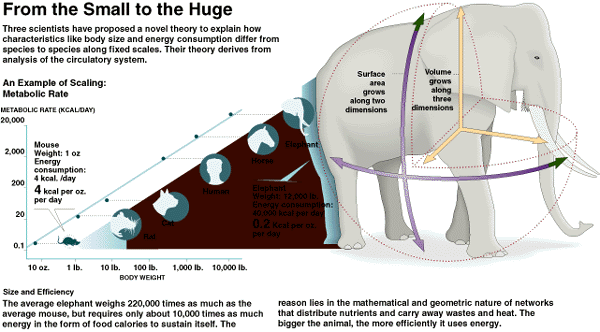
This looks to be the article that belongs to the shot btw:
hep.ucsb.edu/courses/ph6b_99/0111299sci-scaling.html
First, i didn´t read the article linked, just this infography here. Some thinking aloud…
"efficiently": that is a valoration on a fact. The fact is that the bigger the animal the less energy required calculating it under the quotient calorie/gram (or oz.)
I don´t think it is a question of efficiency on energy usage, but simply a cuestion of quality of the proportions… 500 tons of body fat surely don´t require the same energy as same weight of muscle, or nerves, or neurons or whatever… Would you tell me what´s the greatest leap in the body mass composition, from a mouse to an elephant?
And even withtout caring much on the quality of the increase… Doesn´t it happen at all scales and areas/subjects that there is a minimum of resources required to run a certain task or establish an activity or have something done, and once you surpass a critical minimum and reach a certain maximum, then everything added to that figure will almost make no difference in comparison with the resources required?
i.e. a company needs x amount of resources to run with a number of employees. So, say, from 20 employees to 60, each employee makes a considerable difference in the resources the company needs to have them all working. The figures show a difference. But once the company have gotten to deal OK with 60 employees, it takes almost the same resources if it would have to run 90. And even over 90, the difference would be minor in comparison to the first leap from 0 to 20 and from 20 to 60.
Uhmm… perhaps this is not a great example. But think, there are many. Is this exponential or something? You know I am not in this sci business formally. I am just intuitive. It is so clear to me, but I find it so difficult to explain… hope you understand what I mean. And sorry if it is actually very stupid, but I understand it like that at first sight.
jurvetson: I saw that the link wasn’t with the pic itself but I missed your later comment.
That’s the 2nd time you show me that horsey zebra picture 🙂 As for metabolism, zebras and horses are all members of the Equidae family, so yes 😛
(although my GF tells me I eat like a pig, go figure)


Leave a Reply