Canon PowerShot S100
ƒ/2
5.2 mm
1/30
125

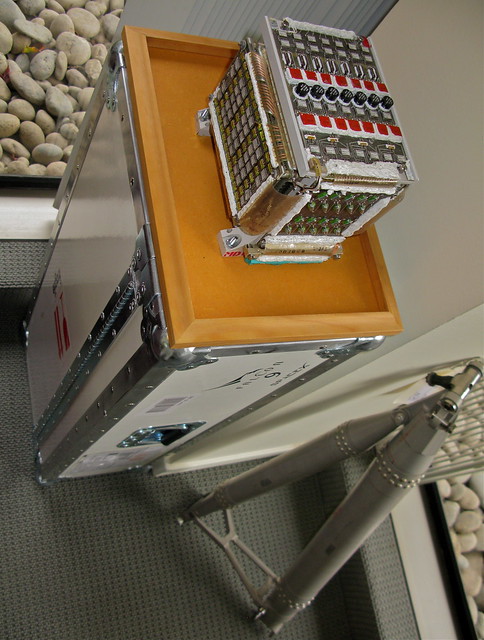
We pulled the core memories into one conference room, and they really look good together.

This was the industry standard for electronic memory before DRAM and SRAM and Flash. Data was stored in the magnetization direction of each ring. It is a non-volatile memory, and relatively immune to radiation and soft errors, much like MRAM today.

Many of the rectangular patches are 4K bits. The early ones were woven by hand, and over the years the iron ring sizes shrank and became tightly woven into an electromagnetic fabric.

10 responses to “Core Memory Room”

  1. some cool details, from the oldest one with the biggest cores, stitched by hand:
    What's That? (5)

    This one has some unusual wiring in the left section:
    Primitive Memories

    Late model (maybe into the 80’s) with a tapestry of tightly woven cores, from a fully automated loom. It’s a huge board with 1.5 Mbits in total:
    Solar Flair

    The core memory planes are typically stacked into a 3D box, like this one from the Apollo flight computer:

    Apollo Lunar Modules

    The magnetic cores within still hold whatever program they had when powered down. Since there are no tapes or archives of the code, it is possible that the only remaining copy of the Saturn V flight program is in cores like this.

    This module holds 114k bits (14 planes with a 128 x 64 fabric of ferrite donuts)… encoding 13-bit instructions, with the first triple-redundant logic. Ultrasonic delay line cache. Destructive readouts. Failure is not an option.

  2. When I was a kid I asked a university computer studies student about how computers worked and he talked about magnetic rings. I never heard about them again until just now.

  3. I am being initiated into the poetry of electronics.

  4. This is a cool display.

    The first computer I operated in the US Navy had ring storage. I can recall seeing the rings and the threaded wires. The computer was a Univac, part of the NTDS system. This was in the early 1970s.

  5. I work for Honeywell, we have a similar display in the halls of my office.

  6. I have seen those fancy core memories, but I was never able to touch them! I started to build electronics projects in the 1990s, of course with totally different memories… 🙂

  7. What I’d like to know is whether the people working with these ever dreamed that one day, we’d have thousands of times the capacity of these great ferrite tapestries on something the size of a little fingernail?

    In 30 years’ time, how clunky will today’s technology seem? That’s what I’m excited to discover.

  8. Thank you for sharing!
    If the hand-stitched pattern is taken to Iran, maybe someone there could weave a distinguished and beautiful Persian rug based on it.

  9. the one from a vcr is probably few vide lines memory to delay lines for sync purposes

Leave a Reply

Your email address will not be published. Required fields are marked *