

Found in Ajdabiya, Libya earlier this year, Jikharra 001 is an impact melt breccia from Vesta, the second largest asteroid in the asteroid belt. At 33kg (73 lbs.), it is also the largest Vesta rock that I have ever seen, at 15″ x 12″ x 10″.
It is an ancient time capsule, older than Earth itself, that embodies a history of incredible violence to Vesta and its ejected material. During the impact of a meteorite, old rocks are broken apart and new rocks are formed. Breccias are rocks composed of fragments of older rocks that have been broken apart and relithified (or “glued” back together) by impacts of meteorites. Impact brecciation results in rock that consists of clasts (rock fragments) of a range of sizes embedded in a matrix of smaller clasts, crystallized impact melt, or glass.
The Vesta breccias are metamorphic because they formed from fragmental material, perhaps several kilometers deep. A large impact occurred that was not direct enough to melt the material but was close enough to “cook” and recrystallize the minerals (thermal metamorphism).
Impact breccias are fractal objects – they look the same regardless of the scale at which you look at them. The clasts have a large range in size. This fractal characteristic differentiates them from terrestrial sedimentary rock clasts whose sizes are nearly all the same.
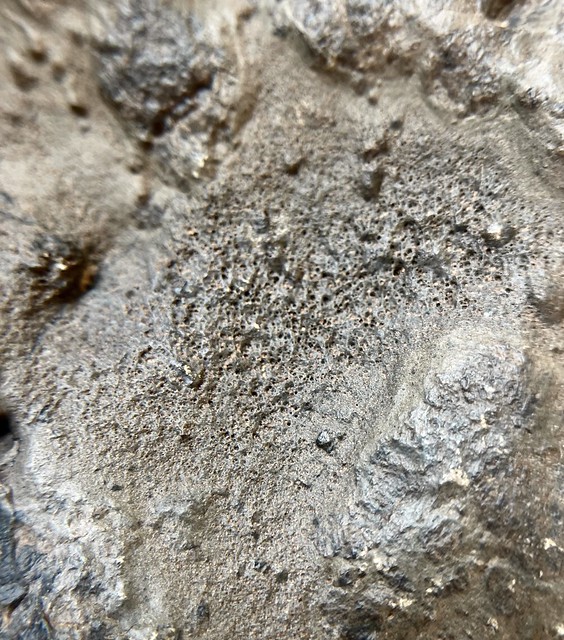
The chaotic turbulence during and after the impact causes hot impact melt to mix with cold rock clasts. The clasts cool the melt, and the melt heats the clasts sometimes to the point where the exteriors melt. This is the only known mechanism that can lead to rare, rounded clasts in impact breccias. Veins of liquid impact melt injected into the space between rock fragments during an impact, which cool quickly to glass, are common in breccias as are vesicles (gas bubbles) that get trapped in impact glass before it solidifies.
Vesta is covered with basalt – the same fine-grained volcanic rock that spews from Hawaiian volcanoes, makes up the dark areas of the Moon, and the huge shield volcanoes on Mars. This eucrite is from the upper crust of Vesta.
4 Vesta accounts for 9% of the mass of the asteroid belt — big enough to provide enough gravity for a differentiated crust, mantle and core, like Earth and Mars, but unlike smaller moons and asteroids. The rocks from Vesta date back to the formation of the Solar System, 4.566 billion years ago (older than Earth itself and very close to the oldest thing you can touch).
Normally, the material deep beneath the surface of a planet stays there, and not even on Earth have we drilled deep enough to sample what is down there.
But Vesta had a colossal collision of planet-busting proportions. It left behind a mountainous crater twice as tall as Mt. Everest and 90% the diameter of Vesta itself. We know this from visual and spectroscopic analysis by the Hubble telescope and, more recently, the by the DAWN spacecraft that orbited Vesta for a year.
About 1 billion years ago, 1% of Vesta’s mass was violently ejected by a high-speed impactor, including several layers of crust (breccias, basalt and igneous rock) and perhaps as deep as the mantle. “Vesta likely came close to shattering,” said DAWN principal investigator Carol Raymond, noting that the blow left concentric sets of fracture lines around Vesta’s equator.
Some of the ejected rock was large enough to become “V-type asteroids” of their own right, and a few of those ended up in an unstable region of the asteroid belt in an orbital resonance with Jupiter, the big boy circling farther out. Every 100 million years, some of the asteroids in that region get ejected out, and a handful of those have been found to have randomly ended up in near-Earth orbits. Those V-type asteroids are subsequently struck by other impactors in multiple events over a subsequent time period of 6-73 million years, dislodging smaller rocks in random directions, a few of which hit Earth. A few of those are large enough to survive the burn of reentry but not so large as to burst into fragments from the impact of hitting the atmosphere at speeds exceeding Mach 32.
From the DAWN mission, we now know that Vesta is the only intact, layered planetary building block surviving from the very earliest days of the solar system, forming within the first 10 million years, long before Earth.
Eucrites are particularly difficult to find in the field as — unlike the vast majority of other meteorites — they contain little or no iron, so will not attract strongly to a magnet. This one is a melt breccia with mixed clasts of both shallow and deep material from Vesta’s crust. A eucrite impact melt is most likely the result of a giant meteorite crashing into asteroid Vesta and melting target rock into a new form.
This meteorite was analyzed by Dr. Ansgar Greshake, meteorite curator at the Museum für Naturkunde in Berlin (MNB):
“Petrography: Achondritic melt breccia composed of several cm-sized lithic clasts set in abundant recrystallized shock melt. Lithic clasts consist of calcic plagioclase and aggregates of fine-grained, 30-70 µm sized pigeonite crystals displaying patchy compositional zoning. The melt matrix is composed of recrystallized pigeonite displaying mottled compositional zoning and fine-grained, mostly fibrous feldspar. Minor phases include silica, Ti-chromite, ilmenite, and FeS. No metallic iron has been detected.”

 A slice from another sample, showing the internal clasts. What a swirl!
 The reason Vesta is one of a kind for cosmic archaeology… You don’t see planet-busting impacts like this very often:
 Another perspective on the H.E.D.’s
 4 Vesta, imaged up close by the DAWN spacecraft which orbited for a year:
 “This mosaic synthesizes some of the best views the spacecraft had of the giant asteroid Vesta. Dawn studied Vesta from July 2011 to September 2012. The towering mountain at the south pole – more than twice the height of Mount Everest – is visible at the [left side] of the image. The set of three craters known as the "snowman" can be seen at the top right.” —
  “One of the goals of the Dawn mission was to test the hypothesis that three specific classes of meteorites were related to Vesta. The elemental data (from Dawn’s GRaND neutron spectrometer instrument) and the spectral data (from its Visual and Infrared spectrometer, VIR) have confirmed the HED connection. In particular, most of Vesta’s surface looks like howardites, which are the type that’s a mixture of the other two. That isn’t surprising; the impact that created Vesta’s south polar basin (actually two overlapping impacts) happened a very long time ago, and more recent impacts have dug into the surface and mixed material around. And gravity data have also confirmed the fact that Vesta is denser toward its center, which is consistent with the differentiation story.” — from
  “For nearly 40 years HED meteorites have been linked to asteroid 4 Vesta because of the very close match in IR and visible spectra between the meteorites and the asteroid. This spectral link was strengthened with the discovery of a dynamic physical link between 4 Vesta and a family of asteroids that can be connected to Earth’s orbit via resonances, such as the 3:1 mean motion resonance with Jupiter and the v6 secular resonance between Jupiter and Saturn. This connection was dramatically strengthened by Hubble Space telescope images that revealed a large 400 km crater in the south pole of 4 Vesta. This enormous crater has been suggested to be the source of the many HEDs that have made their way to Earth.” —


Leave a Reply