

from poetic prose… to watercolor paintings… to high-resolution 3D models .
The cell is a crucible of magical marvels accumulated over millennia. These authors and artists have tried to convey that in various media over time. Perhaps because I am a visual thinker, the richer representations are easier to remember than related text I read many years ago. I’ll share my favorite quotes and images.
Next, we turn to the watercolor paintings of David Goodsell (an eponymous homonym) in The Machinery of Life, first published in 1993. His accurate portrayals belie the simple block diagrams from our grade school textbooks as misleading, much like the spacing of the planets in most solar system representations. Nanomachines also defy our senses and intuition from statistical physics, yet reveal a homologous beauty across structural biology and biochemistry.
“The nanoscale world of molecules is separated from our everyday world of experience by a daunting million-fold difference in size, so the world of molecules is completely invisible. I created the paintings in this book to help bridge this gulf and allow us to see the molecular structure of cells.”
“Cells are small, crowded places with many things happening at once” (25)
“Cells live in a world of thick viscous water, almost oblivious to gravity.” (65)
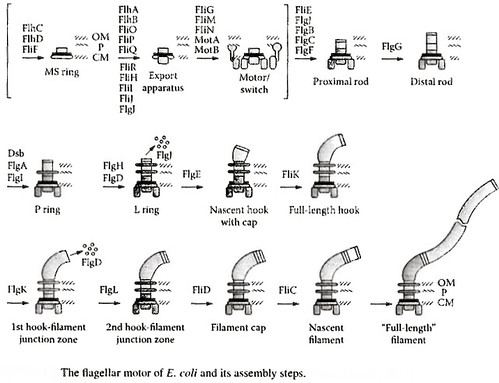
The images below in the comments feature the common gut bacteria E.Coli and its rotary motors:
“E.Coli cells swim using long corkscrew-shaped flagella, which act like propellers. The cells push through water typically moving 10-15 cell lengths/second. But when they stop turning the flagella, they don’t keep coasting along the way a ship or submarine would. Instead, the surrounding water instantly stops them in less than the diameter of a water molecule!
The flagellar motor is one of the wonders of the biomolecular world. The motor spans the entire cell wall, rotating at speeds of up to 18,000 RPM. Each rotation is powered by the flow of 1000 hydrogen ions across the inner membrane. Amazingly, the motor can turn the flagellum in either direction on demand. When it turns in one direction, all of the flagella get tangled into a bundle, and together they propel the cell through the surrounding water. If the motor switches direction, however, the flagella separate and flail in different directions, causing the cell to stop and tumble in place.” (65)
Before modern imaging, we have the poetry of Lewis Thomas, The Lives of a Cell, originally typed in 1973. The cover is but a sketch, the pages sculpted prose:
“Once you have become permanently startled, as I am, by the realization that we are a social species, you tend to keep an eye out for the pieces of evidence that this is, by and large, good for us.” (58)
“My mitochondria comprise a very large proportion of me. I cannot do the calculation, but I suppose there is almost as much of them in sheer dry bulk as there is the rest of me. Looked at in this way, I could be taken for a very large, motile colony of respiring bacteria, operating a complex system of nuclei, microtubules, and neurons for the pleasure and sustenance of their families, and running, at the moment, a typewriter.” (72)
“Inflammation and immunology must indeed be powerfully designed to keep us apart; without such mechanisms, involving considerable effort, we might have developed as a kind of flowing syncytium over the earth, without the morphogenesis of even a flower.” (10)
“The genes for the marking of self by cellular antigens and those for making immunologic responses by antibody formation are closely linked. It is possible that antibodies evolved from the earlier sensing mechanism needed for symbiosis, to keep the latter from getting out of hand.” (41)
“Pathogenicity is not the rule. Indeed, it occurs so infrequently and involves such a relatively small number of species, considering the huge population of bacteria on the earth, that it has a freakish aspect. Disease usually results from inconclusive negotiations for symbiosis, an overstepping of the line by one side or the other, a biologic misinterpretation of borders.” (76)
“We tear ourselves to pieces because of symbols, and we are more vulnerable to this than any host of predators. We are, in effect, at the mercy of our own Pentagons, most of the time.” (80)
“The capacity to blunder slightly is the real marvel of DNA. Without this special attribute, we would still be anaerobic bacteria and there would be no music.”
It reminds me of Juan Enriquez’s definition of life: the imperfect transmission of code.
“The nature of biologic information not only stores itself up as energy but also instigates a search for more. It is an insatiable mechanism.” (93)
“Ambiguity seems to be an essential, indispensable element for the transfer of information from one place to another by words, where matters of real importance are concerned. It is often necessary, for meaning to come through, that there be an almost vague sense of strangeness and askewness. Speechless animals and cells cannot do this. Only the human mind is designed to work in this way, programmed to drift away in the presence of locked-on information, straying from each point in a hunt for a better, different point.
“If it were not for the capacity for ambiguity, for the sensing of strangeness, the words in all languages provide, we would have no way of recognizing the layers of counterpoint in meaning, and we might be spending all our time sitting on stone fences, staring into the sun. To be sure, we would always have had some everyday use to make of the alphabet, and we might have reached the same capacity for small talk, but it is unlikely that we would have been able to evolve from words to Bach. The great thing about human language is that it prevents us from sticking to the matter at hand.” (95)
“It is in our collective behavior that we are the most mysterious. We won’t be able to construct machines like ourselves until we’ve understood this, and we’re not even close. All we know is the phenomenon: we spend our time sending messages to each other, talking and trying to listen at the same time, exchanging information. This seems to be our most urgent biological function; it is what we do with our lives. All 3 billion of us are being connected by telephones, radios, television sets, airplanes, satellites, harangues on public-address systems, newspapers, magazines, leaflets dropped from great heights, words got in edgewise. We are becoming a grid, a circuitry around the earth.” (112, this was written in 1973, before the internet)
“Although we are by all odds the most social of all social animals, we do not often feel our conjoined intelligence.” (14).
“Science is instinctive behavior. You can measure the quality of the work by the intensity of astonishment.” (102, 119)
“Individual organisms might be self-transcending in their relation to a dense society.” (128)
“It is permissible to say this sort of thing about humans: they do resemble, in their most compulsively social behavior, ants at a distance. It is, however, quite bad form in biological circles to put it the other way round, to imply that the operation of insect societies has any relation at all to human affairs.” “Ants are so much like humans as to be an embarrassment.” (11)
“It is from the progeny of this original parent cell that we take our looks; we still share genes around, and the resemblance of the enzymes of grasses to those of whales is a family resemblance. The viruses, instead of being single-minded agents of disease and death, now begin to look more like mobile genes. Evolution is still an infinitely long and tedious biologic game, with only the winners staying at the table, but the rules are beginning to look more flexible. We live in a dancing matrix of viruses; they dart, rather like bees, from organism to organism, from plant to insect to mammal to me and back again, and into the sea, tugging along pieces of this genome, strings of genes from that, transplanting grafts of DNA, passing around heredity as though at a great party. They may be a mechanism for keeping new, mutant kinds of DNA in the widest circulation among us.” (5)
“Our cilia gave up any independent existence long ago, and our organelles are now truly ours, but the genomes controlling separate parts of our cells are still different genomes, lodged in separate compartments; doctrinally, we are still assemblages.” (125)
“It is illusion to think that there is anything fragile about the life of the earth; surely this is the toughest membrane imaginable in the universe, opaque to probability, impermeable to death. We are the delicate part, transient and vulnerable as cilia. Nor is it a new thing for Man to invent an existence that he imagines to be above the rest of life; this has been his most consistent intellectual exertion down the millennia. As illusion, it has never worked out to his satisfaction in the past, any more than it does today.” (3)
“We should credit the sky for what it is: for sheer size and perfection of function, it is far and away the grandest product of collaboration in all of nature. It breathes for us, and it does another thing for our pleasure. Each day, millions of meteorites fall against the outer limits of the membrane and are burned to nothing by the friction. Without this shelter, our surface would long since have become the pounded powder of the moon. Even though our receptors are not sensitive enough to hear it, there is comfort in knowing that the sound is there overhead, like the random noise of rain on the roof at night.” (the closing paragraph, 148)


 and the latest work from the Scripps lab.


Leave a Reply