

This slice was made by others, but it best reveals what lies within my 2kg Martian stone.
My focus is on the vesicles that riddle the darker shock-melt areas. These are trapped pockets of Martan atmosphere, preserved for 175 million years, and brought to Earth by meteorite strike — a sample return for free! This time capsule contains air that has been shown in analysis of similar meteorites to match the noble gas isotope signature measured by the Viking landers in 1976. The early Martian atmosphere was much thicker, warmer and wetter than it is today, possibly even capable of sustaining life.
From meteorite hunter Michael Farmer: “Not many Martian’s have any measurable atmosphere. Not enough vesicles in most.”
In this study of trapped Martian gasses, DaG 1037 provided the most data for their models:
“DaG 1037 shows the most complex distribution of shock‐melt pockets and veins, and consequently the most complex cooling history. This meteorite sample contains abundant pockets that vary in size and spatial distribution, in addition to a 1 mm wide vein cutting across the entire sample.”
As for how the gas gets there: “Shock recovery experiments have demonstrated that hypervelocity impact provides a viable mechanism for implanting a sample of ambient gases in melts produced during shock, without elemental or isotopic fractionation. This results from diffusion in a high‐pressure environment. The high‐pressure gas would diffuse into the locally molten regions of the meteorite (shock melts).
These studies show that Martian atmosphere, traced using 40Ar/36Ar as an isotopic fingerprint (as measured by Viking landers), is specifically sited within the shock melts.
Shock metamorphism is ubiquitous among all meteorites. However, the shock history of Martian meteorites is very different from those meteorites (e.g., chondrites) derived from small planetary bodies. Most chondrites are breccias, reflecting multiple‐impact processing within the asteroid belt early in the history of the solar system. In contrast, most Martian meteorites are coherent igneous rocks that have been strongly shock metamorphosed but not brecciated.”

 And the other areas of grey impact melt:
 From the study referenced in the caption: "Fig d) The contact between the mm‐size shock‐melt vein in the DaG 1037 and the basaltic host rock. Reaction textures and diffusive exchange between neighboring igneous minerals are observed within a zone approximately 500 μm from the shock vein/host rock contact."
 And a graph of their finite element modeling of cooling times for the vesicles in DaG 1037:
 "DaG 1037 shows the most complex distribution of shock‐melt pockets and veins, and consequently the most complex cooling history (Fig. 2). This meteorite sample contains abundant pockets that vary in size and spatial distribution, in addition to a 1 mm wide vein cutting across the entire sample."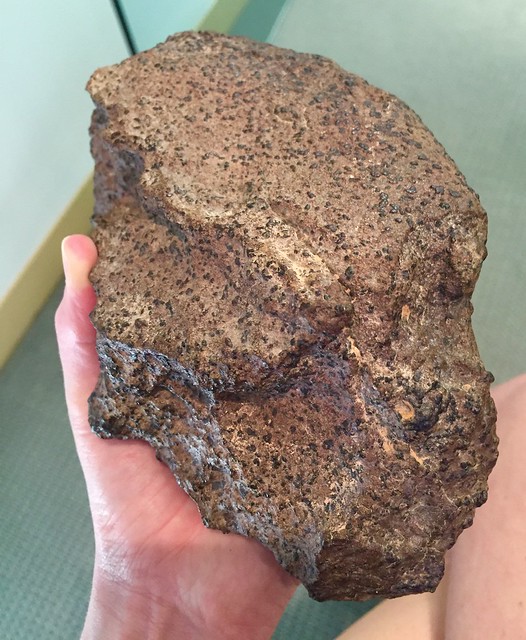
Leave a Reply