DMC-FX100
ƒ/2.8
6 mm
1/30
100

I just finished the Walter Isaacson biography that I started 10 years ago, and it is fascinating to reflect on some of Steve Jobs’ pronouncements in his final year, 2011.

“I think the biggest innovations of the twenty-first century will be the intersection of biology and technology. A new era is beginning, just like the digital one was when I was my son’s age.” (539) [I would agree]

To Rupert Murdoch: “You’re blowing it with Fox News. The axis today is not liberal and conservative, the axis is constructive-destructive, and you’ve cast your lot with the destructive people. Fox has become an incredibly destructive force in our society. You can be better, and this is going to be your legacy if you are not careful.” (508) [ouch!]

“For a computer to be truly great, its hardware and its software has to be tightly linked.” (137)

Walter: “I asked him to name another company that made great products by insisting on end-to-end integration. He thought for a while, trying to come up with an example. “The car companies,” he finally said, but then he added, “Or at least they used to.” (556)
[This was the year before the Tesla Model S first shipped, reviving that model]

“Taking LSD was a profound experience, one of the most important things in my life. LSD reinforced my sense of what was important — creating things instead of making money, putting things back into the stream of history and human consciousness as I could.” (41)
[Jobs was an OG evangelist, before psychedelic medicine mainstreams it. Side note: the book index and a search for LSD in Google Books produces four results. He actually mentions it no less than 12 times in the book]

“We tried to help Intel, but they don’t listen much. We’ve been telling them for years that their graphics suck.” (493) [For the past 10 years, NVIDIA has owned the vanguard of Moore’s Law, supplanting Intel. 125-year graph here]

Advice to Larry Page when he took over as CEO of Google: “We talked a lot about focus. Figure out what Google wants to be when it grows up. It’s now all over the map. What are the five products you want to focus on? Get rid of the rest because they are dragging you down. They’re turning you into Microsoft.” (552) [the winnowing began soon afterward]

“Hewlett and Packard built a great company, and they thought they left it in good hands. But now it’s being dismembered and destroyed. It’s tragic.” (559) [I worked there too. Sad to watch]

“I have my own theory about why decline happens at companies like IBM or Microsoft. The company starts valuing the great salesmen, because they’re the ones who can move the needle on revenues, not the product engineers and designers. So the salespeople end up running the company. It happened at Apple when Sculley came in, which was my fault, and it happened when Ballmer took over at Microsoft. Apple was lucky and rebounded, but I don’t think anything will change at Microsoft as long as Ballmer is running it.” (569) [Nailed it. When promoted from sales to CEO, Ballmer quadrupled revenue but drove >30% decline in market value while Apple grew 2000% in the same period. Then Satya took over in 2014 and Microsoft’s market value went up 6x]

“You should never start a company with the goal of getting rich. Your goal should be making something you believe in and making a company that will last.” (78) [total agreement]

“Great art stretches the taste; it doesn’t follow tastes.” (128)

iPhone: “Think of all the innovations we’d be able to adapt if we did the keyboard on screen with software. Let’s bet on it , and then we’ll find a way to make it work… By having software replace hardware, the interface became fluid and flexible.” (469) [value migrated to the SW stack]

“IBM was essentially Microsoft at its worst. They were not a force for innovation; they were a force for evil. They were like ATT or Microsoft or Google is.” (136) [ouch!]

“Until the teachers’ unions are broken, there is almost no hope for education reform. Teachers should be treated as professionals, not as industrial assembly-line workers. Principals should be able to hire and fire them based on how good they are.” (545)

“I know what I am talking about, and I usually turn out to be right.” (569)

“A lot of us want to contribute something back to our species and to add something to the flow. It’s strange to think that you accumulate all this experience, and maybe a little wisdom, and it just goes away. So, I really want to believe that something survives” (571) [I believe we all seek symbolic immortality]

I’ll add some comments below from my experiences at Apple, NeXT and Pixar as well as the eulogy I wrote for BusinessWeek.

9 responses to “Steve Jobs’ pride and prophesies — 10 years on”

  1. I grabbed this screen shot of the Apple home page on the day of his passing — Oct 5, 2011Walter’s book came out 19 days later, with the exact same photo of Jobs.

    “The right kind of building can do great things for a culture.” (p.430)PIXAR Greeting PartyFor the PIXAR animation studios, Jobs was adamant about central atrium and bathroom placement to promote spontaneous meetings and random encounters. I took this photo in 2010, the year before his passing. Such a fun work environment… and reverie for me… I interviewed with John Lasseter at the old PIXAR facility back in 1994 when Jobs did not want me to leave NeXT, and so he introduced me to the extended family. I did not appreciate the unbridled talent of the person sitting across from me at the time.

    From the President of Pixar in 2014, Ed Catmull
    DSC00827
    “I had a good relationship with Steve, but we didn’t want him there full time. He was really good part time, because he faced outward, and let us figure out how to make this movie.”

    Another photo I took as he was receiving the Entrepreneurial Company of the Year award at the Stanford GSB, 2005.Entrepreneurial Company of the Year - Apple and Steve Jobs I was on the nomination committee and knew this was where he first met Laurene Powell Jobs.

    He bubbled with pride when asked about the cultural impact of the iPod: “People are listening to more music. Millions of people have rediscovered the joy of music.”

    “When I repeatedly read the word ‘beleaguered’ next to ‘Apple’ in the press, it was painful. Physically painful.”

    The following month, Jobs gave his famous commencement speech at Stanford.

    It was a great honor to reflect on his symbolic immortality for BusinessWeek. My eulogy came out just before Walter’s book, and here a passage I wrote that resonates:

    Jobs was the master architect of Apple design. Often criticized for bouts of micromanagement and aesthetic activism, Steve’s spartan sensibilities accelerated the transition from hardware to software. By dematerializing the user interface well ahead of what others thought possible, Apple was able to shift the clutter of buttons and hardware to the flexible and much more lucrative domain of software and services. The physical thing was minimized to a mere vessel for code.

    Again, this came naturally to Jobs, as it is how he lived his life, from sparse furnishings at home, to sartorial simplicity, to his war on buttons, from the mouse to the keyboard to the phone. Jobs felt a visceral agitation from the visual noise of imperfection.

    My full eulogy is here What was NeXT

    Jobs attracted the best people and motivated them to do better than their best, rallying teams to work in a harmony they may never find elsewhere in their careers. He remains my archetype for the charismatic visionary leader, with his life’s song forever woven into the fabric of Apple.

    Jobs now rests with the sublime satisfaction of symbolic immortality.

    It was daunting to reflect on such a great man, from a refined set of exposures… but he was my childhood hero, and I convinced him to let me do a study of his management style while a lowly employee at NeXT. Nevertheless, I wondered if I captured his essence in those years of exile from Apple. So, I was floored when the BW editor wrote back "I think this piece is one of the best things I have ever read about Steve." Original unedited version here.

  2. From the archives… Here is a 1993 video interview with Jobs about Paul Rand and the design of the NeXT logo. This was right before I first met him and went to work for NeXT. Looking at the interview format, it is amazing to me how Jobs formulates such wonderfully sculpted prose on the fly. No sentence fragments. Complex sentences that one might read in a book, not impromptu speech. One might expect this of Jobs in his heavily prepared auditorium-based demagoguery, but the interview format shows how he can do it in everyday conversations.

  3. I read Isaacson’s Jobs biography in a few days eight years ago in an e-book edition – an interesting book about a fascinating entrepreneur. It would be interesting to hear what Jobs thought about the latest tech boom, which seems to have been triggered by the pandemic, and – channeling his remarks about car companies – the media and market excitement about a prospective move by Apple into EV’s. (America definitely doesn’t seem to value its mainstream automakers as much as its tech companies, despite the amount of tech that goes into their manufacturing today.) There do seem to be some parallels between him and Musk, and not just in the fact that they weren’t traditional establishment figures.

  4. A side-note on an aspect of Jobs’ evolution as a creative manager that no one talks about: the influence of Walt Disney and the incredible culture of collaborative design Walt invented in the animation and film groups at the studio. I was a Walt fanatic from early childhood (his spirit and art, not the Disney-fan-mania, not the parks, and certainly not the merchandising). By utterly random coincidence, after a job I moved from Manhattan to LA for with Orion Pictures collapsed due to a studio-head coup, I fell into an opportunity in the just-being-reborn Disney Feature Animation group in Burbank. Pay cut, demotion in responsibility, not live-action film (where my heart and experience was), but, I needed money, the job ("starting tomorrow") was as an assistant to the production managers on a "just going into full production" film called Beauty and the Beast (the original hand animated feature released in 1991), and, during the interview, I learned they had the largest Mac network in the world at that time (very cool, I was a Mac fanatic too), they were pioneering CGI with the eventually Oscar winning CAPS (Computer Animation Production System), they were writing seminal CGI code on a small NEXT network and using Softimage, Wavefront and Pixar Renderman to ramp the first CGI scenes ever in a Disney animated feature (super cool), the music was being written by Howard Ashman and Alan Menken (I had no idea who these guys were but would soon learn of their genius) and the huge production crew led by Producer Dan Hahn and Directors Gary Trousdale and Kirk Wise, was like some rebel force housed off-lot near the WED/Imagineering facility on the old Glendale Airport grounds (this start-up-inside-the-empire tone was immediately apparent on entering the building and incredibly appealing to me). When I drove up to the bleak building entrance at 1400 Air Way, shrouded in early summer "valley" air pollution, I was sure I was never going in that building again, but…the spirit in the building was INTENSE, all the people I met were inspired, and…long story short, I took the job thinking I’d be there for a month or two and ended up staying for ~4 years during which Jeffrey Katzenberg, Roy Disney, and the incredible teams of artists & managers there put Disney Feature Animation back at the top of the world with Beauty, Aladdin and The Lion King. The story of those films and their development and production is CRAZY, but, the point here, is that within a few weeks of being there, I realized I was witnessing an INCREDIBLE SYSTEM OF COLLABORATIVE CREATION, utterly different than the "auteur" mode seen on most live-action feature films (where a single screenwriter, producer and director pretty much dictate/control the story top-down). At Disney Animation, the story was evolved forward by a comparatively huge group of contributors: a large team of story artists who produced story board drawings (and original dialogue) faster than most people can write, screenwriters, the directors, executives (especially Jeffrey and Roy D.), the producer, gag-consultants, background painters, creative directors, layout designers, a full-time editorial crew, the lyricist…through hundreds of "story" meetings where the "boards" are pitched and re-pitched, refined, reviewed, pitched again, shot on film, paired with temporary voice recordings, screened in theater, until honed to perfection. And then the real-voice talent (e.g. Robin Williams as the Genie) make their contribution and the lead animators take everything given to them and breathe life into it, often adding their own story ideas along the way. The fast iteration and "check your ego at the door" collaboration, driving a VIRTUOUS, FAST design cycle was BREATHTAKING to witness. It was my MBA in creative/design management – and the process was invented by Walt. Somewhere during the production of Beauty, Steve Jobs (who had purchased Pixar from Lucasfilm) came down and gave us an evening lecture (attended by a mere ~20 people as I remember) in the Disney lot main mixing theater showing off the latest version of his NEXT OS. He was ebullient about the new software, and also, obviously enchanted by the Disney heritage and very proud to have Disney as a NEXT customer. Cut to a few years later…I’m in San Francisco working in "start-ups" related to gaming and what became the very early Internet. I run into a bunch of folks at Colossal Animation who tell me Pixar is going to try to make a feature animated movie based on the Luxo short. Over the next year as the Internet world goes thermo nuclear, I hear good things through the animation network about what’s happening at Pixar with John Lasseter at the helm under Jobs. I’m trying to bring the Disney collaborative management style I learned at Feature Animation to the start-ups I work at (especially storyboarding as mode of rapid prototyping, fast iteration via team meetings around UI designs and process flows), and am thinking, "you know, Steve J. is probably getting a direct dose of the Disney mode from Lassiter (who started at Disney) and if he absorbs it, he could really turn into the renaissance-product-exec he aims to be. 1995 saw the IPO of Netscape and the release of Toy Story, which was an instant total and mind-blowing breakthrough. My sense was: Jobs has learned. He must have picked up the value of this mode. He returned to Apple one year later (1996) with a focus and zen-like team-leader ability that was light years beyond his early bombastic, troubled-genius style. As they say, the rest is history, including the eventual sale of Pixar to Disney making him the largest Disney share holder. It’s a hunch, because I never got to speak to him about it, but I’d be willing to wager, there is very deep story about what Steve learned from the Disney collaborative mode and how it was incredibly important, not only to the amazing success of Pixar, but also the rebirth and triumph of Apple after his return.

  5. ps: while I was at Disney, an MBA consultant hired by an exec there determined that the only product more complex (e.g.with more custom designed parts) than a Disney hand-animated feature film was a 747 jet. I have no idea if that’s totally legit, but it certainly shows the scale of these creations which depend on the creative input of multiple hundreds of key contributors.

  6. As you point out talking about sales above, in the present, nearly every business seems to be entirely focused on spreadsheets and financial elements. The same for non-profits and healthcare. Organizations are chopped into small pieces and managers must meet financial objectives or lose their jobs. There’s very little systems thought, as Jobs advocates, where someone looks at quality and customer experience end-to-end. Consider AT&T, WalMart, or Stanford University during their current financial crisis, as organizations focused entirely on cash flow. I think Tesla may have it right. Read this keeping in mind that I couldn’t run a successful roadside lemonade stand.

  7. thanks for sharing that insider perspective. It’s also interesting that Jobs plowed around half of his total proceeds from Apple going public into Pixar… and when Pixar went public, as an 80% owner, he made 5x as much as he did in the Apple IPO.

    Here’s an archive photo I have from the Apple IPO party I found this photo on my drive with no idea where it came from, but it prompted me to look up the IPO prospectus for Apple, and I noticed the executives on p.21:
    • Markkula, the first investor and Apple President
    • Jobs as Vice President
    • And Peter Crisp

    On my first week on the job as a newbie VC in 1995, we were on the road to New York to fund raise. We had $26M under management (tiny for our business), and we were meeting with our cadre of current investors, one of whom was Peter Crisp of the Rockefeller family and Venrock funds. I did not know of his Apple connection at the time, but I vividly remember his words to me: he said that he envied us and wished he could be reentering the venture business as a young man (this was just before any hint of an Internet boom)… and he had one piece of advice for me. Looking back from the vantage point of great success, he wished that he had never sold. He realized that for all the temporal gain of market timing, he missed the sea change of history. I have never forgot that, and have not sold a single share of my VC investments. I want to see how that turns out versus the common wisdom to “diversify”… but frankly, even though it seems to be the better strategy so far, it is so much more satisfying to not have to double guess when you should stop believing.

    Which brings me to another peculiar detail of that Apple prospectus. I heard from another VC that Sequoia disposed of all of their shares in Apple before the IPO. That is so unusual that I had to check, and I could not find any mention of them in the prospectus. In any case, they did help finance the company in a critical period… but like Peter Crisp, who sold long after the IPO, they probably wish they had kept the faith.

  8. Oh, my Mac keyboard is also in the bookThe From the NYT coverage of it, Woz wrote to me on Facebook:

    "You may well have the only Apple device with both our signatures on it."

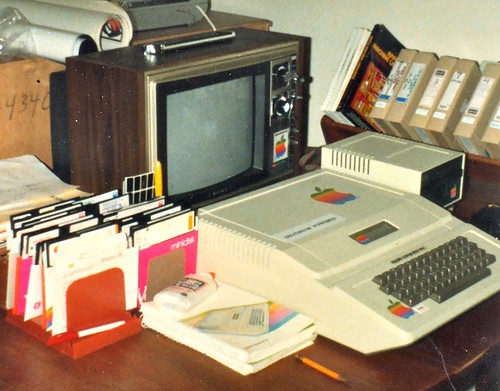
    And my Dad found this vintage photo of my precious Apple ][my first computer

Leave a Reply

Your email address will not be published. Required fields are marked *