A wafer of 10’s of thousands of flexible electrodes, each much smaller than a hair, and manufactured monolithically. Presented by Vanessa Tolosa, head of Neural Interfaces at Neuralink.
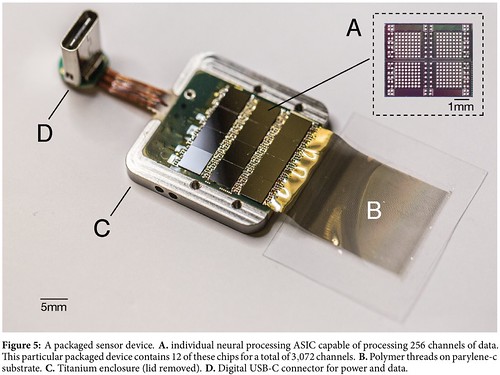
and packaged in a sensor, from their White PaperHere you see 3K channels of data consuming just .7W
"The density of recording channels necessitates placing the signal amplification and digitization stack within the array assembly, otherwise the cable and connector requirements would be prohibitive. This recording stack must amplify small neural signals (<10 μVRMS) while rejecting out-of-band noise, sample and digitize the amplified signals, and stream out the results for real-time processing—all using minimal power and size.
The electronics are built around our custom Neuralink application specific integrated circuit (ASIC), which consists of 256 individually programmable amplifiers (“analog pixels”), on-chip analog-to-digital converters (ADCs), and peripheral control circuitry for serializing the digitized outputs. Each analog pixel consumes 5.2 μW and the whole ASIC consumes ∼6 mW, including the clock drivers."
And woven in the brain and some historical achievements on the long road
You gotta love: "These devices are further supported by a software ecosystem that allows for plug and play usability with zero configuration: neural data begins streaming automatically when a cable is connected."
Leave a Reply