iPhone 6
ƒ/2.2
4.15 mm
1/20
250

Filming a fireside chat in my office and a little tour of the space artifacts all around — video.

In our discussion, Andy & I have a “Bill & Ted moment” when we realized that both of us have a passion for astronaut John Young. And although my verbose ramblings had to be edited for brevity, the discussion led me to believe that humanity will create a rich ecosystem on Mars; we will not import it. Each planet can serve a genetic data vault backup for the other, but we will only share humanity and a few special species (cats perhaps) across the worlds. It is much more likely that we will direct the rapid of evolution of microbes and plants in-situ, and consider “invasive species” imports after a terraformed ecosystem is well underway.

This sparked a Reddit discussion on Martian life forms, remote syn bio, and possible panspermia.

OUr discussion was also summarized in a Space,com article.

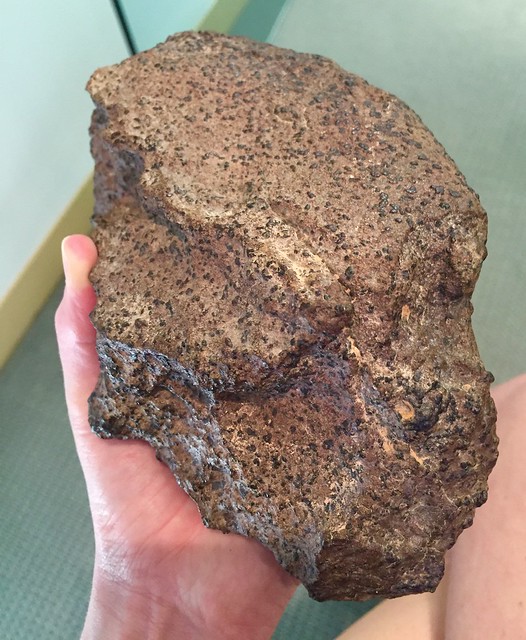
It was a special honor to hand Andy his first rock from Mars. Subsequently, I helped him get one of his own.

The latest arrival, in the red frame, is a production engine from the Mars Viking spacecraft program used for the first landing on Mars. Seemed topical! His book is in production to be a movie by Ridley Scott with Matt Damon as the Martian.

Constructed from Beryllium, Columbium, and stainless steel by North American Rockwell/Rocketdyne, the engine provided propulsion to take the Mars bound orbiter with its attached lander to Mars and an orbital insertion around the planet. The engine was produced by Rocketdyne for the Jet Propulsion Laboratory (JPL) and includes gimbal attachments which allowed the engine to be adjusted on a rotational axis for in-flight course corrections. It’s beryllium thrust chamber was derived from the Minuteman ballistic missile program.

NASA sent two Viking spacecraft to Mars in the summer of 1976, and each comprised of an orbiter, which photographed the surface, and a lander, which studied the surface and conducted several experiments. The whole spacecraft orbited the planet for approximately one month, using the images relayed back to mission control to identify a landing site. The landers then separated and soft landed on the Martian surface, touching down in July and September of 1976.

4 responses to “Andy Weir, author of The Martian, holds a Mars rock for the first time”

  1. Andy’s first exposure to my office turned studio… IMG_1703(full size) They had to keep adjusting the lights as we were experiencing a partial eclipse (which I captured with my pocket camera)

    Mars rockThe second-largest Mars rock in private hands, Dar al Gani 1037Close up of my RS2101 H4129-L61872373 More details from Spaceaholic: this bipropellant engine is fed by a hypergolic mixture of Nitrogen Tetroxide & Monomethylhydrazine (N204/MMH); these hypergolics increased engine reliability as the constituent propellants ignited on contact when applied through the injector plate into the thrust chamber, eliminating the requirement for a separate ignition source. Screen Shot 2014-09-26 at 9.06.35 AM Screen Shot 2014-09-26 at 9.01.46 AM The engine was utilized to provide midcourse trajectory corrections while the Viking was enroute to Mars and executed the orbital insertion and orbit trim maneuvers of the Orbiter/Lander spacecraft upon arrival at the red planet. Orbital insertion of Viking 1 required a long engine burn-38 minutes of thrust, which consumed 1063 kilograms of propellant, slowing the spacecraft from its initial approach speed of 14400 kilometers per hour (8948 MPH) to 10400 kilometers per hour (6462 MPH). To bring the spacecraft to the proper point at periapsis (1511 Kilometers/939 miles above the planets surface), the spacecraft was placed in a long, looping 42.6-hour revolution of the planet, reaching first periapsis; orbital apoapsis was ultimately trimmed to 32800 Kilometers (20,381 Miles above the Martian surface).

    The primary objectives of the Viking orbiters were to transport the landers to Mars, perform reconnaissance to locate and certify landing sites, act as a communications relay for the companion landers, and to perform their own scientific investigations. The orbiter, loosely based on the earlier Mariner 9 spacecraft, was an octagon approximately 2.5 meters in diameter. The total launch mass was 2328 kg, of which 1445 kg were propellant and attitude control gas.

    The Gimbal Ring assembly supported up to 9 degrees off-axis nozzle positioning for thrust vectoring (spacecraft steering): Screen Shot 2014-09-26 at 9.07.19 AM

  2. The first teaser for the Ridley Scott film just came out. Very exciting!

    A comment I wrote on the spacex subreddit: Earth and Mars continue to share a ton of material each year.
    Having just watched Interstellar, I am reminded of something I wrote some time ago:
    “The stars are not for man, that is, not for biological humans 1.0” — Sir Arthur C. Clarke
    Certainly for interstellar travel, we would send the data, not the DNA. The timeframes and radiation exposure make the transmission of tissue a pointless paper exercise. This is unfortunate, of course, to all of our dreams of exploration, using the bodies we are so accustomed to today. But, technology will advance. Today, we could already “send the data not the DNA” for microbial life transmission, purposeful panspermia if you will. (And perhaps that’s what seeded our oceans on Earth).
    We would send robotic probes to the distant stars, with the precursor chemicals for a synthetic biology rig to assemble the DNA locally, ideally incorporating feedback about the local environment (food, shelter, clothing for the microbes if you will, given what kind of world we have found with a planet/moon-picking optimizer using remote sensing before landing). The biological matter compiler, would insert the DNA into zombie cells (lacking any DNA, and relatively immune to soft errors from prolonged radiation exposure during the trip) and off they go. So the long trip to the distant system would contain inert chemicals and no physical DNA that needs protection, and no biological life needing food and breeding over the eons. We can protect the data more easily than the biology.
    I have been meaning to share the story of a conversation I set up between Craig Venter and Scott Hubbard (who led NASA’s Mars program, and before that, NASA’s astrobiology program). It was fascinating. The Mars program has been focused on a long series of steps to prepare for a “sample return” from Mars, to bring back putative signs of life for analysis here on Earth. This material return is quite expensive (just like the moon missions, sending a probe to the moon is a fraction of the complexity and cost of bringing a spacecraft back).
    So Craig’s idea is to do a sample return without the complexity of a return flight and the cost of escaping the Martian gravity well.
    We would send a gene sequencer to Mars, modified perhaps for a wider range of nucleic acids (but some argue that the RNA and DNA set may likely be conserved across the solar system based on theories of the timing and continuity of panspermia, with a ton of material still transferring naturally between Earth and Mars every year).
    So the sequencer would be on a robotic rover (which may be a cave diver or drill probe to get to the likely zone of life. Like Earth, most of the living biomass would be a fair bit underground).
    And, for those who worry that we might discover a castaway microbe from Earth, the answer is fairly simple, if it’s indigenous to Mars, it will live in a colony, and there will be many of them. If it came from Earth, it is very unlikely to propagate into a colony in the local environment (and if it did, that would be a fascinating discovery in its own right, offering a harness for biological terraforming of the abundant CO2 to oxygen).
    With the discovery of microbes (living or potentially even deceased), we would sequence locally, and beam the data back to Earth.
    On Earth, we could study the data, which would be fascinating in its own right. But Venter would take it a step further and boot up a living cell with the Martian DNA here on Earth. We can easily synthesize the physical DNA with just the data. Venter has already demonstrated that this “genetic alchemy” is possible, by removing 100% of the DNA from a microbe, replacing it with a foreign bolus, and converting the cell into the foreign species — a free-living organism that created a trillion offspring. He can print to life, and the software creates its own hardware. So this would be a living sample return. We could call it the Andromeda Strain.

    P.S. Speaking of the Reddit discussion on Martian life forms, remote syn bio, and possible panspermia… here is the latest arrival to the space museum: the Viking biological test instrument: The first machine to test for life on Mars, the Viking flower more

  3. Why ruin Mars with cats? 😉

  4. I hear cats feel earth is ruined with cat-haters.

Leave a Reply

Your email address will not be published. Required fields are marked *