Canon EOS 5D Mark II
ƒ/9
16 mm
1/320
100

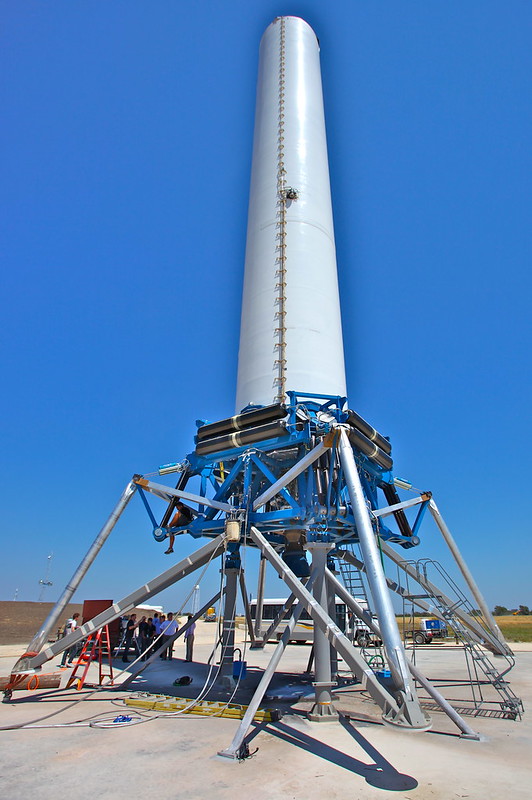
Imagine you threw away the jet after each flight. Flying would be expensive and impractical for most common applications. Same with rockets. To lower cost another 100x, they need to be fully reusable.

This Grasshopper is a software testing rig, for tuning the flight control algorithms. It will begin with simple hops across the landscape.

16 responses to “SpaceX Grasshopper”

  1. the whole enchilada
    IMG_5523

    You are like grasshopper
    IMG_2150

    I had to climb up a bit
    IMG_5562
    as Elon peers into the gimbaled test engine (here’s what they look like when lit — video)

    Seen from a distance, atop the F9 test tower (Grasshopper looks a bit like a bacteriophage):
    IMG_5620

  2. When are they going to fly it?

  3. Imagine hopping from asteriod to asteriod wit h this machine, BTW they oughta use this tech to make the Mars SKYCRANES soft land after there job lowering the payload, seems like a waste of machine and they can use it as a beacon or something else

  4. how do you control roll? – i cant see any rcs nozzles

  5. The flight article will have other thrusters
    (to flip the airframe for example, as they show in this animation)

    bike-R: Yeah, and the primary purpose is to be able to refuel and fly again.

    trent: stay tuned… =)

    P.S. I notice quite a bit of interest from Reddit today.

  6. @Steve Jurvetson Speaking of reusability, do you know how the Falcon Heavy’s center core stage is planned to be recovered? The side cores and upper stage seem obvious enough, but the FH center core will be going pretty fast and far from the launch site after upper stage separation, and I can’t see it boosting all the way back to the Cape without losing a LOT of payload. Would it either land on a barge in the middle of the Atlantic or (and this sounds a bit crazy) boost forward into low-Earth orbit and use a heatshield to reenter and land like the upper stage? Or some other way?

  7. "To lover cost"

    You mean, "To lower cost".

  8. That thing is going to fly? Crazy! Looking forward to video.

  9. Falcon 1 used the turbopump exhaust for roll control, they might do the same with grasshopper.

  10. @agricola, it looks like there are three or four RCR’s at the top of the vehicle

  11. @promethean_spark

    @prpmethian_spark
    yes .. i know

    there is not much visibile of the turbopump exhaust in these pivutres .. but the little that is shown (pics 1 , 3 and 4) gives on indication of a swveling exhaust

    @matthewkantar

    the rcr’s at the top of the vehicle are very nice for pitch and yaw, but for roll controll? one would expect something closer to the vehicle CoG ans as far away dorm the centerline as possible ..

  12. @quantumg and @Jim Rees — first baby hop and video came a few days later. You can see the video here

    And this is the music video that jumped to mind…

  13. This is cool! Nice to be excited about space again.

  14. and a cool video of the hover test last week.

  15. Elon showed the latest video at SXSW yesterday, with new footage from last week. It’s the best one yet… =)

  16. Yes, reusing the boosters… This evening, putting my son to bed, I read a fascinating passage from Arthur Clarke:

    Enter Citizen Astronauts
    Escaping from Earth will not always be astronomically expensive; the energy needed to reach space is remarkably small.

    “About 800 pounds of kerosene and liquid oxygen, costing some $25, will liberate enough energy to carry a man to the moon. The fact that we currently burn a thousand tons per passenger indicates that there is vast room for improvement. This will come… most important of all, through the development of reusable boosters, which can be flown for hundreds of missions, like normal aircraft. We have to get away, as quickly as possible, from today’s missile-oriented philosophy of rocket launchers which are discarded after a single flight.”

    When I wrote these words in July 1969, the Apollo 11 astronauts were on their way to the moon.

    I envisaged that the true Space Age would dawn “…and projects which today are barely feasible will become not only relatively easy but economically self-supporting. The closing years of this century should see the beginnings of commercial space flight, which will be directed first toward giant manned satellites or space platforms within a thousand miles above the Earth’s surface.” [think ISS]

    Well in those heady days of Apollo, I couldn’t have anticipated all the detours and distractions of the 1970s that delayed our optimistic projections.

    Commercial space flight is now beginning to be technologically feasible and soon will become economically viable. The rise of citizen astronauts has already begun — this time, I doubt if politics can hold up progress because it is no longer so closely tied to the fluctuating interests and resources of national governments.

    Fortunately, we need not rely solely on governments for expanding humanity’s presence beyond the Earth.

    In that sense, space travel is returning to where it started: with maverick pioneers dreaming of journeys to orbit and beyond, some carrying out rocket experiments in their own backyards.

    — Sir Arthur Clarke, October 4, 2007, Foreward to Linehan’s SpaceShipOne

    He died five months later. He did not get the chance to see any of SpaceX’s successful launches… making his dream manifest.

Leave a Reply

Your email address will not be published. Required fields are marked *