

I was just reading the latest New Scientist on Neanderthal thinking, and was reminded of the latest revelation from my family’s genotyping. My Mom looks to be quite the beast. =)
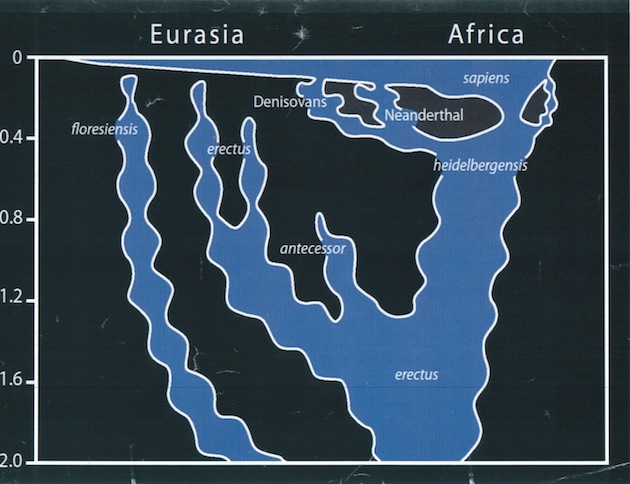
You probably saw the news last year that “Any human whose ancestral group developed outside Africa has a little Neanderthal in them – between 1 and 4 per cent of their genome. In other words, humans and Neanderthals had sex and had hybrid offspring. A small amount of that genetic mingling survives in “non-Africans” today: Neanderthals didn’t live in Africa, which is why sub-Saharan African populations have no trace of Neanderthal DNA. It’s impossible to know how often humans invited Neanderthals back to their cave (and vice versa), but the genome data offers some intriguing details. It must have been at least 45,000 years ago… suggesting that interbreeding occurred before those populations split. The timing makes the Middle East the likeliest place where humans leaving Africa and resident Neanderthals did the deed.” (New Scientist)
And a different IBM analysis of my paternal line shows my ancestors were in the second major wave out of Africa, settling in the Middle East at that very time. And presumably getting friendly with the locals.
More recently, palaeoanthropologists have learned a great deal about how Neanderthals think, and that was tonight’s reading:
“We know Neanderthal brains were a bit larger than ours and were shaped a bit differently. And we know where they lived, what they ate and how they got it.
Looking closely at the choices Neanderthals made when they manufactured and used tools shows that they organised their technical activities much as artisans… Like blacksmiths, they relied on “expert” cognition, a form of observational learning and practice acquired through apprenticeship that relies heavily on long-term procedural memory.
The only obvious difference between Neanderthal technical thinking and ours lay in innovation. Although Neanderthals invented the practice of hafting stone points onto spears, this was one of very few innovations over several hundred thousand years. Active invention relies on thinking by analogy and a good amount of working memory, implying they may have had a reduced capacity in these respects.
But while Neanderthals would have had a variety of personality types, just as we do, their way of life would have selected for an average profile quite different from ours. Jo or Joe Neanderthal were neophobic, dogmatic and xenophobic.
So we could have recognised and interacted with Neanderthals, but we would have noticed these significant cognitive differences. They would have been better at well-learned, expert cognition than modern humans, but not as good at the development of novel solutions. They were adept at intimate, small-scale social cognition, but lacked the cognitive tools to interact with acquaintances and strangers, including the extensive use of symbols.
In the final count, when Neanderthals and modern humans found themselves competing across the European landscape 30,000 years ago, those cognitive differences may well have been decisive in seeing off the Neanderthals.” (New Scientist, Jan 14, 2012)
Here’s a paper on the Neanderthal analysis by 23andMe.

Leave a Reply