Canon PowerShot SD4000 IS
ƒ/2
4.9 mm
1/30
640

For the special tribute issue of BusinessWeek that is coming out tomorrow, I tried to honor Steve Jobs in a small way with my memories of the NeXT days.

Here is the version I wrote (the print edition has several sentences edited out) with some italics added to summary sections:

——————————-

The book of Jobs, a parable of passion

Steve Jobs was intensely passionate about his products, effusing an infectious enthusiasm that stretched from one-on-one recruiting pitches to auditorium-scale demagoguery. It all came so naturally for him because he was in love, living a Shakespearean sonnet, with tragic turns, an unrequited era of exile, and ultimately the triumphant reunion. At the personal and corporate levels, it is the archetype of the Hero’s Journey turned hyperbole.

The NeXT years were torture for him, as he was forcibly estranged from his true love. When we went on walks, or if we had a brief time in the hallway, he would steer the conversation to a plaintive question: “What should Apple do?” As if he were an exile on Elba, Jobs always wanted to go home. “Apple should buy NeXT.” It seemed outrageous to me at the time; what CEO of Apple would ever invite Jobs back and expect to keep their job for long?

The Macintosh on his desk at NeXT had the striped Apple logo stabbed out, a memento of anguish scratched deep into plastic.

The NeXTSTEP operating system, object-oriented frameworks, and Interface Builder were beautiful products, but they were stuck in what Jobs considered the pedestrian business of enterprise IT sales. Selling was boring. Where were the masses? The NeXTSTEP step-parents sold to a crowd of muggles. The magic seemed misspent.

Jobs was still masterful, relating stories of how MCI saved so much time and money developing their systems on NeXTSTEP. He persuaded the market research firms IDC and Dataquest that a new computer segment should be added to the pantheon of mainframe, mini, workstation, and PC. The new market category would be called the “PC/Workstation,” and lo and behold, by excluding pure PCs and pure workstations, NeXT became No. 1 in market share. Leadership fabricated out of thin air.

During this time, corporate partners came to appreciate Steve’s enthusiasm as the Reality Distortion Field. Sun Microsystems went so far as to have a policy that no contract could be agreed to while Steve was in the room. They needed to physically remove themselves from the mesmerizing magic to complete the negotiation.

But Jobs was sleepwalking through backwaters of stodgy industries. And he was agitated by Apple’s plight in the press. Jobs reflected a few years later, “I can’t tell you how many times I heard the word ‘beleaguered’ next to ‘Apple.’ It was painful. Physically painful.”

When the miraculous did happen, and Apple bought NeXT, Jobs was reborn. I recently spoke with Bill Gates about passion: “Most people lose that fire in the belly as they age. Except Steve Jobs. He still had it, and he just kept going. He was not a programmer, but he had hit after hit.” Gates marvels at the magic to this day.

Parsimony

Jobs was the master architect of Apple design. Often criticized for bouts of micromanagement and aesthetic activism, Steve’s spartan sensibilities accelerated the transition from hardware to software. By dematerializing the user interface well ahead of what others thought possible, Apple was able to shift the clutter of buttons and hardware to the flexible and much more lucrative domain of software and services. The physical thing was minimized to a mere vessel for code.

Again, this came naturally to Jobs, as it is how he lived his life, from sparse furnishings at home, to sartorial simplicity, to his war on buttons, from the mouse to the keyboard to the phone. Jobs felt a visceral agitation from the visual noise of imperfection.

When Apple first demonstrated the mouse, Bill Gates could not believe it was possible to achieve such smooth tracking in software. Surely, there was a dedicated hardware solution inside.

When I invited Jobs to take some time away from NeXT to speak to a group of students, he sat in the lotus position in front of my fireplace and wowed us for three hours, as if leading a séance. But then I asked him if he would sign my Apple Extended Keyboard, where I already had Woz’s signature. He burst out: “This keyboard represents everything about Apple that I hate. It’s a battleship. Why does it have all these keys? Do you use this F1 key? No.” And with his car keys he pried it right off. “How about this F2 key?” Off they all went. “I’m changing the world, one keyboard at a time,” he concluded in a calmer voice.

And he dove deep into all elements of design, even the details of retail architecture for the Apple store (he’s a named patent holder on architectural glass used for the stairways). On my first day at NeXT, as we walked around the building, my colleagues shared in hushed voices that Jobs personally chose the wood flooring and various appointments. He even specified the outdoor sprinkler system layout.

I witnessed his attention to detail during a marketing reorganization meeting. The VP of marketing read Jobs’s e-mailed reaction to the new org chart. Jobs simply requested that the charts be reprinted with the official corporate blue and green colors, and provided the Pantone numbers to remove any ambiguity. Shifted color space was like a horribly distorted concerto to his senses. And this particular marketing VP was clearly going down.

People

Jobs’s estimation of people tended to polarize to the extremes, a black-and-white thinking trait common to charismatic leaders. Marketing execs at NeXT especially rode the “hero-shithead rollercoaster,” as it was called. The entire company knew where they stood in Jobs’s eyes, so when that VP in the reorg meeting plotted his rollercoaster path on the white board, the room nodded silently in agreement. He lasted one month.

But Jobs also attracted the best people and motivated them to do better than their best, rallying teams to work in a harmony they may never find elsewhere in their careers. He remains my archetype for the charismatic visionary leader, with his life’s song forever woven into the fabric of Apple.

Jobs now rests with the sublime satisfaction of symbolic immortality.

—-

It was daunting to reflect on such a great man, from a refined set of exposures… but he was my childhood hero, and I convinced him to let me do a study of his management style while a lowly employee at NeXT. Nevertheless, I wondered if I captured his essence in those years of exile from Apple. So, I was floored when the BW editor wrote back “I think this piece is one of the best things I have ever read about Steve.” :))

38 responses to “What was NeXT”

  1. I have found that many great men live a shorter life than we would expect because they have already contributed enormously to humanity. After many productive years, they come to the end of their lives. I find it not surprising that the universe has it this way.

    Interesting article, Steve. I understand this person’s need for simple perfection, both visually and physically. I also know that his personality needed to be as it was to equal the results that he had.

  2. What WAS NeXT is cool!! "living a Shakespearean sonnet" is beautiful…yes, "an exile on Elba" – can definitely feel the pain… as well as the story of Jobs second birth and Apple rebirth…going home:):) Apple=Jobs

    would like to get deeper into Steve Jobs legacy… it is really a key strategic question for the humanity in the 21st century to understand what his legacy was truly about and to carry the light… maybe his wife should say something too…

  3. Perhaps it’s the fire in the belly that Bill so clearly describes about Steve, that turned into a cancer. Sometimes, the body can’t stand to handle and harness that so extreme energy and force and degenerates for wrong. It’s no wonder that people with passion, commitment and totally driven to give their all suffer from this kind of physical problems. You can’t prevent it from happening, it’s part of the potential side effects of such an existence. And as we know: "It’s not a sign of sanity to be well adjusted to a profoundly sick society"… I am sure, and the most I read about it, that Steve Jobs suffered, up to physical levels, the most of the society he belonged to. No wonder it was cancer in the pancreas (responsible for digesting and metabolizing what you get in your system from the outside in order to nurture yourself) and not a heart stroke or an infection. Rest in peace.

  4. I’m proud to say I lived in his generation

  5. Thanks for posting this here.

  6. Excellent. Thanks Steve.

  7. What is that F1 key for? He was damn right, as always. Despite only meeting him once, he has coloured so much of my life.

  8. You have a flourish to your writing that’s a bit unexpected in the often barren world of narrow-minded and hyperkinetic Silicon Valley techne; the Elba analogy in your eulogy, for example, is a potent image.

    Products that make a difference need a powerful, all-encompassing guiding vision.
    Steve Jobs was exceptional as a conflation of the charisma, authority, obsessive attention to detail and ability to intuit the people, product and market dynamics necessary to make his visions happen.

    The recently introduced iPhone 4S has been described by some as a disappointment, but, IMHO, those disappointed people, fixated on mere hardware characteristics like CPU clock speed or display size, miss the product’s point. The communicating devices we use — computers, tablets, mobile phones, portable media players etc. — can and should become transparent, location-independent interfaces to a unified corpus of our documents, music, pictures, contacts and information channels.

    The cloud, sitting at the nexus of the communication between these devices, is the natural place to make this unification happen. The comibination of the iPhone’s Siri, speech recognition, natural language parsing, Wolfram|Alpha and cloud services integration, however imperfect they’ll appear when we’ll look back at them a decade or two from now, clearly show the vision and path to a more natural and "button-less" interaction with our digital assistants.

    The quality of the people working at Apple notwithstanding, my fear is that the loss of a perfectionist aesthete like Jobs who was truly at the intersection of technology and liberal arts will set back by several years the realization of a seamless and intuitive access to the aforementioned corpus.

  9. absolutely fabulous! well done, well written. a fitting tribute to an amazing man.

  10. I like how the PC is sucking the vibrance out of the hapless man sitting at the desk. How prophetic. Also…is that Steve Ballmer? Even *more* prophetic!

  11. Beautifully told, he says, not touching his F1 key.

    My small tribute:
    http://www.flickr.com/photos/jimheid/6217644131/in/photostream

  12. I loved your story! Your relating "with his car keys he pried it right off" is wonderfully told, and pure Jobs – and he did sign your keyboard! (Once it suited his requirements 🙂

    The current Time cover (above) shows Steve sitting in full lotus position. What captain of industry could, let alone would, pose for the camera in FULL lotus position (tried it lately?) for a product shot?

    Although it would reduce the alliterative P’s in your title to four, I think "parsimony" is not quite the quality Jobs expressed: "Mere parsimony is not economy. Expense, and great expense, may be an essential part in true economy." – Edmund Burke

  13. Thanks for sharing, Steve! You’re such a generous soul.

  14. merci y’all ! I was floored when I submitted this draft to them, and the BW editor wrote back: "Having met Steve a few times when I was editor of Time and having read so much about him, I think you have done a remarkable job of capturing the man with your reporting and insight. I have trimmed the piece a bit, partly to emphasize your telling anecdotes and partly to avoid some overlap with other parts of the package. As I said, I think this piece is one of the best things I have ever read about Steve, which means that if you ever want to switch jobs and become a journalist…"

    And the strange inversion of Moritz‘s path came to mind, from TIme journalist writing about Jobs to VC. When Moritz was putting the 1982 Person of the Year package together and gathering the material on Steve Jobs, they had a falling out over Jobs refusal to discuss his out-of-wedlock daughter Lisa, and Time switched the cover at the last moment to make the PC the "Machine of the Year" instead of Jobs. Jobs was devastated. Here is the slapped together cover from the past and the one running now, perhaps a revival of the original:

    …to…

    Which reminds me of another strange tidbit of history: Sequoia sold their Apple shares before the IPO.

    I just read the print edition, and it’s pretty cool. Some new tidbits in there and some details I thought only a handful of us heard privately from Woz back in ’89. There are three full page articles from outside sources: Eric Schmidt on the modern era, John Sculley on the earlier Apple days, and little ‘ole me in between:

    BusinessWeek Eulogy on Steve Jobs

    Here is my Mac keyboard from the articleThe From the NYT coverage of it, Woz wrote to me on Facebook:

    "You may well have the only Apple device with both our signatures on it."

  15. What a story, Steve! Thanks for sharing it with us.

  16. Steve,

    Having worked for Apple from 80-86, then for five more at NeXT, yours has captured the man I remember. Thanks.

  17. So happy to hear that. In sharing the patterns I saw, I had to wonder if others saw it the same way. Alas, we don’t have the ability to hear Steve’s reaction to these descriptions of him…..

    P.S. links to this appears at the top of a Facebook search for "Jobs"
    Steve Jobs FB Search and share
    Needless to say, Facebook Search is still a very weird thing.

  18. Great article, and in great company. But a really hard-core publication would have also interviewed Bill Budge!

  19. Total flashback, tube steak… Lord British too.

  20. I remember being over at David M.’s house, back in probably 7th grade, and Mort had an Apple II+ running VisiCalc. What a waste, I thought. Load up Zork or (later) Space Eggs!

  21. And I remember our programming space games together. Here is a good place to share your shape tables for hard coding into the Apple ][, pixel by x,y pixel:Apple ][ Shape Tabels Bradley MillerFor some reason, I never forget Call -151 Oh, and "peek but don’t poke" (Here’s a list)
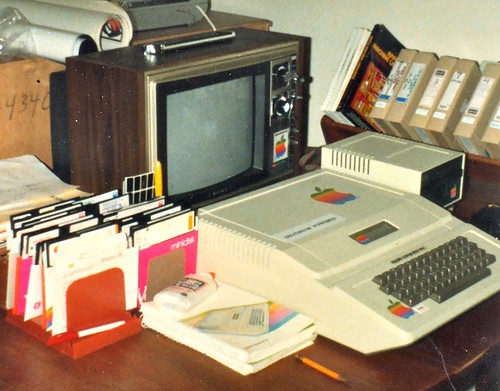
  22. The coolest part of the game was the tone generator code I happened to acquire from some other student in the computer room. It had a huge number of variables that controlled functions I didn’t fully understand. But if you changed those variables even slightly, it made some really wild, complex tones. I recall it as being a massive string of peeks and pokes. (Much unlike my sex life at that age.)

    I also remember one of us holding the graph paper and calling out "up…left…up…right…" while the other pressed the corresponding arrow keys. Tedious! Then figuring out what memory range to stick the shape tables into, so they wouldn’t conflict with anything else.

  23. [http://www.flickr.com/photos/jurvetson] Call -151 sounds so familiar but I can’t recall what it did.

  24. It enters the monitor. I found this great resource while searching for "PR#6"…. (bet that brings back memories too)

    My Dad just found this vintage photomy first computer

  25. Ho and the trailer just came out :

    Jobs TRAILER 1 (2013) – Ashton Kutcher
    http://www.youtube.com/watch?v=yMSsf9szC2o

  26. IPO revelations: Jobs plowed around half of his total proceeds from Apple going public into Pixar… and when Pixar went public, as an 80% owner, he made 5x as much as he did in the Apple IPO.

    Here’s an archive photo I have from the Apple IPO party I found this photo on my drive with no idea where it came from, but it prompted me to look up the IPO prospectus for Apple, and I noticed the executives on p.21:

    • Markkula, the first investor and Apple President
    • Jobs as Vice President
    • And Peter Crisp

    On my first week on the job as a newbie VC in 1995, we were on the road to New York to fund raise. We had $26M under management (tiny for our business), and we were meeting with our cadre of current investors, one of whom was Peter Crisp of the Rockefeller family and Venrock funds. I did not know of his Apple connection at the time, but I vividly remember his words to me: he said that he envied us and wished he could be reentering the venture business as a young man (this was just before any hint of an Internet boom)… and he had one piece of advice for me. Looking back from the vantage point of great success, he wished that he had never sold. He realized that for all the temporal gain of market timing, he missed the sea change of history. I have never forgot that, and have not sold a single share of my VC investments. I want to see how that turns out versus the common wisdom to “diversify”… but frankly, even though it seems to be the better strategy so far, it is so much more satisfying to not have to double guess when you should stop believing.

    Which brings me to another peculiar detail of that Apple prospectus. I heard from another VC that Sequoia disposed of all of their shares in Apple before the IPO. That is so unusual that I had to check, and I could not find any mention of them in the prospectus. In any case, they did help finance the company in a critical period… but like Peter Crisp, who sold long after the IPO, they probably wish they had kept the faith.

  27. Now that 10 years have passed, I wrote a post on Steve Jobs’ pride and prophesiesSteve Jobs’ pride and prophesies —  10 years onpulling juicy quotes from the Walter Isaacson book of Jobs that came out a couple weeks after this original post in 2011.

Leave a Reply to jurvetson Cancel reply

Your email address will not be published. Required fields are marked *