Canon EOS 5D Mark II
ƒ/10
100 mm
1/4,000
800

My carbon fiber Mongoose 98 had a beautiful launch and successful recovery with a Cesaroni N1100 Moonburner motor (it has an off-center grain geometry that burns for a long time).

Launch video compilation (HD).

Here are the flight stats:
• Altitude: 35,184 ft. MSL
• Max Speed: 1,111 MPH, Mach 1.5
• Acceleration: 10 g’s, 0 to Mach in 4.5 seconds
• Booster burn time: 9.4 seconds
• Coast time to apogee: 28.1 seconds
• Return time: 6 minutes
• Weight: 12 lb airframe + 25 lb motor
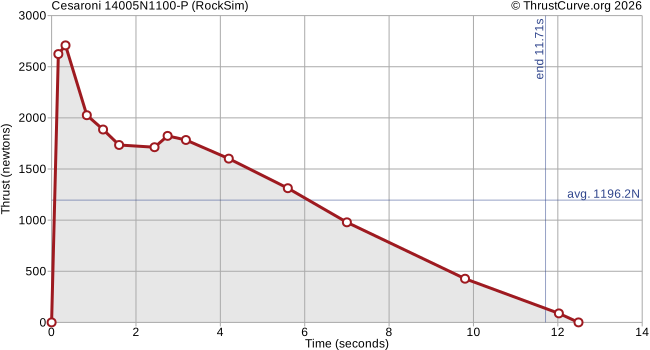
• Motor: Cesaroni N1100 thermoplastic propellant, total impulse of 14,000 Ns

Build photos: fin alignment jig, avionics bay with flight computers, CO2 piston for drogue and main chute deployments, and a propellant mixing party where James and I built a pair of N1100 motors.

15 responses to “Mach 1.5 Rocket Launch at Aeronaut”

  1. Ready for launch
    IMG_1529

    To infinity and beyond (with some pitch-yaw-roll coupling off the pad)
    IMG_7701

    Some strong winds aloft distort the contrail. This is the burnout of the smoke grain 14 seconds in (the rocket is the little dot, shot with a 400mm zoom):
    IMG_7744

    Recovery on the playa, 3 miles downwind.
    IMG_1537
    The one and only benefit of strong winds is that the parachute stays fully inflated on the ground, making it much easier to spot from a distance with binoculars.

  2. This is the G-Wiz flight computer log, with 500 samples/second:
    Screen shot 2011-08-11 at 8.42.15 AM
    Green is the vertical component of speed in MPH, blue is altitude above ground level, red is the acceleration (or g force). At apogee (the peak in blue), the computer deploys the CO2 piston and the airframe splits in two with a long kevlar ribbon holding it together. It does a lateral fall back to Earth, with a wicked spin induced by the fins. The ribbon ends up like a tightly wound cord. The baro and accelerometer sensors show a lot of vibration noise during the long fall. There is no parachute to minimize wind drift. At 800 ft. above ground, the second CO2 cartridge deploys, blowing off the nose cone, and the 60" parachute comes out. You notice the shocks of these events in the red spikes, and the change in the blue decent slope at 800 ft.

    Zooming in to the boost phase detail:
    HCX Boost phase zoom

    The red accelerometer readout correlates with the motor’s thust curve:


    except for an anomaly around 7 seconds. I notice the thrust suddenly dropped, and the motor burn time was less than expected.

    Since I had photos for every quarter second of this flight, I looked at them closely around this time, and I did not see debris or a flame burp. Also, the nozzle looked intact at landing but I forgot to do a detailed inspection, so perhaps it hollowed out internally? Or perhaps the rocket hit some wicked jetstream.

    7 second after launch, at the time of the thrust anomaly, you can see a new corkscrew effect started overhead (this is 7.5 seconds in, showing the corkscrew):

    IMG_7727

    And versus the Rocksim, we came a bit short on altitude (31 vs 33K ft.) but were quite accurate on predicted max speed (1,111 vs 1,189 MPH):
    Mongoose 98 Rocksim
    Note: the measured altitude is the vertical component of the flight. If it was at an angle into the wind, the distance traveled diagonally could have been 33K ft.

  3. P.S. A fun story from the motor build gathering: James and I were both building N1100 motors, and we had to lather the surfaces of each of the 6 grains with PAPI (Polymethylene Polyphenyl Isocyanate) which acts as a binder for the R45 HTPB propellant. There are several tight fits for each grain, and an alignment mandrel runs up the middle that needs to be removed. Gunk is dripping everywhere, and starting to cure. Think of a viscous, epoxy-like toxin. Well, after we finished, James somehow got it in the bangs of his hair….

    A rocket-geek version of Cameron Diaz in There’s Something about PAPI

  4. Remind me…
    1 Newton is roughly 1/5 pound (thrust)…?

  5. close. 4.45 Newtons = 1 lb of thrust
    So, at ignition, we had just over 600 lbs of thrust for a 37 lb rocket. Rocksim estimates that stable flight speed was reached in the first 29 inches of movement! So we had plenty of safety margin with a 12 ft. launch rail. Motor grain design often includes an initial thrust pop for that reason. Over the total burn, the 1120 N average thrust = 250 lbs.

    Pad cam sequence from the video
    Screen shot 2011-08-09 at 9.58.48 PM Screen shot 2011-08-09 at 9.59.31 PM Screen shot 2011-08-09 at 9.59.45 PM Screen shot 2011-08-09 at 10.00.13 PM

  6. very skinny rockets this time:) the movie is cute:)

  7. Thanks y’all. And yes, this is the unpainted carbon fiber rocket and first flight of that avionics bay. We launched 3 of the 4. The "epic" cluster rocket was a poor match for high winds. We did not want to risk multiple motors and automated air-starting of the main in a situation where the flight angles could get a little wonky. =)

    Oh, and Ken put together a video of the other launches, best viewed 720p full screen

  8. Could the 7-second anomaly be the Mach transition? I’m not sure how the airflow changes, but it seems conceivable that if the Cd changes at Mach, the net acceleration could be discontinuous, even if the motor’s thrust was continuous.

    For similar reasons, I wonder if perhaps the motor burn time was correct, but towards the end of the burn, the motor’s thrust was just less than the force of drag, causing net acceleration to swing negative before burnout. How does that curve compare to simulation with an ideal motor?

  9. I think you are right on the second point. (and it jives with the photo records).

    I wondered about the Mach transition too, but looking just at the velocity curve (MPH / sec):
    Velocity Curve
    She hits Mach 1 at 4.5 seconds, takes a velocity hit at 7 seconds for some reason, but stays supersonic until about the 17th second (and you see a velocity slope change there).

  10. An armchair astronaut speculates;

    From that curve directly above…it seems velocity was always rising until the (slightly premature) burnout…(9 seconds)
    I mean at some point (with the motor still burning) the drag would have equaled the thrust and velocity would stop climbing,(because drag relates to V(sq)…right ?
    So reaching that point you would enter a steady (velocity and acceleration) state…aside from air density considerations…
    The accelerometer and velocity curves would be flat
    I don’t see that.
    The acceleration went from positive to negative at 9 seconds
    But then I guess at 20,000 feet or more, air density is also a factor…

    Fun to look at all this stuff.

  11. After a good nites sleep i am thinking that I was being overly simplistic…..
    Reduced weight as fuel burns,reduced air pressure with altitude and increased drag due to non vertical angle….
    Plus reduced thrust (as seen in the manufacturer’s specs…)
    And instrument error..
    Quite a lot of variables there…

  12. You’re not kidding. Here is a NASA ed primer.

    And there are special supersonic considerations and some pitch-yaw-roll coupling as well.

    Maybe you can help me find a better tutorial. While my son was working on a science fair project, I wanted to walk through the basic formulae for flight with him since he loves calculus and this looked like a perfect real-world use case. After several hours of searching and asking a guy who teaches a class on rocketry, I could not find a sequential walk through anywhere, just various summaries of the solution or a brute force derivation of the complete model with all variables.

    I wanted to start with simple assumptions – constant mass and no drag (i.e., how it would fly in a vacuum) before introducing drag and second order effects.

    It turns out that for the rockets we fly, we can safely ignore mass changes much of the time: “The propellant has to exceed 67% of the total rocket mass before a 10% error is induced” (source) and that is generally a concern for large liquid-fueled rockets, not our solid rockets, and certainly not Estes rockets. “The assumption of constant mass works… fairly well for solid model rockets” (source).

    In short, I wanted to go through the integrals (without drag) to see where the error comes in dv/dt.

    I was hoping there was someone who stepped through it in phases (e.g., presume a vacuum to start to ignore drag). Not even the NASA site does that. It covers ballistic launch, like from a canon (simple), and then jumps to adding drag to the model (hairy).

    I would have thought that there would be some pages out there that go through the analysis without drag, but I can’t find one! Wouldn’t a class on this start simple, and then layer in more complexity? A model without drag has some use – such as the lunar module ascent. Won’t the integrals be a bit easier with a constant mass, no drag model?

    Google gives pages with confused discussions, with errors, such as….

  13. Wow…
    Thanks for the detailed response..and good links.
    Well,sadly,unlike riding a bicycle…you can forget calculus completely…and I have.
    So I may not be much help…
    But I will see if I can find something…web wise.

    In my mid 30’s I built a few rockets using the (?) mid sized motors that were (at that point anyways) still "over the counter" in the USA…
    By mid size I do not know….I mean the whole motor was maybe 12 ounces…
    ANYWAYS…point being I was curious enough to do a lot of reading on the drag issue…
    Its huge..and somewhat put me off.
    NASA only has to really consider the atmosphere in terms of turbulence…
    But these models are so light and (relatively) low powered that drag is huge…and goes up so quickly…..
    The more I read the more discouraged I got..
    So I amcurious as to why you would want to focus on just the (vacume) theory…
    You are interested in the effects of just the declining thrust and weight ?

    Getting back to my love of staged rockets… this flight to 30,000 feet…that’s impressive;
    Air density is low at this point…
    Imagine if you could get a second stage going at that point !
    Despite the (theoretical-NASA) advantage of 2nd stage ignition at Vmax…with these models you would do well to wait until you are in thin air..
    Does anyone try this..?
    You seem to have enough electronics/electrical power on these things to do it…
    You guys would not need to rely on the (motor to motor) direct ignition that I used to use…
    Anyways…just rambling..because you have encouraged it..(!!)
    But I will read more…

    In closing I would just say that I recall one of our first chats when I was asking about losing all the heavy gear (and even the parachute) in favor of more staging…(!)
    Going high was always my first fascination.But I lacked any telemetry etc..
    They mostly just disappeared..:)

    Anyways…I will keep my eyes open…
    Just a quick starter link talking about Mach speed and drag(and not integrating for progressive air density changes) was enough to make my eyes glaze over;
    http://www.jmrconline.org/Drag_Coefficient_Prediction.pdf

  14. It appears the Mongoose98 does not use the zipperless fincan concept and has a very short upper section for the Main chute. What is the size of your Main chute and are you not concerned about getting a zipper on the fincan section during apogee ejection?

Leave a Reply to caseybarker Cancel reply

Your email address will not be published. Required fields are marked *