

It all began when two termites fell in love.
Were it not for the terraforming termites, the Okavango Delta of Botswana would be a barren flat floodplain in the Kalahari desert, much like the Black Rock Desert.
The termite mounds tower up above the seasonal floodplain, up to 30 ft. tall in some cases, and provide a base for bushes and trees that need to be above water to germinate. And that supports the larger animals, like the Fisher Eagle seen here.
The landscape is literally transformed by termites.
After a mature colony dies, the inner chambers provide birthing dens for jackal, hyena and wild dog that dig out caves to raise their pups.
As with the other social insects, the termite behavior at the colony level is just fascinating. They farm a fungus underground, and their crop needs a constant temperature of 87 degrees. While outside temperatures can fluctuate between 35 degrees during the night and 104 degrees during the day, the thermoregulation of the mound keeps the temperature in a 2-degree band. Hot air rises in the vertical column drawing cooler air in from below, regulated by continual termite tending to air vent opening and closing. Wind also induces airflow rhythms similar to the breaths of a cow. No single termite has enough neurons to build or manage such a complex system.
It reminded me of a SFI talk on another social insect:
“Bee hives must stay at 96 degrees for the bees to reach maturity. Bees can cool with their wings or huddle together for warmth. Genetically homogenous bees all move together, and the temperature fluctuates widely. Genetically diverse bees keep the hive at a constant temperature.”
The program does not reside in the individual.

 And an interesting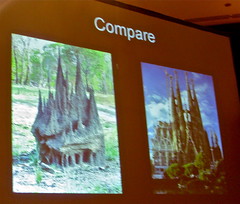


Leave a Reply