

I just got back from the Churchill Club’s 13th Annual Top 10 Tech Trends Debate (site).
Curt Carlson, CEO of SRI, presented their trends from the podium, which are meant to be “provocative, plausible, debatable, and that it will be clear within the next 1-3 years whether or not they will actually become trends.”
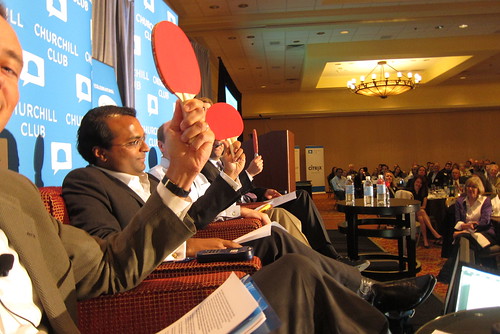
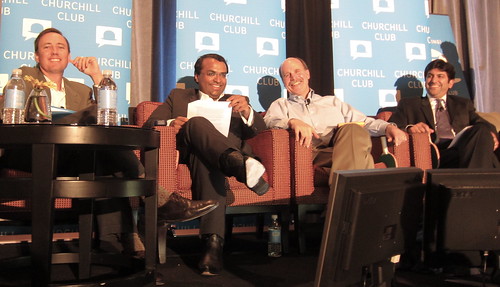
Then the panelists debated them. Speaking is Aneesh Chopra, CTO of the U.S., and smirking to his left is Paul Saffo, and then Ajay Senkut from Clarium, then me.
Here are SRI’s 2011 Top 10 Tech Trends [and my votes]:
Trend 1. Age Before Beauty. Technology is designed for—and disproportionately used by—the young. But the young are getting fewer. The big market will be older people. The aging generation has grown up with, and is comfortable with, most technology—but not with today’s latest technology products. Technology product designers will discover the Baby Boomer’s technology comfort zone and will leverage it in the design of new devices. One example today is the Jitterbug cell phone with a large keypad for easy dialing and powerful speakers for clear sound. The trend is for Baby Boomers to dictate the technology products of the future.
[I voted YES, it’s an important and underserved market, but for tech products, they are not the early adopters. The key issue is age-inspired entrepreneurship. How can we get the entrepreneurial mind focused on this important market?]
Trend 2. The Doctor Is In. Some of our political leaders say that we have “the best medical care system in the world”. Think what it must be like in the rest of the world! There are many problems, but one is the high cost of delivering expert advice. With the development of practical virtual personal assistants, powered by artificial intelligence and pervasive low-cost sensors, “the doctor will be in”—online—for people around the world. Instead of the current Web paradigm: “fill out this form, and we’ll show you information about what might be ailing you”, this will be true diagnosis—supporting, and in some cases replacing—human medical practitioners. We were sending X-rays to India to be read; now India is connecting to doctors here for diagnosis in India. We see the idea in websites that now offer online videoconference interaction with a doctor. The next step is automation. The trend is toward complete automation: a combination of artificial intelligence, the Internet, and very low-cost medical instrumentation to provide high-quality diagnostics and advice—including answering patient questions—online to a worldwide audience.
[NO. Most doctor check-ups and diagnoses will still need to be conducted in-person (blood tests, physical exams, etc). Sensor technology can’t completely replace human medical practitioners in the near future. Once we have the physical interface (people for now), then the networking and AI capabilities can engage, bringing specialist reactions to locally collected data. The real near-term trend in point-of-care is the adoption of iPads/phones connected to cloud services like ePocrates and Athenahealth and soon EMRs.]
Trend 3. Made for Me. Manufacturing is undergoing a revolution. It is becoming technically and economically possible to create products that are unique to the specific needs of individuals. For example, a cell phone that has only the hardware you need to support the features you want—making it lighter, thinner, more efficient, much cheaper, and easier to use. This level of customization is being made possible by converging technical advances: new 3D printing technology is well documented, and networked micro-robotics is following. 3D printing now includes applications in jewelry, industrial design, and dentistry. While all of us may not be good product designers, we have different needs, and we know what we want. The trend is toward practical, one-off production of physical goods in widely distributed micro-factories: the ultimate customization of products. The trend is toward practical, one-off production of physical goods in widely distributed micro-factories: the ultimate customization of products.
[NO. Personalization is happening just fine at the software level. The UI skins and app code is changeable at zero incremental cost. Code permeates outward into the various vessels we build for it. The iPhone. Soon, the car (e.g. Tesla Sedan). Even the electrical circuits (when using an FPGA). This will extend naturally to biological code, with DNA synthesis costs plummeting (but that will likely stay centralized in BioFabs for the next 3 years. When it comes to building custom physical things, the cost and design challenges relegate it to prototyping, tinkering and hacks. Too many people have a difficult time in 3D content creation. The problem is the 2D interfaces of mouse and screen. Perhaps a multitouch interface to digital clay could help, where the polygons snap to fit after the form is molded by hand.]
Trend 4. Pay Me Now. Information about our personal behavior and characteristics is exploited regularly for commercial purposes, often returning little or no value to us, and sometimes without our knowledge. This knowledge is becoming a key asset and a major competitive advantage for the companies that gather it. Think of your supermarket club card. These knowledge-gatherers will need to get smarter and more aggressive in convincing us to share our information with them and not with their competitors. If TV advertisers could know who the viewers are, the value of the commercials would go up enormously. The trend is technology and business models based on attracting consumers to share large amounts of information exclusively with service providers.
[YES, but it’s nothing new. Amazon makes more on merchandising than product sales margin. And, certain companies are getting better and better at acquiring customer information and personalizing offerings specifically to these customers. RichRelevance provides this for ecommerce (driving 25% of all e-commerce on Black Friday). Across all those vendors, the average lift from personalizing the shopping experience: 15% increase in overall sales and 8% increase in long-term profitability. But, simply being explicit and transparent to the consumer about the source of the data can increase the effectiveness of targeted programs by up to 100% (e.g., saying “Because you bought this product and other consumers who bought it also bought this other product” yielded a 100% increase in product recommendation effectiveness in numerous A/B tests). Social graph is incredibly valuable as a marketing tool.]
Trend 5. Rosie, At Last. We’ve been waiting a long time for robots to live in and run our homes, like Rosie in the Jetsons’ household. It’s happening a little now: robots are finally starting to leave the manufacturing floor and enter people’s homes, offices, and highways. Robots can climb walls, fly, and run. We all know the Roomba for cleaning floors—and now there’s the Verro for your pool. Real-time vision and other sensors, and affordable precise manipulation, are enabling robots to assist in our care, drive our cars, and protect our homes and property. We need to broaden our view of robots and the forms they will take—think of a self-loading robot-compliant dishwasher or a self-protecting house. The trend is robots becoming embedded in our environments, and taking advantage of the cloud, to understand and fulfill our needs.
[NO. Not in 3 years. Wanting it badly does not make it so. But I just love that Google RoboCar. Robots are not leaving the factory floor – that’s where the opportunity for newer robots and even humanoid robots will begin. There is plenty of factory work still to be automated. Rodney Brooks of MIT thinks they can be cheaper than the cheapest outsourced labor. So the robots are coming, to the factory and the roads to start, and then the home.]
Trend 6. Social, Really. The rise of social networks is well documented, but they’re not really social networks. They’re a mix of friends, strangers, organizations, hucksters—it’s more like walking through a rowdy crowd in Times Square at night with a group of friends. There is a growing need for social networks that reflect the fundamental nature of human relationships: known identities, mutual trust, controlled levels of intimacy, and boundaries of shared information. The trend is the rise of true social networks, designed to maintain real, respectful relationships online.
[YES. The ambient intimacy of Facebook is leading to some startling statistics on fB evidence reuse by divorce lawyers (80%) and employment rejections (70%). There are differing approaches to solve this problem: Altly’s alternative networks with partioning and control, Jildy’s better filtering and auto-segmentation, and Path’s 50 friend limit.]
Trend 7. In-Your-Face Augmented Reality. With ever-cheaper computation and advances in computer vision technology, augmented reality is becoming practical, even in mobile devices. We will move beyond expensive telepresence environments and virtual reality games to fully immersive environments—in the office, on the factory floor, in medical care facilities, and in new entertainment venues. I once did an experiment where a person came into a room and sat down at a desk against a large, 3D, high-definition TV display. The projected image showed a room with a similar desk up against the screen. The person would put on 3D glasses, and then a projected person would enter and sit down at the other table. After talking for 5 to 10 minutes, the projected person would stand up and put their hand out. Most of the time, the first person would also stand up and put their hand into the screen—they had quickly adapted and forgotten that the other person was not in the room. Augmented reality will become indistinguishable from reality. The trend is an enchanted world— The trend is hyper-resolution augmented reality and hyper-accurate artificial people and objects that fundamentally enhance people’s experience of the world.
[NO, lenticular screens are too expensive and 3D glasses are a pain in the cortex. Augmented reality with iPhones is great, and pragmatic, but not a top 10 trend IMHO]
Trend 8. Engineering by Biologists.
Biologists and engineers are different kinds of people—unless they are working on synthetic biology. We know about genetically engineered foods and creatures, such as gold fish in multiple other colors. Next we’ll have biologically engineered circuits and devices. Evolution has created adaptive processing and system resiliency that is much more advanced than anything we’ve been able to design. We are learning how to tap into that natural expertise, designing devices using the mechanisms of biology. We have already seen simple biological circuits in the laboratory. The trend is practical, engineered artifacts, devices, and computers based on biology rather than just on silicon.
[YES, and NO because it was so badly mangled as a trend. For the next few years, these approaches will be used for fuels and chemicals and materials processing because they lend themselves to a 3D fluid medium. Then 2D self-assembling monolayers. And eventually chips , starting with memory and sensor arrays long before heterogeneous logic. And processes of biology will be an inspiration throughout (evolution, self-assembly, etc.). Having made predictions along these themes for about a decade now, the wording of this one frustrated me]
Trend 9. ‘Tis a Gift to be Simple. Cyber attacks are ever more frequent and effective. Most attacks exploit holes that are inevitable given the complexity of the software products we use every day. Cyber researchers really understand this. To avoid these vulnerabilities, some cyber researchers are beginning to use only simple infrastructure and applications that are throwbacks to the computing world of two decades ago. As simplicity is shown to be an effective approach for avoiding attack, it will become the guiding principle of software design. The trend is cyber defense through widespread adoption of simple, low-feature software for consumers and businesses.
[No. I understand the advantages of being open, and of heterogencity of code (to avoid monoculture collapse), but we have long ago left the domain of simple. Yes, Internet transport protocols won via simplicity. The presentation layer, not so much. If you want dumb pipes, you need smart edges, and smart edges can be hacked. Graham Spencer gave a great talk at SFI: the trend towards transport simplicity (e.g. dumb pipes) and “intelligence in the edges” led to mixing code and data, which in turn led to all kinds of XSS-like attacks. Drive-by downloading (enabled by XSS) is the most popular vehicle for delivering malware these days.]
Trend 10. Reverse Innovation. Mobile communication is proliferating at an astonishing rate in developing countries as price-points drop and wireless infrastructure improves. As developing countries leapfrog the need for physical infrastructure and brokers, using mobile apps to conduct micro-scale business and to improve quality of life, they are innovating new applications. The developing world is quickly becoming the largest market we’ve ever seen—for mobile computing and much more. The trend is for developing countries to turn around the flow of innovation: Silicon Valley will begin to learn more from them about innovative applications than they need to learn from us about the underlying technology.
[YES, globalization is a megatrend still in the making. The mobile markets are clearly China, India and Korea, with app layer innovation increasingly originating there. Not completely of course, but we have a lot to learn from the early-adopter economies.]


Leave a Reply