Canon PowerShot S90
ƒ/2
6 mm
1/30
160

Astro Teller, grandson of the hydrogen bomb and Moonshot maven, introducing me at Google. The video of my talk just went up.
—————
ABSTRACT

Many of the interesting challenges in computer science, nanotechnology, and synthetic biology entail the construction of complex systems. As these systems transcend human comprehension, will we continue to design them or will we increasingly evolve them? As we design for evolvability, the locus of learning shifts from the artifacts themselves to the process that created them. There is no mathematical shortcut for the decomposition of a neural network or genetic program, no way to “reverse evolve” with the ease that we can reverse engineer the artifacts of purposeful design. The beauty of compounding iterative algorithms (evolution, fractals, organic growth, art) derives from their irreducibility.

Google itself is a complex system that seeks to perpetually innovate. Leadership in complex organizations shifts from direction setting to a wisdom of crowds. The role of upper management is to tune the parameters of communication. Leaders can embrace a process that promotes innovation with emergent predictability more than they can hope to dictate the product of innovation itself.

Innovation is critical to economic growth, progress, and the fate of the planet, yet it seems so random. While innovation may appear inscrutable at the atomic level, patterns emerge in the aggregate nonetheless. A critical pattern, spanning centuries, is that the pace of innovation is perpetually accelerating, and it is exogenous to the economy. Rather, it is the combinatorial explosion of possible innovation-pairings that creates economic growth.
—————
(more on the dichotomy of design and evolutionary search, organizational optimization, and innovation)

I arranged the talk to overlap with a SFI brain spa @ Google. Some quotes from that event (without attribution per Chatham House rule):

“Unlimited power limits intellectual parsimony.”

“With machine learning, we are creating electronic savants. They are happy in a high-dimensional space. They have no desire to reduce. What we want is electronic Keplers that can recognize the ellipse, not savants that can force fit a heliocentric model.”

“The target of evolution can’t be more complex than the selection pressure itself. If you can come up with the selection pressure, you might as well design it.”

“I don’t think there is any natural process that is incompressible. It’s not random.”

[I disagree with the premise of those last two quotes]

43 responses to “Google Tech Talk on the Dichotomy of Design”

  1. Sounds awfully complicated. Perhaps if I read it a few times.

  2. Or smoke something…..
    !!!

  3. "Target of evolution" is a phrase I can’t quite swallow.

  4. I agree with you. The last two quotes seem profoundly wrong to me, although he claims the first has been proven as a theorem. He is referring primarily to artificial evolution, to build an AI for example. So think of targeted evolution as directed evolution. I would agree perhaps that in a constrained environment of selection pressures (when evolving a simple sort algorithm for example), then the complexity of the resulting sort program is on the same order of complexity of the selection test. We would not expect the resulting sort program to be transcendent. So perhaps he means that if you hope to have a design level of control with an evo approach, you might as well design it. The interesting case to me is transcendent, and by definition, out of control. The robotic AI people argue that we need to train these AIs with a sensory-motor cortex in the real world to minimize the alien elements in their intelligence. By so doing, the selection pressure is similarly complex as with biological evolution. And strangely, given the differential immunity risks whenever something is not co-evolving with its environment, is it safer to let all robotic AIs and GMOs free in the environment during their development, or to think that we can sequester them in industrial facilities in perpetuity?

  5. I think that last one is true to a scientist. It’s when it comes to engineering that it’s impracticle (butterfly effect, etc) not to assume some degree of ‘random’. Science-wise, I postulate that it’s generally accepted that natural processes follow the laws of nature. Assuming a perfect unified field theory and everything that flows from it, everything from sub-atomic parties to macro objects ultimately behaves predictably and is hence compressible in a sense. Random factors are seldom that when you dive deeply enough. Randomness is an approximation that results from observing (or modeling) statistical processes (a la Monte Carlo) where you don’t have complete knowledge of initial conditions or feel like applying all layers of physical laws but still want a representative understanding of a system.

  6. Ah, yes, I think we agree on randomness, but my quibble is with the claim that there is no "natural process that is incompressible."

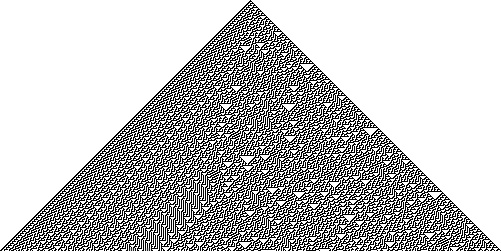
    The iterative algorithms that accumulate complexity (evolution, organic growth) seem incompressible. Like Rule 30 in cellular automata, the only way to generate the output is to run the algorithm.

    There is no mathematical shortcut or compression. A simulator is as complex as the simulated.

  7. we are like fish in a fishbowl (well-known allegory) – to be outside the fishbowl is outside of the experience of being human…
    there is a lot to learn here – thanks for the post… will take time to learn… and there is some very interesting mix of ideas and patterns… and great talk at Google, congratulation!

  8. Seems like that’s saying a fractal is incompressible. One way to look at that is to say, well, the data result isn’t compressible. Take a psudo-random sequence from a Mersenne twister (or Rule 30) or a computed transcendental number. If I can provide a formula whereby you can computationally derive any other point deterministically, what makes this different from a Huffman coded compressed data set? That formula is likely to be smaller (albeit a lot more compute intensive for the decompress) than the every day compression.

    Things we think of as evolving complex systems are deterministic as long as the input state is well known. "Data compression … is the process of encoding information using fewer bits … than an unencoded representation would use" They can be complex, but still compressible in a sense. Perhaps it’s when we don’t know the input states that things get incompressible (i.e. in reality)

  9. Right, and saying "row X of rule 30" to the right interpreter is a wonderfully compressed representation. The interpreter would run the CA, and slowly but surely get to that row.

    So, I should be more clear – I am referring to computational compression (or time compression if you will). Can one reduce the effort required to generate row X? (other than a brute force look up table which dodges the spirit of the question) Is there any meaningful computational shortcut other than running the iterative algorithm itself?

    And back to some implications of this… If this line of reasoning makes sense, and if transcendence can only come from iterative algorithms, then we need not fear a "hard take off" of self-improving AI. They would only be able to improve the process – not the product – or their creation. Computational gestation would remain the rate limiter.

  10. Ah – much clearer. Computational compression is a much more interesting problem! I suspect (though I’ve got no examples) there are proofs to show that it’s impossible to compress the computation necessary to run an evolver or CA system.

    So now, reinterpreting, I do believe that there are incompressible processes if not actual systems/evolved results. It seems like there is a terminal computational velocity here, deterministic or not…

  11. Regarding electric bicycle growth, today I came across an article with this quote:

    "Nationally, electric bike sales grew steadily to 170,000 units in 2008 from 100,000 in 2005 — only to retreat last year to 150,000 units, said Frank Jamerson, founder of Electric Bikes Worldwide Reports."

    e-bikes over the hill and heading into the trough of disillusionment? My legs are getting sore just thinking about riding out of it without one.

  12. Counting something different versus the 24M number for 2009 quoted here? [ah yes, that article is about the U.S….]

    I updated the chart from Jonathan Weinert of Chevron:

    Weinert E2W

  13. I was watching the talk. Impressively intense. My favorite part is the last part, from minute 50, I think. The explanations of building bottom-up or top-down, AIs, intelligence, genetics, etc…

    A thought to share, before it flies away…

    There is this rooted problem (based I guess in the old dichotomy of "form" vs "substance") of dichotomizing everything, forgetting that dichotomies are just a convenient thinking models and what is worse, mistaking them for the facts. I think that the greatest challenge to overcome in order to be able to create more than we can understand (Dany Hills), is to fully understand and be able to handle the fact of the continuum condition of everything that is. I think we are in the way to it, at least in that we now accept ideas like dark matter, that there is no vaccum, even when we can’t yet understand what is that thing mistaken for "vaccum" made of, or how it works. There’s a role of quantum mechanics here, no? I think we are now entering into a new shift in our comprehension of the universe, in which we will tear down dichotomies and will start pursuing the understanding of reality in wholes (not holes). Biology shows that there is no such thing as form (substrate) on one side and substance (information) on another… they are inseparable, they are two ways of looking at the one same thing, or two expressions of the same thing. Our challenge as thinkers of this time is, among others, to help bridge this gap, or narrow it, or at least, set the building blocks for the next generations to start thinking this way.

    When I try to think reality in abstract as a continuum, it makes sense. In macro. When I think about the building blocks of the universe and of, later, life, it’s again easy to grasp. But when I try to get an idea of this continuum in the built complexity of life forms of higher order like us and other complex systems, I just get lost in the maze. I think there is where the challenge lies.

    I personally believe that there is randomness, that it is not true that everything in nature is ultimately compressible. But even when this may be the case or not, we are still missing the lost link between the building blocks and the final complex buildings (biotic and abiotic / natural and artificial). To being acknowledging the idea of continuum, and thinking about it, I believe we will be able to understand the process of evolution and therefore begin to build technologies that will harness its force for directed purposes.

    And there’s also several overlapping ideas of Time, and our idea of it, which I consider outdated even when I cannot explain even to myself why… which with this concept of continuum make sense to me like keys to a higher level of understanding and to evolve.

    I admit I don’t finish to understand what I wrote, it’s very intuitive… but there’s something that rings true enough to share. (Here you have an example of creating something bigger than what I the individual can understand!)

    Hope I didn’t waste your time reading. And any feedback whether to contribute or tear down what I am thinking aloud here is more than welcomed.

  14. Oh, and one question: Isn’t the Large Hadron Collider, the LHC, as example of a bottom-up approach or technology, based on the evolution of its system through certain designed pre thought processes, as opposed to the top-down / designed building technolgy?

  15. Another question… I was caught by your observations about fan-outs… I didn’t know where the term came from, but I grasped what you meant. Now I was searching for fan-out and I see it’s related to design of integrated circuits. I wanted to ask, because it mostly exceeds my background: Is the fan-out to an integrated circuit what plasticity is to the brain?

  16. The similarity is to the wiring topology of the brain; how many neurons (or transistors, or gates) take their input from the output of another? For the brain, you can measure this as the synapses per neuron cell. We start our lives with a fan out of 10,000 and around the age of 2-3 years, we prune 90% of those connections, resulting in 1,000 synapses per neuron (and about 100 trillion synapses in general).

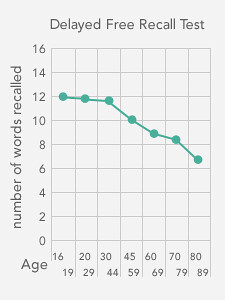
    Plasticity refers to the dynamic rewiring that can occur, most dramatically in the sensory cortex. If you cut the nerve to a thumb, the cortical sensory map changes within 1 hour. Plasticity in adults is why we can hope to adjust the pace of cognitive decline — which follows a constant downward slope from our 40’s until end of life (unless Alzheimer’s kicks in).

    Cognitive Decline by Age

    If we want to mimic neural circuits, the massive interconnectivity of the nodes is a key challenge. The only proposal I have heard for how to physically implement that in a research system involves the growth of neurons themselves.

    And from EPFL: no brain wiring is the same, even in clones. Structural topology and functional spike train variation is immense. There are over 300 types of neurons in neocortex that are structurally and electrically different. And they each have ~200 ion channels from a pool of 20-40 variations. Looking at possible neuronal connections, it’s an all:all structure that is in place. But only 10% of the connections will grow a synapse.

    We can simulate small subsytems, like a cortical column, with arrays of NVIDIA chips:

    Brainstorm

    This incredibly complex system is not ‘installed’ like Microsoft Office from your DNA. It is grown, first along chemical gradients in a fetus, with widespread connectivity sprouting from ‘static storms’ of positive electro-chemical feedback, and then through the pruning of many underused connections through continuous usage-based feedback. From age -1/2 to +2, we form millions of new synapses per second… day and night.

    Much of the power in bio-processing comes from reentrant mapping and the use of feedback in the electrical, physical and chemical domains.

  17. As to the question, is the LHC bottoms up?

    I view it as a traditionally engineered system that studies a low level phenomenon in the hierarchy of abstractions in science. Perfect determinism at a low level of the physics does not imply a lack of richness (complexity and unpredictability and free will) at a higher level. It has to do with computational complexity. Just because simulating the world like the Matrix is a theoretical possibility in the reductionist sense, the computational complexity of the simulation is precisely the same as the real world. But lacking quantum computers, not even a nanosecond of an interesting subset of that world (like the room you are sitting in) could ever be perfectly modeled even if all of the universe was dedicated to that simulation, for all of time. I put that in the category of impractical. =)

    And with quantum computers, where you can approach a 1:1 mapping to quantum variables, the elements of computation are still much larger than the subject of simulation. So the best quantum simulator is the real world itself and the experiments that we can run here.

    For a bottom-up evolutionary alternative to design, you want variation and selection on rapid time scales. Over time, the locus of evolutionary progress rises in layers of abstraction – from chemicals to informational pointers to systems switches to networks to technology (which then follows the same sequence). The pace of progress of each new hop dwarves the predecessor into glacial irrelevance. And so, biological evolution is ceding to the pace of human interaction (mimetically, as seen in cultural drift, and purposefully, through reentrant loops into lower levels to evolve evolvability itself).

  18. Easy for you say…..
    (A Luddite writes…)

    On a serious note….if you are saying computers/circuits etc can mimic human brains…I have great doubts..
    Just think of the visual data we process 16 hours a day….
    Mind you I am not a tech guy….but that must be trillions of "bits" of data…every hour…
    And yet 15 years later,while sleeping (dreaming) we can see (recall) the exact scene..
    (Similar analogy (maybe) is the guy who can look at a Rubik’s cube…and then solve it blindfolded.. )
    Mind you I think a specifically designed computer could do that in a flash…
    A computer may win a chess match…but I would never want it to start thinking for me…
    (If that is where this complex thread is going…)

  19. It’s a representational challenge. The brain does not store scenes as a bitmap, nor would an AI.

    Jeff Hawkins ends On Intelligence with a call to action: “now is the time to start building cortex-like memory systems… The human brain is not even close to the limit” of possibility. He estimates that the memory size of the human brain is 8 terabytes. (blog)

    I would want a computer to think for me. Driving and flying to start…

  20. Wow….that was quite a hash over of AI in general.Most of it over my head…
    My favorite comment (naturally);

    "We’ve probably already managed to build a system with greater memory and raw processing power capability than let’s say a cat. Still, without an equally complex "pipeline control mechanism", a cat remains vastly more intelligent. We can see the neural pathway that’s invoked when a person’s thinking about the color blue, but do we really understand how it all works together? Do we really understand the principles that govern the development and complexity of interconnectivity?"

    Personally,I think the electrical activity in the brain…in terms of neurotransmitter release,in terms of amounts,types and structural patterns allows a lot more complexity than any binary (I mean zero-one) system can have.No matter how many wires and switches it has…
    But again I am strongly biased here….
    just as I sense you are in the opposite direction…!!

    Do you still write that blog…?
    (or whatever it is…)

  21. too much work. text is hard. a photo immediately conveys whimsy vs. dedication and does not waste people’s time if it’s whimsy. video is the hardest format, IMHO. You have to invest a lot of time as a viewer before you know if it was worth it.

    I’m not sure if I have a binary bias. Analog computers may be the future. Carver Mead thought so. It’s just a matter of computational complexity. Is there any particular reason that humans are special, other than we’d like to think so?

  22. [http://www.flickr.com/photos/jurvetson] You should still have to write down, or have someone transcript your talks / photo comments (like these). You have a lot to say, and (un)fortunately text is still our substrate of preference for storing knowledge. Pictures are good, for all that you mention, because they are a simultaneous form of acquiring knowledge, more brain-friendly, as opposed to the sequential nature of spoken language, but still, text is what we still we primitive humans rely on to build knowledge….

    My comebacks: Fan-out = thank you. I understood the analogy alright, then, but it was not happy the way I posed it (plasticity)… got it.

    I don’t think that we are (I was) trying to make similar one thing to the other, I was simply trying to make an analogy to understand the relation between the two concepts.

    I don’t personally think that binary is the way to mimic the brain. Nevertheless, it’s of value of its own (re: [http://www.flickr.com/photos/daveh56] . I am certain that the brain does not think binary. It’s too clumsy a substrate. It’s sequential (again) and the brain activity is simultaneous… and I don’t think that a lot of parallel logic gateways (or whichever the node) working together can make a neuron, neither of course a neural network, just like Steve puts it (better than me, and if I got it right).

    About the HLC, ok. I understand, but I admit your explanation in the details exceeds my background. But I understand your view on it.

    On analog… your last comment… it rings to me for my intuition on the importance of the observance of the continuum nature of everything that is. I don’t think binary is a way to mimic our intelligence, but anyway, do we have to find a way to mimic it? We may be building several forms of intelligence, and hope for them to interact and bring together some other forms of intelligence. Like you say, there’s nothing special about humans, but the fact that we cannot understand ourselves… our nature is curious and our intelligence is in some way crafted to be attracted to what we cannot understand… well, we cannot understand ourselves, and how we think (about everything and about ourselves)… this redundancy is what I think it make us special to ourselves…

    I am reading The Philosophy Book I got in Santa Monica (as a refreshment of old ideas before plunging into the other big books in my list) and my mind is cracking…

    And I cannot but feel hopelessly and an idiot in conversations like these right now… All my scaffolding of thought is at stake (it’s my normal sign of growth, tho)

    Thank you.

  23. oh, and I agree totally with: [http://www.flickr.com/photos/jurvetson] "And so, biological evolution is ceding to the pace of human interaction (mimetically, as seen in cultural drift, and purposefully, through reentrant loops into lower levels to evolve evolvability itself)."

    Just one question: Why do we have to be so focused in accelerating purposefully evolotuionary time? I mean, I thought that the acceleration of change is an unintended consequence (TED) of our work, but not a goal in itself, or is it?

  24. [http://www.flickr.com/photos/gi]

    "biological evolution is ceding to the pace of human interaction (mimetically, as seen in cultural drift, and purposefully, through reentrant loops into lower levels to evolve evolvability itself)."

    Not so sure on this one…
    We are probably just a flash in the pan on this planet…
    Flashier in some ways than the Dinosaurs….but probably just as doomed..
    A more successful prototype at best…
    Some of these ideas just remind me of the fascination that a primitive culture gets when it is able to (first) see its image in a mirror…
    (well…back in the 1700’s etc..)
    Probably a ? better (more successful) life form is evolving away out there…somewhere near a nicer galactic neighborhood…
    Maybe they have figured out how to evolve,create and control things better…
    Maybe they have bigger recycle boxes…whatever.

    (I am still waiting for the signal to join and lead them…)…(!!)

  25. [http://www.flickr.com/photos/daveh56] Dave, I think we cannot be compared to the dinosaurs. That idea reminds me of the fascination a child feels when reading his first book on dinosaurs… 😉

    What is a better life form? Can you define better in this context? For your comment, your vision of "best life form" has attributes of: knowing how to evolve, knowing how to create and control things better (ej> bigger recycling boxes). I am not sure that those are things which could define a life form as better than another.

    Like Arthur C. Clarke said:

    "It has yet to be proven that intelligence has any survival value."

    Perhaps the final conclusion in "the end of times" will be that intelligence (like in humans) has no survival value, and all life forms everywhere in the universe with such traits perished…

    Perhaps a successful life form from the evolutionary perspective is just about sustainability, not about increased complexity able to develop intelligence enough to modify and manipulate "artificially" -with an intelligence like ours- the system they belong to for the most strange reasons, apart, against and regardless many times of that only one: sustainability.

    But, yet again, life is an outcome and not a target in the evolution of the universe. Otherwise we couldn’t be talking of evolution. I don’t think there are best or worst in the universe, but in our thoughts. We have no mission assigned. we don’t necessarily have to be better than. Having that in mind, I believe it’s anyway a "good" thing that we humans want to evolve faster (re:question to steve) or affect evolution ourselves. I prefer that to live unaware and unintentionally [probably because I am human and I am already aware and living intentionally]. But the question is still the same: from a universal point of view, how cares?

    But even in this cynic escenario, (and I would like to know if you were thinking along this line when you made the comparison) I still don’t think humans can be compared to dinosaurs, nor that we will have such an end. I don’t think so, not out of hope, but of fact.

    ?

    🙂

  26. [http://www.flickr.com/photos/jurvetson] Oh, thinking again: Socrates didn’t write anything in his life. But he had Plato at that time. Maybe you don’t have to write in the orthodox way, but leave your minds footprints like this, all over the place, and someone will naturally curate(*) them and publish them in an orderly fashion some day. Hope it’s not post-mortem.

    But remember that writing books is cool and people consider that and tend to give you more "clever" points in their score. Not that you need more of those points, but, well, you know… they are always welcome.

    (*)Remember my comment: "curation" is this new decade’s word, like "design" was in the 2000’s… We have to learn how to include it in our daily vocabulary. 😀

    Now, giving it a little more thought, perhaps this pattern I see in the use of words has to do with a real thing going on, not just fashion. The past decade piles of new information were created, processed, published and poured to public access. And in this process, design had an active role, as a key component of the carrier and vehicle of that phenomena (technology). Now, this next decade, curation will play a key role after the past decade as the sensible way to collect, store and organize what emerged the past decade (and put it in relation with what existed before).

  27. [http://www.flickr.com/photos/gi]
    Good morning !
    Well dinosaurs was just a "toss out example"…
    But maybe one day we will be referred to similarly….

    Success for a life form implies sustainability….no ?…Ultimately ?
    Not so much quality of life…or even longevity of each particular organism…
    Crocodiles and cockroaches come to mind…I realize that one can easily make fun and say who wants to be a successful cockroach…!

    Do we not want to reproduce and feel it will be better (or at least as good) for our offspring ?
    This is the imperative for all life forms…(Darwin)
    Maybe for mechanical,computer "life forms" its different…(!!)

    So,….. even though I personally have no children….I fret about the future,….
    Heck…I am sure the oil supply and global warming etc will not impact me so much…(!)

    So my quip about "bigger recycle boxes" is not so lighthearted…
    There is NO WAY we can sustain this planet,and our lifestyle on it another 500 years at this rate…
    When are we supposed to run out of oil…?
    50 years…?
    SJ,and others continue to believe that we will "think our way out of this"…(mess) and I follow his ideas with interest…
    I guess why I get so fired up here (often)….is that I see no evidence of this impending success at all….Our genetic modification of bacteria (so far) scares the heck out of me…if we screw it up.
    etc,etc
    Having said that I haven’t the foggiest idea what the solutions are…I suspect there is not one (possible) at this point…honestly…so I am a little discouraged…..
    Wasn’t it Hawking who recommends we start building an exportable colony soon…?
    As for us left here….?
    Maybe an asteroid impact….then another 10 million years of (re) evolution…
    Etc…
    Meanwhile I think we are just "speeding up the merry go round"…
    10 million people a year in India can buy their first car…and do.
    This is the main result of our "progress"….and it just feeds into it all…
    Short term thinking…………
    (You can see the same destructive effects of this in the financial world….computer driven trading has been a real negative in so many ways….)

    OK…gotta go take my medication now…
    !!!

  28. Off world colonies. Yup. Working on that too…

    a) locally

    b) Seeding other solar systems: I had dinner with Craig Venter on Thursday, and he suggests that the best way to send biological material over the long distances of space is to not send germplasm at all (and try to protect it from radiation). Instead, send a library of code and a set of sensors to analyze the local environment. Then synthesize the genomes of interest at the destination. Seems like a more promising panspermia package to me.

  29. Hmmm….
    What did Elton John say about Mars ?

    "Mars ain’t the kind of place to raise your kids
    In fact it’s cold as hell
    And there’s no one there to raise them if you did"…

    Luckily, we have a spacecraft out looking at other real estate right now;
    science.nasa.gov/missions/kepler/

    Location,location,location….

  30. [http://www.flickr.com/photos/daveh56] I see. 🙂

    Birth control is more feasible solution in the meantime… we are abuot too many and the thing is getting exponentially troublesome. I don’t see why we cannot enforce birth control policies at a global scale, when we are spending such amount of time, money and resources in combating famine, for example. Famine is a clear example that the population of a country exceeds it’s sustainable amount. Therefore, we should control brith rate, as we try to better the conditions of the existent population and gain time for other systemic solutions to unfold.

    I don’t think we will be able to colonize any other planet in some reasonable time ahead, however we can begin preventing overpopulation right now. This doesn’t mean that we shouldn’t study ways for outter colonization to happen one day, of course.

    The solution will have to be multi-causal…

  31. [http://www.flickr.com/photos/gi]
    Bingo….good comment.
    But this is just another "great idea"…that is not going anywhere….
    ? People in poorer countries see more children as an asset…?

    Meanwhile I am pretty sure the $$ spent on military activity in the last 15 years (globally) could have solved any number of our problems…eradicated Malaria,etc,etc.
    But apparently we are now taking on an extra war (as of today…)
    !

  32. Yes, poor people are said to take offsrping as an asset (a kind of feeling of having any buying power)…

    But this would be policy, not preference. So they would have no option but to get gelded after a second child, for example. It’s not about not letting people have children, it’s about sanity, in all its aspects. And reality and common sense. I don’t see it rational at all to be spending money in fighting malaria (finding cures to problems) without population control (prevention being made)

    If we are so easy to understand and implement pest control, why is it so difficult to understand that we humans are a pest to the Earth and we need pest control, by the means of the least cruel method, which is prevention?

    I think it can work out, given the governments commitment of course. I know it can be considered an economic turn off, but we have to begin to see things systemically and long-term (sustainable), not short-term and partially.

    RE: wars. Absolutely. But birth control can be enforced even when wars are still an issue… Btw, the countries who have overpopulation and malnutrition problems are usually highly corrupted and depend on external aid to help them with their problems… so, why not first talk about correcting that, right?

    It’s so complicated…

  33. I admire your courage to speak so bluntly….
    (Just a marketing suggestion…. Gelding…?)
    !!

    Meanwhile if you look at todays APOD
    apod.nasa.gov/apod/

    You will see that maybe there is a parallel universe…(or many)
    The LHC is potentially able to explore this possibility (don’t ask me how…!)
    http://www.dailygalaxy.com/my_weblog/2010/01/experts-say-cerns-l...

    So….perhaps they are running things better…
    So we can relax !

  34. LOL! ok, it was not a happy word, but it conveyed the message. I didn’t remember another more humane word for that… but the real thing doesn’t change for the word anyway, right?

    WIll read on the LHC.

    The question is, if there are parallel universes, but we can’t inhabit them or access them in any way… how can the sole awareness of them help us solving our problems?

    !!

  35. [http://www.flickr.com/photos/gi]
    So…do you worry about dying ?
    I mean it sounds kinda awful….but my interest in Astronomy has reassured me that "life goes on"…even if its not necessarily going to be here on earth…
    (!)
    But yes…this attitude is a cop out that I have adopted…
    (Serenity Prayer…)
    I must say that I also spend far less time following the (depressing) world news now…

    As for dying…I always quote Woody Allen…
    "I am not afraid of dying…I just don’t want to be there when it happens…"

  36. Oh, well, I must have explained myself wrongly! I am not afraid of dying. Looks more like you are? 😉

    I was trying to understand why you connected the topic on how to solve the world’s problems with the existence of parallel universes!

    If you go up some comments, I made quite a point in the Who Cares -about us- from the universe’s perspective, so I am really not afraid of dying, or let’s say, of my own mortality and insignificance…

    I really don’t buy that about trying to fight the aging processes to make us immortal one day. I find it quite disgusting the idea, like the way of some scientists to try to achieve an afterlife on earth by scientific means, given that they cannot get one by religious means. Me, I don’t need an afterlife, here or there, thank you. Living what my body is apt for will be fine… 😀

  37. Good spot for us to close…
    (and give SJ a rest, !)
    Nice chatting !
    🙂

  38. [http://www.flickr.com/photos/24270806@N06]
    You need to find Dr Doolittle….
    Despite the 400 (?) word languages of dolphins and parrot’s etc….its the lack of communication (I think) that is keeping cats (etc) from getting ahead.
    But then I may be wrong here..
    Being able to smell Velveeta from 50 feet…or finding the same river you were spawned in are examples of remarkable ability in animals…
    But having a (larger) olfactory cortex is not even close,I think to the extra chunks we have.
    I think Carl Sagan had a book on this in the 80’s…

  39. Do you need words/language to "think"…?
    Good question…

  40. actually cats and dogs are more intelligent when it comes to smells… can read more (ignoring strange taste preferences)… maybe new AI can benefit from other species… fly like a bird, read smells like a dog, swim like a dolphin and live longer like an elephant… why not? I believe humans can live longer than 100 years… one can learn more and evolve more with more time… this thought I heard from a very young person (a kid) first, it was not my own… it took me by surprise at first… but honestly, after reading a few books here and there… slowing down aging is a real area of research in our days… not a dream any more… they already did it for mice… probably doing it for humans as we speak… China is leading the way (somewhere in secret labs) since the cost of human life there is zero… for better and for worse… so they can experiment as much as they want and they are not concerned about intellectual property (rather spooky!)…

    i love my hamsters – we have one thing in common, first goes the curious nose… then the rest of the body:) although one thing mother nature got wrong with hamsters – they eat their own babies… still did not recover from this experience… hope our AI will be more advanced in terms of consciousness… kinda like elves in Tolkien’s stories….

  41. Some folks here might very much enjoy finding a copy of Charles Darwin…
    The Descent of Man
    In chapter 7 (notes at the end) he writes a surprisingly thoughtful bit on the differences between animal brains and man..
    Bit of a slog but the chapter on sexual selection,for example, is fascinating.

  42. [http://www.flickr.com/photos/24270806@N06/ ] – "my cats can lie" cracked me up… but then I realized that my cats spend much of the day lying!

    P.S. in response to a question on YouTube about my comment on the fascinating case of evolving algorithms in FPGAs, and the lessons on how "life will find a way", someone pointed me to this fine article which concludes with: "While today’s computers politely use programmed instructions to solve predictable problems, these adaptable alternatives may one day strip away such limits and lay bare the elegant solutions that the human mind is reluctant– or powerless– to conceive on its own."

Leave a Reply to jurvetson Cancel reply

Your email address will not be published. Required fields are marked *