Canon EOS 5D Mark II
ƒ/6.3
50 mm
1/25
1250

Three vintage bipropellant engines from the space race. Each of them was used for maneuvering in space, and each has a simple solenoid valve assembly, which allows the fuel and oxidizer to spray into the combustion chamber. These particularly noxious hypergolic chemicals have the valuable property that they ignite spontaneously upon contact, in a vacuum, with no spark required.

From left to right:
• Gemini SE-6, provided attitude and maneuvering control for the Gemini spacecraft. Pitch, roll, and yaw torques were obtained by firing these engines in pairs. Sixteen SE-6 engines made up the Reentry Control System (RCS) in the nose of the Gemini spacecraft. Made of steel and an ablative nozzle by Rocketdyne, these engines produced 25 pounds of thrust.

• Apollo Command Module SE-8: A set of 12 of these Rocketdyne RCS engines provided the Command Module with rotation control, rate damping, and attitude control after separation from the Service Module and during re-entry. The engine has had several test firings. Described in detail when it first arrived. 93 lbs. of thrust.

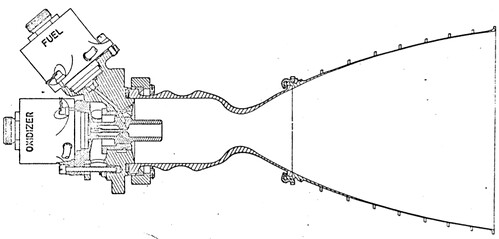
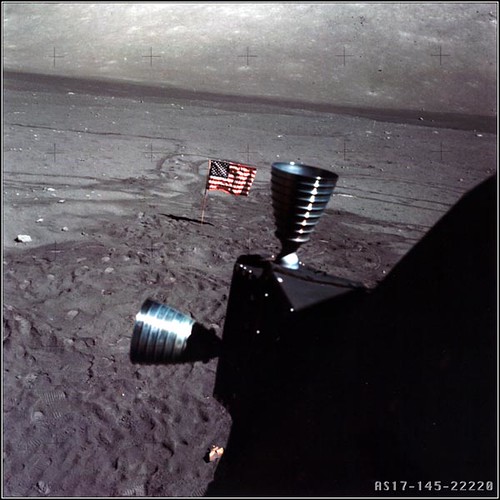
• Apollo Lunar Module R-4D: The most difficult to find, clusters of four of these engines were an iconic external feature of the Lunar Module and Service Module. I’ll post some photos below from the moon. This one is still fully functional and came directly from the manufacturer (Marquardt Corp.), where it was test fired. Molybdenum nozzle, radiation cooled, 100 lbs of thrust. Part Number 228686-501. Test fired four times in Apollo LM testing. I posted a detailed writeup on this particular R4D, and some pretty pictures, in the comments below

The fuels are similar, but the valves become more complex for the main Lunar Module Descent Engine and Ascent Engine.

27 responses to “Apollo Rocket Engines: SE-6, SE-8 and R-4D”

  1. Clear view of the R-4D on Apollo 17:
    NASM Apollo 17 AS17-145-22220

    Diagram
    Buzz leaving the LM, R-4D cluster at mid-left:
    aldrin leaving lander

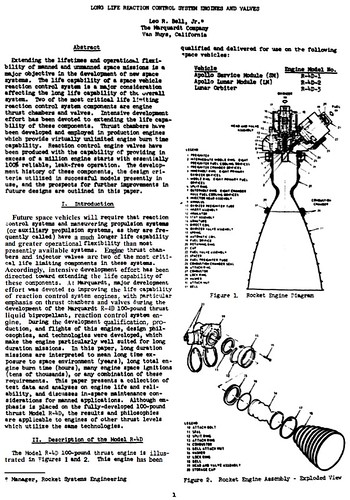
    Research report conclusion: “Reaction control engine valves have been produced with the capability of providing in excess of a million engine starts with essentially 100% reliable, leak free operation.”
    Long-Life RCS
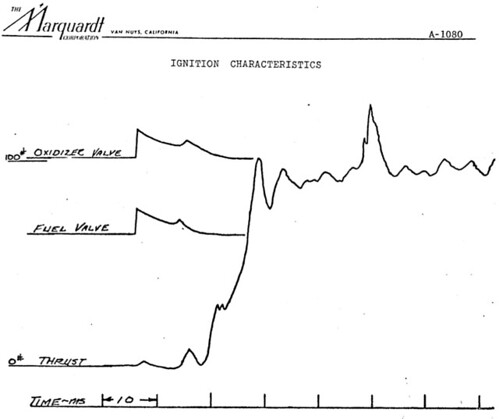
    Gotta love their data analysis tools….
    Igniter test Curves

    Endurance testing
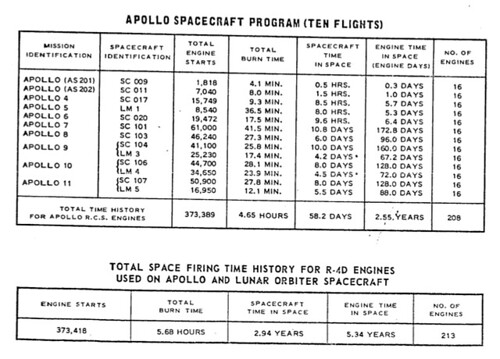
    Apollo Test Flights

  2. You’re quietly acquiring the pieces to build your own Saturn V, aren’t you?

  3. "A million engine starts with essentially 100% reliable, leak free operation!" Sounds like we need to have the designers work on the rest of the essentials that we use here on earth too! I grow weary of buying the same things over and over again.
    Nils, I think his office is actually just a front for a large spacecraft. One of these days we are going to see Steve post photos from the surface of Mars =)

  4. You are bargain hunting the Apollo program…!!

  5. "Where does he get those wonderful toys?"

    🙂

  6. Nice… but what was the stories behind that particular motors/engineering samples??

  7. If you’re ever interested in acquiring a window from the Apollo spacecraft, remember I have one. Make me an offer…

  8. Old and shiny… nice.

  9. [http://www.flickr.com/photos/tomitapio/]
    good point…!
    Us gadget fans are drawn like moths…!

  10. Love these! Grew up in Houston as a kid when all this was going down. It still draws my eye. Can’t beat the chemistry – spontaneous ignition is handy when you are far from home!

  11. Impressive piece of history!

  12. the R4Ds are very recognisable… if u look at LEGO models of the Apollo lander module, there are tiny rocket engines just like that 🙂

  13. When are you opening the museum???? Opening night invites for the Flickr team???

  14. I got distracted by the Rocketeer’s Apollo window offer above and fell behind on thanking photon~wave and avlxyz for the links.

  15. I just got Volume 2 and 3 of the Apollo SM-LM RCS Engine Development Final Report.
    Volume 2 contains a reference to this exact engine (228686-501 S/N 0331). It was one of two used for LM engine tests using helium instead of nitrogen to address a thrust instability problem that arose with nitrogen. It was fired four times (per the table) and worked like a champ.
    Screen shot 2010-11-11 at 2.06.51 PM
    Screen shot 2010-11-11 at 1.55.26 PM
    Screen shot 2010-11-11 at 2.09.41 PM

    Some other cool stuff from the 864 page document….
    Screen shot 2010-11-11 at 1.50.14 PM
    Screen shot 2010-11-11 at 2.32.45 PM
    Solenoid cutaway view:
    Screen shot 2010-11-11 at 2.35.42 PM
    Screen shot 2010-11-11 at 2.36.55 PM

    You gotta love the pre-CAD/CAM era…
    Screen shot 2010-11-11 at 2.40.10 PM
    Screen shot 2010-11-11 at 2.40.28 PM

  16. an interesting update from Marquardt Engineering:
    "I read the section on firing the engine w/ entrained or dissolved GHe. The report says that bubbles won’t happen in flight because the tank bladder isolates the He from the propellants. Not true, we now know that the bladder matl is permeable to GHe. On long duration missions, like satellites with 10-15 yr life spans in orbit, the propellants do get saturated with the pressurant. So it is now standard practice to conduct all ground tests (acceptance and qual) with He saturated propellants. Qual tests always include GHe ingestion tests where a known bubble of helium is intentionally fed into the engine (ox/fuel separately and also together). The concern being the oscillations will trigger a combustion instability or a thermal runaway condition. The engine must resume stable operation after gas ingestion to pass the qual test."

  17. Wow, what a great piece of history!!!

  18. very interested in the apollo lunar modular. i actually have one myself and would like to get involved in your group, is this possible?

  19. Oh sure. Anyone with a LM at home is welcome! Email at SteveJ@Boxbe.com
    I am very curious as to what you have…

  20. i tried to email you with a photo of my apollo rocket engine but your email wouldn’t accept my email?

  21. my email is randymentzer@comcast.net. Randy worked at Marquardt until they sold to the company in Washington, so please feel free to email at any time, have lots of info you might want, Bonnie Mentzer

  22. And this just came out in EDN: Chronicles of Grumman’s 1960s Lunar Excursion Module development

    "The RCS (reaction control subsystem) serves to stabilize the LEM vehicle during descent and ascent and to control the vehicle attitude about, and translation along, all axes during landing, rendezvous, and docking maneuvers. The RCS consists basically of 16 thrust chambers supplied by two separate helium-pressurized propellant-supply sections. The 100-pound thrusters can be fired in a pulsed or continuous mode and are radiation-cooled. The thrusters and the dual propellant-supply sections make up two parallel, independent systems. The propellants are identical to those used in the descent and ascent engines. The ascent-system propellants can be used to supply the RCS thrusters in certain operational modes."

  23. Reposting comment photos hidden by new flickr format…. Clear view of the R-4D on Apollo 17:
    NASM Apollo 17 AS17-145-22220

    Diagram
    Buzz leaving the LM, R-4D cluster at mid-left:
    aldrin leaving lander

    Research report conclusion: “Reaction control engine valves have been produced with the capability of providing in excess of a million engine starts with essentially 100% reliable, leak free operation.”
    Long-Life RCS
    Gotta love their data analysis tools….
    Igniter test Curves

    Endurance testing
    Apollo Test Flights ———————————- I just got Volume 2 and 3 of the Apollo SM-LM RCS Engine Development Final Report.
    Volume 2 contains a reference to this exact engine (228686-501 S/N 0331). It was one of two used for LM engine tests using helium instead of nitrogen to address a thrust instability problem that arose with nitrogen. It was fired four times (per the table) and worked like a champ.
    Screen shot 2010-11-11 at 2.06.51 PM
    Screen shot 2010-11-11 at 1.55.26 PM
    Screen shot 2010-11-11 at 2.09.41 PM

    Some other cool stuff from the 864 page document….
    Screen shot 2010-11-11 at 1.50.14 PM
    Screen shot 2010-11-11 at 2.32.45 PM
    Solenoid cutaway view:
    Screen shot 2010-11-11 at 2.35.42 PM
    Screen shot 2010-11-11 at 2.36.55 PM

    You gotta love the pre-CAD/CAM era…
    Screen shot 2010-11-11 at 2.40.10 PM
    Screen shot 2010-11-11 at 2.40.28 PM

  24. Just took a photo of the R4-D cluster on the LM-2 at NASM

Leave a Reply

Your email address will not be published. Required fields are marked *