I launched my 9 ft. tall Sledgehammer rocket at DairyAire with the biggest motor I have flown in California – an Aerotech M1850. I just posted a HD video compilation (weaving the rocket’s onboard videocam, the pad cam, and a tracking videocam back at launch control).

On-board computers detect apogee and deploy the parachute. They also recorded a max speed of 430 MPH and 8 g’s of acceleration.

The rocket takes video the whole way, and amazingly drifts back over the flight line to land near its launch pad.

15 responses to “Sledgehammer M1850 Pad Cam”

  1. Wow! that was kewl! great video..

  2. Data log from one of the flight computers (HCX-100):

    Sledgehammer M1850 DairyAire HCX

    Looking at the red accelerometer, you can see positive thrust until burnout at 4 seconds, then air drag for 19 seconds, punctuated by a pop of the explosive charge blowing off the nosecone and parachute bundle. The parachute unwraps and catches air at 24 seconds bringing the airframe to a jostling halt and beginning her long, slow drift back to Earth.

    Launch photo I took with the long lens:

    Sledgehammer M1850 DairyAire 6455_2

  3. Wow. That looked and sounded incredible. The video rocked…. very well done.

  4. Damn, you are picking up your game!

  5. Steve, I was thinking this was your L3 rocket… But not dual deploy?

  6. Interesting to see the LOSS of acceleration during the boost phase…as drag builds up…the rocket motor is most efficient at zero airspeed..
    (I would be interested to (re)see a graph of drag versus airspeed for small rockets…its scary stuff.
    It was this small scale/low mass/drag effect (frankly) that caused me to sort of decide this was "scalable" but unwinnable game…
    In astronomy we have more tools to battle atmospheric effects;
    Narrowband filters
    computer stacking
    signal averaging
    adaptive optics

    As well,unlike Keck,etc,we can spend ALL the time we want on a particular exposure…no research schedual to keep to…
    So we do not need to go to mountain tops or have 10 meter scope mirrors to level the playing field (somewhat…)
    Small scale can deliver…
    (Trying to convert you…!)

    Not to take anything away from it…and really enjoying the pics,and yr site…
    Great stuff !

  7. Have you done any experiments for fun with your rockets? (aeronomy, astronomy, guidance, atmospheric chem, etc..)

  8. So far, I have focused on video capture with various configurations (wide-angle side view, downward pointing strap-on-cams, wireless transmission) and some RF/GPS tracking with real-time overlay onto Google Earth (thanks to Tom’s military satellite link in the desert =)

    Active guidance is illegal, unfortunately, but we can deploy gliders or UAVs or rovers at apogee. Tom has a very cool astrobiology project in the works, with the first test launch this summer. Details:

    Is that a rocket in your garage?

    DixonTJ: Yes it was my L3 Cert rocket, but in a shorter configuration. I had the very first prototype build of this puppy, and so it is a bit unusual (but super strong on the tail end). Instead of a piston, I used some of the design mod components to add a large video bay segment mid rocket. I could fly dual deploy, but for a rocket this fat and this heavy, it tops out just over a mile up, and so I have not found the need. I just use dual deploy for the supersonic screamers that disappear from sight.

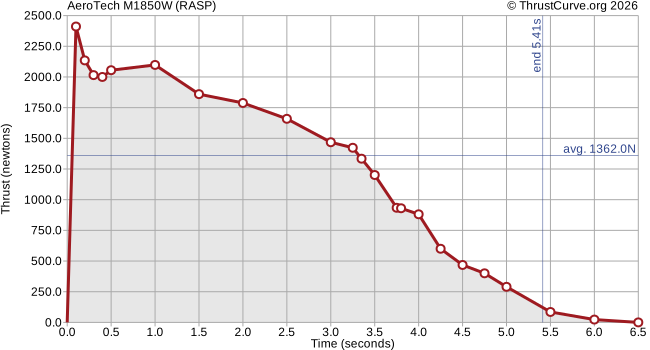
    DaveHalliday: During the first 4 seconds, a big part of the acceleration curve relates to the thrust curve of the motor. As the propellant burns from the core out, the thrust is not linear:

    P.S. the SpaceX Falcon9 live webcast is underway…. Will likely be a long wait though, to set expectations properly….

  9. Very nice video! It got pretty stable there towards the end.

  10. Up!

    Aim for the sky and try not to miss.

    She has had seven successful flights so far.

Leave a Reply to karl.simpson Cancel reply

Your email address will not be published. Required fields are marked *