

Canon EOS 20D
ƒ/4
18 mm
1/60
400
(in the J.J. Abrams sense)
Photo from the sender…. ready to ship out today…
It’s huge… It’s heavy…. a hyperbolic hypergolic!
(in the J.J. Abrams sense)
Photo from the sender…. ready to ship out today…
It’s huge… It’s heavy…. a hyperbolic hypergolic!
A "Lunar Module Descent Stage Rocket Engine Thrust Chamber"?
http://www.apolloartifacts.com/2007/09/tr-201-bipropel.html
The combustion chamber consists of an ablative-lined titanium alloy case to the 16:1 area ratio. Fabrication of the 6A1-4V alloy titanium case was accomplished by machining the chamber portion and the exit cone portion from forgings and welding them into one unit at the throat centerline. The ablative liner is fabricated in two segments and installed from either end. The shape of the nozzle extension (not installed on the example in this collection) is such that the ablative liner is retained in the exit cone during transportation, launch and boost. During engine firing, thrust loads force the exit cone liner against the case. The titanium head end assembly which contains the Pintle Injector and propellant valve subcomponents is attached with thirty-six A-286 steel ¼ inch bolts.
In order to keep the maximum operating temperatures of the titanium case in the vicinity of 800 degrees (F), the ablative liner was designed as a composite material providing the maximum heat sink and minimum weight. The selected configuration consisted of a high density, erosion-resistant silica cloth/phenolic material surrounded by a lightweight needle-felted silica mat/phenolic insulation.
The Pintle Injector, unique to TRW designed liquid propulsion systems, provides improved reliability and less costly method of fuel oxidizer impingement in the thrust chamber then conventional coaxial distributed-element injectors typically used on liquid biproellant rocket engines.
Dry mass: 300 pounds (with Columbian Nozzle Extension Installed)
Length: 51 inches – Gimbal attachment to nozzle tip (minus nozzle extension)
Maximum diameter: 34 inches (minus nozzle extension)
Mounting: gimbal attachment above injector
Engine cycle: pressure fed (15.5 atm reservoir)
Oxidizer: 50/50 N_2O_4/UDMH at 8.92 kg/s
Fuel: monomethyl hydrazine at 5.62 kg/s
O/F ratio: 1.60
Thrust: 42.923 kN vac
Specific impulse: 303 s vacuum
Expansion ratio: 16:1, 43:1 (with Expansion Nozzle)
Cooling method: quartz phenolic chamber ablation and columbium (niobium) nozzle radiation
Chamber pressure: 7.1 atm
Ignition: hypergolic, started by 28 V electrical signal to on/off solenoid valves
Burn time: 500 s for total of 5 starts; 10 350 s single burn
exactyl! But with the injector and plumbing still attached. (There is a similar thrust chamber, also missing the injector manifold, on display at the Chabot Science Center.) I’ll take photos when this one arrives as it may be the only complete unit in existence.
Rocketeer: it is just going to show up in the lobby as it is too big for my office. Will hope everyone likes it as much as I do…. or that inertia sets in… =)
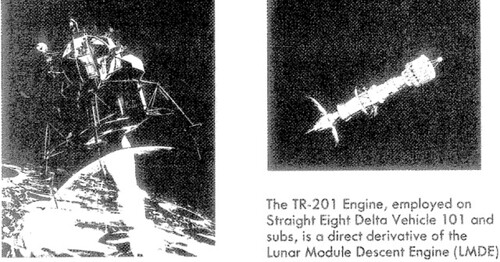
Here is the opening image from a 1976 TRW document on the engine:
I have a cool display plan – it will be on top of a circular stand of the same radius, but with an open center. This will allow for a tilted mirror to give a peek up the skirt…. =)
Here’s what you can see looking way up the nozzle:

Interior Nozzle View – Pintle Injector. On the far left are the annular ports which drizzled propellant down the upper thrust chamber walls, supporting film cooling.


> Oxidizer: 50/50 N_2O_4/UDMH at 8.92 kg/s
> Fuel: monomethyl hydrazine at 5.62 kg/s
Uh-oh.

> injector and plumbing still attached.
> it is just going to show up in the lobby
Uh-oh.
After the biohazards, now this ?
(makes mental note of the proper dress code when visiting DFJ’s offices)

Assume this was from the new NASA online spare parts shop (http://www.rocket-scrap.com) and that it cost at least $49.95 😉
ps: thrust of 42.9 kn = ~9,649.5 lbs which is ~1/3 weight of entire descent package (32,399 pounds). These numbers seem tailored for lunar gravity at 1/6th earth’s.
pps: random fact: In Apollo 13 emergency return to earth, "return to a free return trajectory was performed with the LM descent propulsion system within hours of the accident. The descent engine was fired again two hours after pericynthion (closest approach to the moon) for a PC+2 burn to speed the return. One more descent engine burn was later required for a minor course correction."
OMG Steve! You have gone to a whole new level =) In short order you take things to their limit…and a few months later, you go beyond. "Ummm, limit. What limit?" I love your mindset and the anticipation of what must be coming next! Suggestion…A full Saturn V …please.

Leave a Reply