Canon PowerShot G9
ƒ/2.8
7.4 mm
1/60
125

So when Santa delivered this pine box and electric screwdriver, I was very curious…

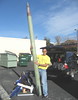
And delighted to find a gonzo huge rocket motor… a bit over 8 ft. tall.

For context, the largest motor I have launched so far is 1/8 the size, a sparky N.

And the Aerotech G motor in the foreground used to impress me… It’s the largest you can buy without a license, but now I see why my mentors chuckled that they make good igniters.

The machined aluminum closures and graphite nozzle are on the left, as well as the infamous o-rings. Next step – anodizing the aluminum. Then we have to pour the solid propellant grains, just like the Space Shuttle boosters.

I’ll post some photos below of the rocket this baby will fly in… Should hit Mach 2.4 on a single stage… and Mach 4.3 and 250K+ ft. altitude with Tom’s two stage bio-sampling rocket.

28 responses to “Q Motor !!!”

  1. Upper stage, upper stage test, RM team shot, Last Q Motor launch:

    Rocket Build Weekend P-Ref  Blastoff Mavericks Team Picture Mavericks QP Blastoff Beagle II On Mavericks Q-18330
    Beagle II Wireframe

  2. Whoa. When/where do you plan to launch it?

  3. Q motor! could very well mean (as read in spanish) : "What an engine!" which clearly applies.

  4. Jeepers, Steve! When I add up the stats for the year, the total of all the motors flown at LUNAR events (the nation’s largest rocket club) from both of our launch sites for the entire year is in the "Q" impulse range. You’re going to match that in one flight!

  5. whoa.

    kbaird: somewhere in Nevada, maybe Black Rock at BALLS for the single stage. Perhaps the RocketMavericks spaceport for the biorocket…

  6. Wowzers!! I knew it was for a rocket when you described the box, but had no idea it was the engine alone.

    Am I reading that right, 26′ tall rocket? & 47 miles up? Sounds like bit more then a garage project, you’d need a road train of teslas to transport it

  7. You left one minor detail out. For the Beagle II we will be flying four of these in the same airframe. 3 in the booster, and one in the sustainer.

    That’s 4 Q’s. Why do you think they call us MAVERICKS!

    By the way, the simulation Steve posted is without any recovery, which of course he will be flying. This plot shows the pure ballistic trajectory.

    If you build anything bigger than this Steve (Which we will!!!) You may have a conflict of interest with SpaceX. 😉

  8. So if I read the simulation graph correctly, after the sustainer burns out it’s still traveling upwards for almost 2 minutes??

  9. Sometimes I check in just to see what Steve is up to. This is over the top insane – serious toys for serious fun, methinks.

  10. Steve, just a question concerning the simulation graph:
    when the rocket is coming down the thrust seems to be zero, but the acceleration increases. How come ?

  11. Deceleration (due to increasing drag) as it comes down?

  12. I can here my wife now, "boys and their toys". You defiinitely have the best toy, Steve!

  13. strange_wax

    What you are seeing is the effect of freefall with no atmosphere. All objects fall at 32 ft/sec^2 accelerated field. From 250,000 feet, its a long time before you hit anything with atoms in it. The tropopause starts to thicken up around 65K. You can see some effects in the upper atmosphere that start to decelerate it, but basically terminal velocity for this beast is about Mach 3 until it hits the atmosphere. Then……watch out!! Clearly we will be using kinetic decelerators to offset this as much as possible.

  14. As I recall the nozzle might have cracked on the last Q motor. Are these nozzles of a different design or construction? I am really looking forward to see your progress!

  15. Congrats! Looks amazing…now its time to put her up in the sky!

  16. Ever seen the movie "Wizkid of Riverton"?

  17. No…. worth seeing?

    conformation: yes and yes… thanks y’all… even Make Magazine… =)

  18. I guess I still don’t understand that acceleration graph. After burnout (and it leaves the substantive atmosphere), it should be accelerating at -32.2 f/s/s (negative 1 g) until it hits atmosphere again. This graph shows zero acceleration until it hits atmosphere, at which point it gets larger positive, not negative. The only way this makes sense is that the graph is using vehicle-centered coordinates instead of world, and that it is tail-sliding vertically.

  19. I think you should attach it to the family SUV.

  20. I see in the NYT today that NASA has dropped the price for surplus space shuttle main engines. They had wanted $400,000 to $800,000 each but now you can have one for the cost of shipping. I immediately thought of you and wondered if you would be adding one to your collection of space artifacts.

  21. Been looking into this…. Trying to convince the RocketMavericks non-profit to set up a museum so we can submit a proper request…

    Wonder if we get bonus points if we want to reuse them?

    jhagerty: Tom is looking into the simulation. I was wondering if the acceleration curve is unsigned.

  22. P.S. When Tom is done with it, it will have modified closures, and a special forward closure ignition system and propellant.

    Which, from this static test, might be a good idea…. =)

  23. The test is amazing….but hope you guys have better luck on your way to 400k!!

  24. nice steve! is loki doing the AP as well or you guys?

  25. Might try both… if all goes well with the home brew….

  26. Latest rendering & astrobiology discussion

    Beagle IV Biosampling Rocket

    and motor blueprint:

Leave a Reply

Your email address will not be published. Required fields are marked *