Canon PowerShot G9
ƒ/2.8
7.4 mm
1/60
100

After reading the book Apollo, I took a closer look at the lunar orbital chart of LM pilot Fred Haise (a really cool birthday gift from my rocket buddy Erik), with the forlorn inscription near the landing site that they bypassed to return to Earth:

“No LM touchdown, but no LM impact either! Freddo”

On approach to the moon, debate ensued on what type of burn to use to get the Apollo 13 lifeboat to loop around the moon and back to Earth. To preserve options and later course corrections, they decided to start with a partial burn to orient the craft in the general direction of an Earth return path.

Since an earlier explosion took out the main oxygen tanks, they improvised and used the Lunar Module Descent Engine (LMDE) DPS engine — the engine from the lunar lander, designed to slow the LM’s decent to the moon — to instead push the crippled Command Module and reentry capsule in an untested manner:

“Finally, at 2:43 in the morning, Lovell pushed the ignition button and the DPS engine ran at low throttle for thirty seconds, putting the spacecraft into a trajectory that, even without a second burn, would bring it down in the Indian Ocean not quite four days later. Lovell was relieved. He wasn’t completely confident that the burn provided them with a survivable entry [angle], but at least the spacecraft would intercept the Earth’s atmosphere. In his mind, this was much better than the alternative that had just been avoided — orbiting the Earth indefinitely, in a lonely revolution with an apogee of 240,000 miles and a perigee of 3,000 miles, a ‘perpetual monument to the space program.’” (Apollo, p.410)

13 responses to “The Course of Apollo 13”

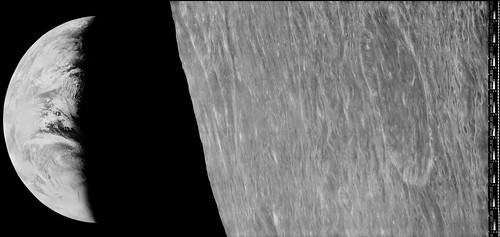
  1. the perspective from up there, recently recovered:

    Earthrise

  2. Good stuff.

    The "perpetual monument" comment reminds me of the comment Bill Anders made on Apollo 8. Lovell said "Did you guys ever think that one Christmas Eve you’d be orbiting the moon?", to which Anders replied "Just hope we’re not doing it on New Years."

  3. Perhaps prematurely pessimistic, but it’s beginning to look like the US is getting ready to cede further manned space exploration to Russia and China. Maybe with India and ESA as possible future participants. But we’ll be green …. with the best windmills gov’t can buy, no doubt.

  4. SpaceX has a place, and I wish them much success, but that’s sort of like Cessna vs Boeing (if they’re lucky). It’s just a different game altogether.

  5. Since it appears we will be locked in LEO without a viable NASA manned rated system for many years (my money is on Ares-1 being terminated due to unresolvable technical issues with thrust oscillation, safety and zero performance margin) Space-X seems well positioned to have a major impact in this area.

  6. "Major impact" might be an unfortunate choice of words to describe Space-X.

  7. I’m probably missing something… how is Space-X well positioned to solve problems typical of such a massive development effort for manned space flight, if Ares is canceled?

    I’ve seen a number of "cheaper, better, faster" programs over the years. When it comes to space flight, especially manned flight, the working corollary for that motto is "you can have any two of the three". And I’ll add, "if you’re very lucky".

  8. "Major Impact" in the context of LEO. Ares-1 is the sub-component of the Constellation architecture designed specifically to address LEO access and it appears the Augustine commission is set to recommend to Obama that LEO rides be outsourced to US commercial vendors. Deep space and lunar/mars human exploration programs will still require government resourcing of course.

  9. Hey, MIT’s Tech Review just arrived, with some photos that remind me so much of my McMoon tour from a year ago… but with a newly recovered scan of the Apollo 13 landing site, marked on the map above…

  10. Maybe AlienessGG =) can do a quick comparison of the before (above image) and after (image below)? Then we can “prove" men walked on the Moon! =)

    Apollo 13/14 landing site

  11. I would not be so quick to give up on Spacex, but not because of what they have today, but what they can acquire tomorrow. The key to Spacex I think is that Elon has been smart to bootstrap the company on a niche. Servicing the Space Station, which NASA has an international commitment to meet, and NASA has no budget or resources to fulfill.

    The key question is going to be the start-ups and innovators that Spacex is able to acquire to rocket it past the traditional thinking at Boeing, or China, or Russia. I do believe that they are going to be difficult to compete with on a cost basis with traditional technology, but the US has the innovative edge and drive to change that equation if Elon can establish an operating model and cash flow to leverage market money to acquire what he needs to compete.

Leave a Reply

Your email address will not be published. Required fields are marked *