Canon EOS 5D
ฦ’/4
28 mm
1/400
800

Electric vehicles are on my mind.

The design space opens up dramatically for EVs, given the small size of the drivetrain and the various options for battery size, shape and location. I like to call it EV 2.0

Itโ€™s like a Cambrian explosion of body plans, from the 3-wheel Aptera motorcycle pod to the Tesla Sedan with weight below the wheel line.

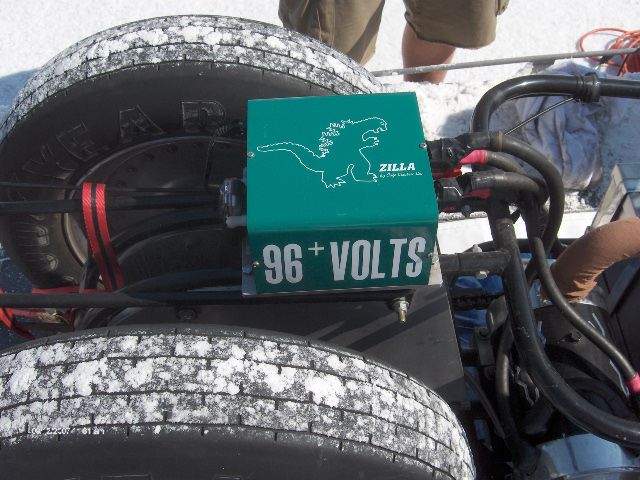
Here, Ian Wright poses with his second Wrightspeed X1 in Monterey, with wider wheels as the car is traction limited in its acceleration. Ian spends about $1/mile for tires, the primary operating expense of the vehicle.

Hereโ€™s the video of my ride in the first X1. With the wind noise, itโ€™s hard to hear my discussion with Ian, so here are some interesting tidbits from the drive:

โ€ข 1/3 the energy consumption of a hybrid (170 Miles Per Gallon equivalent).
โ€ข Like several early cars built by hobbyists, this is a retrofit (of an Ariel Atom)
โ€ข Everything you see is in first gear.
โ€ข The fast stops are regenerative braking (returning energy to the batteries).
โ€ข He accelerates from 0-60 MPH in under 3 seconds with the wider tires. That beats the $1.5MM McLaren F1 and Ferrari Enzo for a fraction of the cost. (Hereโ€™s a race with some other gassy supercars.)

33 responses to “New Body Plans”

  1. That looks alot like the Atom.

  2. It’s built from an Atom.

  3. What do you think of the Aptera?

    It’s sexy, but when I saw it at the TED party I wasn’t filled with confidence in it’s safety… I think it should come with anti-SUV preemptive missile defense systems.

  4. " Ian spends about $1/mile for tires "

    Wow there Ian! You don’t have to nail it everywhere. You’d probably get more than 170mpg if you didn’t drive like you stole it.

  5. I see that a couple of days ago, the first electric car was approved for use on public roads across the EU (they call it "homologated" but that’s technically a mistranslation – this is more like a "certificate of roadworthiness" or "general type approval". )

    It is not quite in the same performance league as the above;-) but you can configure it with a choice of three kinds of batteries – one sodium based and two lithium-based. It is also designed to be able to exchange batteries at a filling station if you don’t want to hang around for charging.

    Flickr refuses to let me post a tinyurl to the reference, but you can find it as the top entry under "press releases" on http://www.think.no/think/Press-Pictures/Press-releases

  6. I don’t think it’s the first, those horrible G-Wizz things have been legal in the UK for several years.

    I’m not sure I’d want to swap batteries though, you wouldn’t know the age, condition or previous use of the replacement set.

  7. I got a ride in the X1 as well (thanks, Ian!)
    Yes, electric drive-train is definitely the way to go for a sports car where absolute top speed or maximum driving range isn’t the goal.
    Seamless, relentless acceleration with no pause for shifting, and pedal control that you really can’t match otherwise. Even if the environmental benefits weren’t there it still makes sense. And today’s batteries are making it do-able, although not exactly the most cost effective at the moment. Here is hoping for more battery breakthroughs to bring this technology into the mainstream.


  8. > they call it "homologated" but that’s technically a
    > mistranslation – this is more like a "certificate of
    > roadworthiness" or "general type approval".

    I think the nuance they want to convey with "homologation" is that it’s more than a mere type certification โ€” it’s a formal sanctioning of the legality of the sale and use of the vehicle in the entire European Union.
    An aircraft, for example, despite having a type certification, might not be legal to operate in all airfields due e.g. to local noise regulations.

  9. Teg2 – I think your underestimating the value of driving range. My nearest racetrack is over 90 miles away, the run there, a few laps and a thrash back can easily add up to over 200miles – something I believe a Telsa would struggle with. If I wanted a fast trailer queen, i could get one for a lot less than the ยฃ92k a Telsa costs.

  10. beautiful – well done.

  11. $1 / mile for tires?!?!?
    would someone please check their math?

    I have 144,000 miles on my Chevy truck… if that had cost me $144k, I may as well start saving for a supercar instead.

  12. Hoosier A6 tires (super soft rubber with 1.19g of grip) $1,000 – $1,600 depending on the source, and he gets about 1000 miles from them.

    Tayne: Different people have different driving patterns. The Tesla can go over 200 miles, but I don’t even look at the range any more as I never get close to that before returning home. And I start each day with a full charge.

  13. now, if you could harness/store (the currently wasted) g-force energy …… interesting ….

  14. @egoboss
    Could you explain what you mean by "wasted g-force energy"?

  15. i would love to buy an electric car, but i’m sure the oil companies will do everything in their power to stop the proliferation of electric cars.
    if the car manufacturers are smart, they would introduce electric vehicles right now, instead of continually churning out monster trucks.

  16. don’t give up hope. Stay tuned ’til Tuesday.

    egoboss – if I understand, electric cars do better than gas cars because of regenerative braking. The motor becomes a generator when the car is not accelerating

  17. Even hybrids, such as the Prius, do better than equivalent gas cars because of regenerative braking. When slowing down, kinetic energy is recaptured and converted to electricity rather than lost as heat in the friction brakes.

    In addition to regen, pure electric cars do better (in terms of energy efficiency) than gas cars simply because of how inefficient the internal combustion engine is… typically about 30%. Think how hot your engine gets… that heat is lost energy. Compare that to the Roadster’s motor which is about 90% efficient

    I’m not sure what egoboss means by "g-force energy". For the most part, the energy used to accelerate the vehicle is not wasted. It’s the work required to change the vehicles speed and/or direction against its inertia as directed by the guy behind the wheel.

    He might mean the energy lost as heat in the shocks when the suspension system gets loaded and unloaded. In which case, it is possible to replace the shocks with linear motors/generators that might recover some useful energy in the form of electricity.

  18. doug, hi – as you can probably tell i know diddly-squat re: physics/et al – just seems that if a force is trashing tyres so aggressively, then that force could somehow be harnessed a kinetic energy for later release, in a manner similar to the current F1 cars re: capturing the forces from braking? no idea, just rambling now, would love someone infinitely better informed than i to explain if remotely feasible?


  19. > if a force is trashing tyres so aggressively, then that force could
    > somehow be harnessed a kinetic energy for later release ?

    The energy loss in the tires of a typical car (the rolling resistance) is quite modest in the overall energy balance sheet.

    Furthermore, rubber isn’t a perfectly elastic material, and doesn’t give back as much mechanical energy as was put in to deform it โ€” i.e. it exhibits hysteresis. The input-output energy difference causing the rolling resistance is lost as heat ๐Ÿ™

    Tire grip is correlated with hysteresis loss, and high-grip tires like the Hoosier A6 will thus exhibit much more rolling resistance and heating up than, say, an "eco" tire.

    Switching from the wide high-grip racing slicks to grooved narrow-ish eco tires would perhaps improve the Wrightspeed’s electric mileage by about 10%, but I doubt such tires would befit the car’s intended usage pattern.

    Still, using low-hysteresis tires seem to be a more realistic solution than trying to come up with a mechanism that would somehow recover a usable form of energy โ€” e.g. electricity โ€” from the heat dissipated in the tires. If such a heat-to-energy conversion system existed, it would already have been applied to the large thermal loss flux generated by an internal combustion engine…

  20. Sticky tires aren’t the most efficient way to go. Harder, lower rolling resistance tires would give more range, but maximum range really isn’t the goal for the X1. Ian is showing that an electric drivetrain can out-accelerate gasoline supercars on the track. He has the low end torque, light weight and power to weight ratio to do it as long as the tires don’t lose traction. To get the traction he needs, those sticky, expensive race tires are needed. You end up using some of your stored energy to keep unsticking those tires from the road as you drive along. I can’t fathom any way to get that energy back… Just the price you pay for this level of high performance.

  21. Just imagine the trailing edge of the tire, stuck like glue to the road, needing to be pulled off of the road to spin around for another pass. The car is constantly doing this.

    By the way, the Tesla Roadster now has two tire options – the standard low rolling resistance, but good handling tires, and the higher performance, sticker "sport" tires better suited to track use. Getting the stickier tire option reduces your range somewhat.


  22. > Just imagine the trailing edge of the tire, stuck like glue to
    > the road, needing to be pulled off of the road to spin around
    > for another pass. The car is constantly doing this.

    I’m not sure whether metaphors like "sticky" or "glue" are the most appropriate to describe the energy loss caused by soft, compliant tires.

    The tire doesn’t "stick", in a literal sense, to the road. At any rate, if it was really sticky, it would quickly accumulate enough dirt on its surface that its adhesive properties would be lost.

    The tire undergoes a compression, e.g. at the leading edge, and a rebound at the trailing edge. The compression stage absorbs the wheel movement and slows down the car. The rebound stage at the trailing edge pushes the wheel, accelerating it, and thus impels the car forward.

    A perfectly elastic material would give back as much mechanical energy at the rebound stage as was stored in the material in the compression stage.
    Hysteretic materials like tire rubber, however, are lossy and convert part of the mechanical input energy into heat. This loss can be demonstrated by putting a rubber block in a press that subjects it to a periodic compressive force: the rubber heats up even if the pressing surfaces remain in contact with the rubber throughout the cycle, eliminating the stick/unstick "glue" factor from the equation.

    Elastic materials with low mechanical hysteresis, like steel, would thus obviously reduce the rolling resistance compared with soft rubber, but the grip achieved by a steel tire would likely be unsatisfactory for most modern vehicles ๐Ÿ˜‰

  23. thanks, nhr – fascinating stuff – what do you think of the KERS systems being used by some of the current F1 cars?

  24. nhr wrote:
    > The tire doesn’t "stick", in a literal sense, to the road.
    > At any rate, if it was really sticky, it would quickly accumulate
    > enough dirt on its surface that its adhesive properties would be lost.

    I have seen plenty of race tires with all sorts of road debris including dirt and pebbles stuck to the sticky rubber. I didn’t use "glue" and "sticky" by accident.
    They try to keep the tracks clean to avoid this sort of thing.
    Here are some pictures of race tires that pick up dirt and debris from the track:
    http://www.marcuccimotorsports.com/billy/enkei/test/compare1.jpg
    http://www.6speedonline.com/forums/attachments/automotive-parts-...
    http://www.skuttlemotorsports.com/images/newtires.jpg
    http://www.explodingdinosaurs.com/saltflats/2007worldofspeed/ele...

  25. Here is another:
    derfotohof.net/autos/tires/Hoosier/two_opr_600_Hoosier.JPG
    I have gone up to race cars after a race and touched a warm tire with my finger and had some of the tire rubber stick to my finger as I pulled it away.
    Also, I have seen races cars round the track leaving a thin trail of tire rubber stuck to the track as they go by.


  26. > I have seen plenty of race tires with all sorts of road debris
    > including dirt and pebbles stuck to the sticky rubber. I didn’t
    > use "glue" and "sticky" by accident.

    That’s all well and nice, but AFAIK, it’s quite difficult to maintain for any reasonable length of time a driving style on public roads that allows tires to reach a temperature of around 100หšC, where the rubber starts to melt and chemically react and bind with the road surface, and the tread starts to deform.

    Tires driven in such conditions are unlikely to last even 150 miles, by the way.

    OTOH, I understand Ian Wright gets about 1000 miles out of one set of tires with his Wrightspeed X1. That car also has a license plate, which makes me suspect that it tends to dwell on public roads. Also note that tire wear is heavily influenced by the suspension geometry settings chosen by the driver โ€” an increased toe-in angle, for example, decreases a powerful RWD car’s tendency to oversteer, but increases the tire slippage, and hence, the abrasion.

    You’re free to believe that glue-like stickiness is the factor that causes energy loss in rotating tires, but I suspect most other people have experienced that tires on normal cars last longer than 150 miles and don’t generally heat up to rubber-melting temperatures, chemically react with the road, peel away, blister, feel sticky to the touch, or accumulate debris on the tread โ€” the odd sharp-edged rubber-penetrating pebble, glass fragment or unwelcome nail excepted (^^;


    > what do you think of the KERS systems being used by some
    > of the current F1 cars?

    I’m afraid I’m not really interested in F1 racing and the accompanying regulatory paraphernalia like KERS, and don’t have an opinion on them (^^;

  27. On the tyre subject, I know plenty of people who run sporting cars with tyres capable of achieving almost 10k miles. I’ve seen quite a few of these pick up small stones on the flats of the tyres on a warm day. It does happen.

    Now back to Ian’s X1.
    He’s taken somebody else’s very fast and very impractical car and spent a lot of money on it (and voided his manufacturers warranty) in order to make it a bit faster(and I am aware that a "bit" at this end of the spectrum counts for a lot) and a lot less practical. Less practical in the sense that a petrol Ariel Atom, and almost all other exotics, can filled up at any one of thousands of petrol stations in under five minutes.

    Just like the Tesla Roadster, a slower and more expensive Lotus, there is a serious practicality issue. That of range and time to recharge. And I mean recharge properly. Empty to full on a standard UK socket is 16 hours.

    Now I don’t doubt the engineering brains at Wrightspeed (and Tesla) but I don’t think there is the big leap forward the the "Ev 2.0" tag implies.

    At the moment these cars are unsuitable for me and a hell of a lot of other people. I don’t think chasing Ferraris and burning off Porsche’s is really the way forward.
    I am aware that the Tesla Sedan is coming in 2011 but thats still only got a potential range of 300 miles and is two years away.

    And please don’t think that I’m some petrol loving luddite writing this out of hate. I would love an electric car, having previously experimented with lpg and my own blend of biodiesel, but right now they can’t work for me. I do drive 300 or miles in a day (once or twice a month) and sometimes find myself driving home at midnight or one am and back in the car at 8 am.

  28. nhr wrote:
    > You’re free to believe that glue-like stickiness is the factor that causes
    > energy loss in rotating tires, but I suspect most other people have
    > experienced that tires on normal cars don’t generally heat up to
    > rubber-melting temperatures,

    The X1 isn’t a ‘normal’ car, and it sounds like you haven’t gotten a ‘proper’ ride in it !

  29. @Tayne – fair enough if you drive 300 miles a month, I’m sure there are a small minority of people that do.

    But I’d be surprised if you drive 300 miles and don’t stop for a bite to eat, in which case we need to get sub 1 hour charging stations in place and then the 300 mile Model S will meet your needs, my needs and practically anyone’s needs who doesn’t drive dangerously long distances non-stop.

    At that point the EV becomes very practical.

  30. And yes, I know that it takes some energy to deform the tires too. Running them at higher pressures can help avoid this, but also hurts traction (less contact patch and all that). I doubt Ian runs the X1 tires at high pressure to increase range. The car is set up for high limit handling, not range, as far as I can tell.

    Tayne, various "answers" to the range concern are being investigated and developed. From high current, sub 1 hour full recharges to battery pack quick swap stations. Perhaps still not yet ready for everyone, but it isn’t to hard to imagine that electric could become a dominant mode of ground transportation someday.

  31. # Jurvetson wrote:
    ## don’t give up hope. Stay tuned ’til Tuesday.

    carscoop.blogspot.com/2009/05/mercedes-parent-company-dai…

  32. what would be the battery range in everyday off road use ? 2-3 hours or less ?

Leave a Reply to TEG2 Cancel reply

Your email address will not be published. Required fields are marked *