Canon PowerShot G9
ƒ/2.8
7.4 mm
1/13
200

The first fascinating speaker in the bowels of the Bio-X building (at the Imitating Life Symposium this morning) was John Donoghue, Professor of Neuroscience at Brown University on the topic of “Turning Thoughts into Action: Neural Interfaces to Restore Movement in Humans with Paralysis”

Here is opens with an interesting image in the bottom left corner – the first cardiac pacemaker (a full push cart of equipment). Neurotech is in an early phase of development, although he notes that 50K people already have deep drain stimulation implants.

“Many diseases impair sensory input but leave cognition intact (spinal cord injury, ALS, stroke, limb loss…)”

He inserts a 4 sq. mm array of 100 neural probes into the M1 arm knob of the cortex. With a random sample of neural signaling from that region of the brain, and some Kalman filtering, patients can instantly control the cursor on screen (unlike biofeedback or sensory remapping which require training). They can deduce motor intent from a sample of an average of 24 neurons.

When connected to a robot hand for the first time, and asked to “make a fist” the patient exclaimed “holy sh*t” as it worked the first time.

Prior to the experiments, open questions included: Do the neurons stay active (other work indicates that the motor cortex reorganizes within minutes of decoupled sensory input)? Can thinking still activate the motor neurons? The test patients had been in sensory deprivation for 2-9 years prior. Will there be scarring and degradation over time? One patient is three years in. What are the neural plasticity effects?

Here is a video overview… just a pop, flip and hump to The Matrix. Wait a minute… John bears an uncanny resemblance to The Architect (below)…


12 responses to “Neurotech”

  1. …crossed with the mad scientist in Jurassic Park

    Matt Nagle, the fist human trial in 2004:

  2. That’s great news. Imagining exoskeletons that can jack into the brain and assist aged, crippled, or maimed people, or create fearsome cyborgs.

  3. As I rub the sleep from my eyes, and fire up my desktop, waiting for
    my 1st coffee, this greets me!! I think you live in an exciting location,
    with a great link to the motivators, but perhaps sensory overload
    may require an alternating rhythm of isolated retreats? If not now,
    then on the agenda …?
    Keep raising the bar, Steve, it keeps those of us in other locations,
    in the circuit. This is a great inspiration to wake up to.
    Spectacular!
    Graphic concept ~

    Invited to "***Earthcare ACTIONS!! ~ ‘FIRST-THE EARTH!’ Photo-ART.
    Please add tag, firsttheearth.

    Find the way to solve the world’s financial crisis, to provide
    enduring eco-NOMIC door-openers for those with no current
    means to participate. That will really excite my neurons!!!
    Have a great evening!

  4. Happy Tin Hat: Yes! Or both at the same time… Thank you DARPA:

    John’s BrainGate team is talking to DEKA

  5. This will have to be non-invasive for me or for my grandkids evolve into a cortical stack. (Altered Carbon)

  6. This is truly amazing! Imagine what doors this opens. It is only the beginning!

  7. Of course, it is inevitable that some day this will lead to elective procedures. Steroids were first used as tools for physical rehabilitation.

    Usain Bolt passed the drug tests, but did anyone check the metal detector? 🙂

  8. Thanks for the infos, links etc.
    Perfect Brainyfood, to wake up with, on a fogy frenchy sunday =)

    Ho and here is another one, from yesterday ; ) The Nano Quantum Architect ; )
    PhotonQ-The Nano Quantum Architect

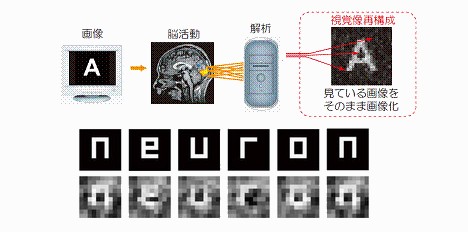
  9. StarrGazr: right you are!! Look at what they just did in Japan, using non-invasive fMRI to tap into the vision system… From pinktentacle

    “In as little as 10 years, advances in this field of research may make it possible to read a person’s thoughts with some degree of accuracy.”

    and before that?
    "According to the researchers, further development of the technology may soon make it possible to view other people’s dreams while they sleep."

  10. whowwwwwwwwwwwwwwwwwwwww…. !!!!!

    "The researchers suggest a future version of this technology could be applied in the fields of art and design — particularly if it becomes possible to quickly and accurately access images existing inside an artist’s head. The technology might also lead to new treatments for conditions such as psychiatric disorders involving hallucinations, by providing doctors a direct window into the mind of the patient."

    Now a question came to my mind.
    What if you show to the subject the bottom blurry line.
    Will his brain "adapt" and see the picture as the "concept" of the letter, or the letter itself.
    And if so..what will come out from the reconstruction and display =) Something even more blurry..or the same !?!
    Blurry question too =P

    Thanks for the news and link Steve !
    Will be following their research closely

  11. Just watched something amazing. Have a look if you haven’ t seen it yet =) :

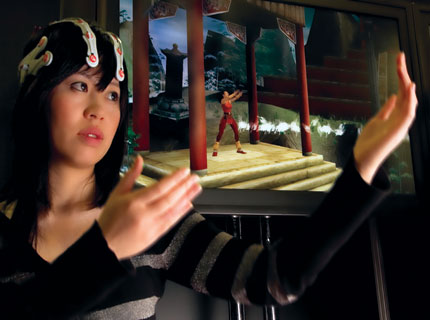
    Tan Le, co-founder and president of Emotiv Systems, gives a live demo of a mind control device that uses a person’s thoughts to input computer commands :

    Tan Le Brings the Force to Life with Mind Control Device

    ( "Use the Force Marvin (minsky)" ; )

Leave a Reply to melcir.meri Cancel reply

Your email address will not be published. Required fields are marked *