Canon PowerShot G9
ƒ/2.8
7.4 mm
1/15
200

When I visited the Everspin spinout of Freescale yesterday, it seemed eerily familiar. Sure, I was born in Phoenix, so visiting the Chandler suburb and the temperature shift from outdoors to air conditioning brought back memories.

But there was something about the stark brightness of the wafer fab corridors. It reminded me of my first real job, at 17, when I got a job at Mostek, the largest DRAM manufacturer at the time. I was testing final product, and they had just introduced ZRAM, a nonvolatile memory consisting of a DRAM chip with a battery on top of the package. Ironically, it is a modern variant of that, battery-backed SRAM, that Everspin is replacing today (with magnetic non-volatile MRAM).

But that wasn’t it.

Then it hit me. Freescale is the semi fab that spun out of Motorola. The reason that I am a U.S. citizen (instead of Canadian, like all of my relatives) is that Motorola brought my Dad to the Phoenix area as they were entering the new industry of integrated circuits. I was born soon afterward. My earliest memories of visiting him at work included a tour of the drafting tables where the ruby lith was cut by hand with Exacto knives (for mask making in the early days of photolithography).

My Dad convinced the nascent team at Motorola that he knew about photolithography because he knew about photography… a tenuous connection at best… but life takes strange turns sometimes.

11 responses to “Déjà vu”

  1. Great story SJ. Adventure at every turn.

  2. Ouch, your description brings back memories for me too. I was using Rubylith — at Motorola, even — at my first ‘real job’ in 1981/82. Oh, memories of the pain of hand layout. It comes all rushing back. It’s one of the reasons I quit and went back to university.

  3. I thought you were a native Texan, Steve.

  4. I got my first research position in a neural electrophysiology lab because I was well versed in issues relating to analog-to-digital conversion, not something teenagers usually get into.

    This was because I’d just finished converting all my music to MP3, and had just been in an internet argument about ripping. This was pre-Napster on slow internet, so file sizes were a touchy subject that had to be balanced with sound quality.

    See, arguing on the internet does get you somewhere!
    (I still hate audiophiles)

  5. The pieces fall in place…!

  6. Rocketeer: I did 12 years in TX, from 6 to 18 years old… So they were the primary school years and I have many more memories from there.

    Todd: heh, my next summer job was building an A/D sampling system for electrochemistry experiments. I had about 4 boards of custom hardware (A/D, memory array, sensor interface, control logic) managed by an Apple III that I programmed for sample collection and graphing. The first application was for rapid PH transition measurements.

    More MOSTEK memories… literally…. And it happened on my birthday no less. =)
    But it was late to market, with advanced features for future scalability and two-layer metal. The Japanese entry into the memory business collapsed prices. I recall the detail that in 1985, they were selling chips for 25 cents that cost MOSTEK $1 to produce. The late ramp of this 256K product generation led to the collapse of MOSTEK’s business, massive layoffs, and our move to California.

    The early years:
    early chips
    • MK 4006 = 1k PMOS aluminum-gate DRAM
    • MK 6010 = Single chip calculator (like the Intel 4004)
    • MK 4096 = 4096 X 1 bit DRAM, with the novelty of address multiplexing for future scaling
    • MK 4027 = silicon-gate version of the 4kb DRAM
    • MK 4116 = 16kb double-poly silicon-gate DRAM
    • MK 3870 = single chip version of the Fairchild F8 (8-bit processor)
    • MK 36000 = 64Kb masked ROM (8k x 8)
    • MK 5116 = the first single-chip CMOS voice CODEC
    • MK 4801 = SRAM with Poly 5, the first fully implanted manufacturing process

  7. SJ – How did you go from being an honest Hardware/Software guy to being a VC dude? 🙂

    BTW – picked up RockSim last night… the dramatic downslope on my
    personal productivity graph in the last 12 hours is remarkable.

  8. So you were an Apple guy the whole way?

    Rapid PH transition… Interesting… It’s been a while, but what time-scale constitutes rapid?

    Understanding A/D is surprisingly useful. I’m not an expert in it, but there have been innumerable times where knowing about simple things like binning artifacts has helped me understand some phenomenon.

    It’s also pretty easy to teach people about A/D, since it’s easy to illustrate and wrap your head around. I’d put it in 5th grade curriculum… nothing complicated, just some nice physical examples of how analog phenomenon gets turned into a digital signal.

  9. I sometimes wonder what your life would have been like if your father had not moved away for his work. Different schools, different cultural influence, bilingualism, probably an eventual move yourself to the U.S., perhaps the same careers but in different paths with different connections and work relationships. However, the essential person remains intact. 😉

  10. Mais oui!

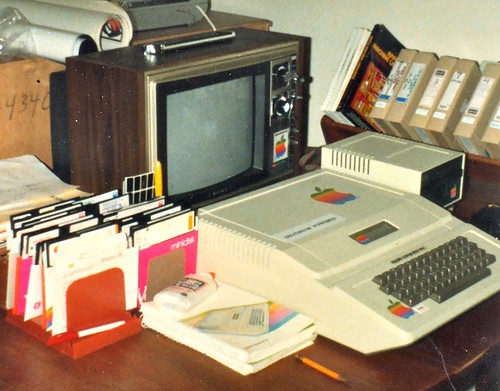
    [http://www.flickr.com/photos/oddwick] — once you’ve taken a bite of the Apple, you can’t do Windows. Here is a photo of that time, recently uncovered by my Dad:

    my first computer

    [http://www.flickr.com/photos/tamooj] — I got corrupted by Bain in between! 😉

  11. Oh, this was when you were very young! Floppy disks! Sometimes, old photos make us appreciate what we had then as well as what we have now.

    This brings back memories for you but for me too! I still have hidden away a television exactly like this one, inherited from an uncle in the mid-eighties. I spent many years not wanting a television. I used to be against it when very young and thinking about raising children. I changed my mind after getting this colour television and enjoying the positive aspects of watching TV. So I still have it but I must get rid of it. It is useless with digital cable. Of course, I have better now since many years!

    As for taking a bite of the Apple, I have a long time ago and I have been wanting a Mac but it is not possibe for now. Yet, there are things you cannot do with a Mac that I could not do without.

Leave a Reply to P^2 – Paul Cancel reply

Your email address will not be published. Required fields are marked *