

16 responses to “Wasp”
-
Fantastic photos!!
And it makes one marvel at the dynamic range and overall acuity of the human eye…which can often perceive the full experience conveyed by this photo almost simultaneously …
I once read an analysis of the human optical system that estimated (in a crude sense) the specs required to electronically reproduce its capabilities (see link below for full detail which includes some really excellent examples)
http://www.clarkvision.com/imagedetail/eye-resolution.html
1) Sensitivity: variable noisless and grainless ISO/dynamic range of from 1 to 800 (the human eye can see very accurate detail in extremely bright sunlight, and wide-open and adjusted for darkness, the human eye can sense single photons (~ISO 1000), although our built in "noise filters" require 2 successive photons on the same "sensor" within a short interval to "register" & pass it on to the brain as an event. This is not yet within range of current civilian tech, although we are getting close…
2) Dynamic range: between 10,000:1 and 1,000,000:1 – "In any one view, the eye eye can see over a 10,000 range in contrast detection, but it depends on the scene brightness, with the range decreasing with lower contrast targets. The eye is a contrast detector, not an absolute detector like the sensor in a digital camera, thus the distinction. (See Figure 2.6 in Clark, 1990; Blackwell, 1946, and references therein). The range of the human eye is greater than any film or consumer digital camera." Quite a ways to go on this one…
3) Resoving power: a sensor of around 8k rows high and 20k rows wide = 2 full size 35mm 80 megapixel sensors (this is in range of current tech) – enough to resolve two pixels per line pair (acuity of 1.7 corresponds to 0.59 arc minute PER LINE PAIR) = pixel spacing of 0.3 arc-minute! For full field of human view this number would be much larger…580 megapixels for a stereo 120 degree field of view. This kind of resolution is available at the high end of digital large format photography, but dealing with the data output at full bore is troublesome for most computers, and screens/displays are NO WHERE NEAR this resolution yet…
4) A 24 bit color space. This is actually very common, albeit at lower resolutions than mentioned above…
Now pack all that into TWO small ping-pong-ball sized gizmos with full auto-focus and diaphragm control, and hook them to a recorder the size of a pool-ball that can process the full output of both sensors in real-time at ~30 "frames" per second…and selectively "record" a full human-lifetime’s worth of "footage" with accompanying 24/96 stereo audio, a funky form of GPS data, and full "odorama". 😉
-
thanks y’all.
sbove: I’ve been meaning to tell you how much I have enjoyed your comment. Fascinating stuff. I had seen some anecdotal summaries of the contrast point, but not a complete comparison with the vernacular of photography.
And humans are just one node in the vision marvel-place:
1) Birds! We see in a RGB color space and they have four or five dimensions, the most complex known in nature, and provide a perception of the world that we cannot intuitively understand. More:

2) Frogs! Frog eyes are fascinating. Their eyes are sensitive enough to detect a single photon, whereas our eyes need several photons to register the presence of light. You could say frogs are way better than the Nikon D3 in processing dim light without a high noise problem.
(so they must ponder parallel universes while peering through pairs of slits…)
How about this for multipurpose use: their eye muscles pull the eyeballs back down into their skull for an extra push in swallowing a large catch.
But their vision system is even more interesting….
Frogs have binocular vision to catch flies. Tadpoles have eyes on the sides of their heads, a common difference between predator and prey.

The frog’s eyes move halfway through life, and so the visual system in the frog’s brain needs to be rewired. The nerves from half of the tadpole’s eyes must remap to the other half of the brain to properly process the new overlapping field of view.
One gene (ephrin B) modulates the axon’s growth cone in the optic chiasm (a crossroads junction of sorts) to achieve binocular vision. The same gene serves the same function in mice, but is silent in fish and chicken, which lack binocular vision.
3) Hawks and Octopussies and Bugs, oh my!
The physics of light have constrained solutions to collecting and focusing light to eight basic types of optics, seen in this chart (with imaging based on shadows on the left, refraction in the middle, and reflection on the right). Eyes have evolved independently at least 40 times.
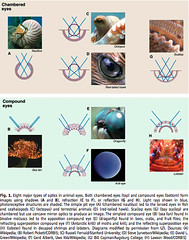
(also, cool as it was my first photo in Science =)
-
amazing architecture and fantastically captured…
—
Seen in the group" The World Through My Eyes – Post 1 / Comment Any 1" (?) -
I guess I’m late to the party… but while on the topic of vision, I thought I’d introduce you to Stomatopod vision. Stomatopods, also known as mantis shrimp, are jokingly cited as proof of visitation from other planets because their eye structure is so unique and complex.
-Phil

Leave a Reply to bourbaky Cancel reply