Canon PowerShot SD700 IS
ƒ/2.8
5.8 mm
1/800

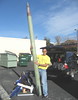
Rainy weekends are perfect for rocket building. This is a project that is nearing completion, and just needs some finishing, paint and final assembly. You can see the ugly seams of layers of fiberglass (thick and thin) and the grey of JB Weld.

I started with a Phoenix BH-2000, and modified it to take two extra motors (inside the originally decorative side boosters) and a HCX flight computer to airstart them when the accelerometer detects that the central main engine has burned out. I also fiberglassed everything (fins tip-to-tip, upper body tubes, and thin fiberglass around the whole side booster assembly) for extra strength. I plan to use the strap-on-videocam, so I added layers of fiberglass to raise the GLR metal launch lugs higher, and cut out a rectangular patch in the fiberglass above the top lug for the nylon strap to wrap around the rocket without rubbing against the launch rail. I added Kevlar-wrapped racquetballs internally for protection against body tube zippers during parachute deployment (drogue and main). I also added a GLR metal engine retention system for the main motor tube so I can easily fly larger reloadable motors. And on the backside of the rocket, seen here, I ran a line of plastic straws (under the epoxy+milled fiber fillets) from the external engines up into the upper part of the rocket where the HCX computer will reside (the top straws are flex straws for the bend into the body. This should allow me to route the wires for the outboard motors up to the computer without having them flap around outside the rocket during flight.

If this all works, I hope to capture some cool video looking downward from the top of the rocket… as the main H210 redline motor burns out, and then the outboard white motors ignite mid-flight, carrying the rocket to new heights.

After painting, this should all look smooth and lovely, hiding the patchwork within.

8 responses to “Airstart Rocket Project”

  1. roarrr….whooooosh….roarrrr

  2. I’ve been resisting rocketry because I know once I get in it, I won’t be able to get out. This is very dangerous for me to be seeing. Thanks.

  3. if the 2 side boosters don’t ignite simultaneously, will it start rotating off trajectory?.. do those motors go to full power right away, or do they build up to full power over the burn?… or are they close enough to the middle, that what i’m thinking about is a non-issue?
    .. can’t sleep… just curious
    ..and yes… very KEWL!

  4. I can not wait to see her fly! And…wow, the straw idea will revolutionize small rocket multi-motor design! Great insight…Ok, now some thoughts for future flights =)

    Flight #2
    Air start the auxiliary motor .5 – 1 second after main ignition (Try to see if you can get a shot of them igniting while she comes off the pad — with the main motor is at full thrust!!

    Flight #N
    Main motor + 1, + extra weights on the opposite side. Can you draw a circle??

  5. @Erik: I can easily do #2 by adding a jumper to the computer board…. That was my original plan, but I thought #1 might be more interesting for the on-board video…. Gotta try both.

    #N may happen by chance during #1 or #2 attempts, per Leino’s scenario…. I think it will still fly straight from what I have seen of other partial cluster ignitions… but we won’t know for sure ’til we try. 😉

  6. Musing; why not run ribbon conductors down to the motors ? Much clearer (aerodynamically) and conformal, and a layer of fiberglass or even paint would hide and secure them.
    Nice design, btw. Please post her final performance data if you get a chance.

  7. will do. The HCX computer should give us a great graph of altitude, speed and acceleration over the whole flight.

    I think Tom is planning on some ribbon cable for the big project, the RocketMavericks Reference Design…

    Rocket Build Weekend

    That bird has to be super sleek as it will break Mach 3, and it is minimum diameter for a Q motor, so there is no internal room for wires.

    For the simpler project shown here, I have the much easier option of routing the standard wires up through the straws. The igniter comes with standard wires, so adding a segment of ribbon cable would require two splices, and might be a point of failure for the outboard splice without some shelter design. Actually, we’d probably just do one splice for the computer hookup internally, and then dip our own pyrogen igniter, which might work right off the ribbon cable (Now sure though… I’d have to test that…)

    Update: this Brighthawk is almost ready to fly… on Saturday…
    Brighthawk

Leave a Reply to jurvetson Cancel reply

Your email address will not be published. Required fields are marked *