Canon EOS 5D
ƒ/5
100 mm
1/5,000
640

Having successfully flown on a J-size motor, she was ready for the challenge of a K. You can see the video camera hanging off the side, with half an Easter Egg fiberglassed on for a nosecone (rocket details).

The long-burn K185 is a wonderful motor. From the ground video, you can hear its throaty roar with the deep Doppler Shift of a 480 MPH departure.

As she was pulling 7 g’s, the weight of the flight computer’s 9V battery ripped through its restraining straps. Luckily, it did not tumble far enough to yank the power wires out, as the rocket depends on the computer and its sensors to deploy the parachute. With that mishap barely avoided, it was a perfect flight, returning close to the far launch pad without a scratch.

Here’s the video from the rocket.

9 responses to “Strap-On Video Rocket”

  1. Congrats!!!

    Suspense! Drama! Excitement!

  2. Wow, dizzying video.

  3. I watched the video. Very nice indeed! I was wondering if it was possible to attach the camera in such a way that a bit of horizon could also be seen (might have been a nice view!). Also the video made me think about free spinning of the rocket around the roll axis. Do they usually control this DOF in more advanced missiles (such as millitary ones)?

  4. After a second thought, I think the answer to the previous question is probably yes. Becasue the free spinning produces coriolis effects when the missile moves in a curved path, changing the dynamic and producing problem. But if the roll motion is sensed, the dynamic will be predctable and consequently controllable (making the answer to the previous question both yes and no!).

  5. Yes. There are a few options for horizon capture:

    1) The bulkhead coupler is angled, so I can tilt further out by attaching farther down by a little bit, and reduce the amount of rocket in frame (it’s a bit much here, but I like to have some in frame for context). It’s not the horizon, but I think I could tilt 30° outward.

    2) 45° mirror. This is the best way to shift the perspective 90° without ruining the aerodynamics or having to retrofit a video bay inside the rocket. (My goal is an easy swap of the video cam across a fleet of rockets). With the mirror, you can also go half-n-half, with part of the frame shooting down and the other part reflected out horizontally. The two images are nicely sync’d in time too.

    3) Pan-tilt camera. If I was to start over with a fancy design, I could consider a pan-tilt camera (no longer strap-on most likely though) that captures a near-360 view of the horizon from apogee (the best view for this). Tom is planning one of those for our high-altitude project

    Spin: Spinning in our rockets comes from asymmetries in the build (usually slight variation in the fin angles; here the camera plays a role). You gain stability (so you can launch bigger motors before becoming a land shark), but you lose altitude… and make for a dizzy video… I will see if there is less spin on the other two rockets I plan to strap on to (a GLR Firestorm54 with integrated fin can and Phoenix BH2000 with air-started side booster motors).

    More advanced missiles control many factors and can even fly without fins. We are not allowed to use dynamic stabilization or guidance… yet. Maybe one day.

    ’til then, we design the fin area and weight placement (CP<CG) so as to be stable, and to put the fins on straight as as to not spin much.

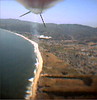
    And sometimes you get real lucky when the rocket arcs over. Here’s a shot of Half Moon Bay from a simple Estes Oracle video rocket (modified to take a motor 4x larger than the kit is designed for):

    Rocket-eye’s View

  6. I got my answer. Thanks for the elaborate reply. … and the Moon bay shot is nice. You should be lucky for something like this to happen.

  7. Love the corkscrew contrail (well not contrail to be exact… smoke)… Great flight!

  8. Does it get the L730 next month?

  9. I’m thinking April or May… Would like to try the camera on those subsonic flights first, and then go for broke…

Leave a Reply

Your email address will not be published. Required fields are marked *